
Description
What Is Arazlo?
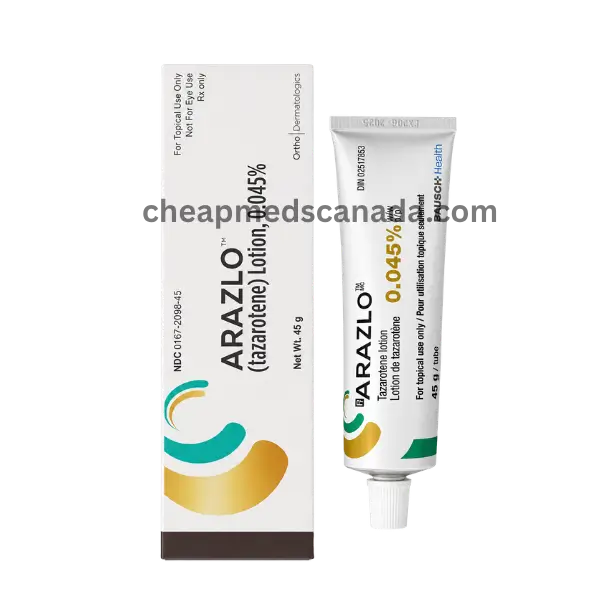
Arazlo is a prescription topical lotion that contains Tazarotene 0.045% as its active ingredient. It is made by Bausch Health and comes in a 45g tube. The lotion is applied directly to the skin — not taken by mouth — which makes it different from oral acne medications like isotretinoin.
Tazarotene belongs to a group of medications called retinoids, which are derivatives of vitamin A. Retinoids have been a cornerstone of dermatology for decades, used to treat everything from acne to psoriasis to signs of aging. Arazlo is a newer, lower-concentration formulation specifically designed to treat acne with a reduced risk of the intense irritation that older retinoid products sometimes caused.
No generic version of Arazlo is available at this time. It is a prescription-only medication, meaning you will need a dermatologist or physician to prescribe it before you can access it.
What Is Arazlo Used For?
Arazlo is approved to treat acne vulgaris — the most common type of acne — in patients 9 years and older. This includes:
- Blackheads and whiteheads (comedones)
- Red, inflamed pimples (papules and pustules)
- Deeper, painful lesions like nodules and cysts
It is applied once daily to the affected areas of skin, typically the face. Unlike some acne treatments that only target surface breakouts, Arazlo works deeper — addressing the skin behaviour patterns that lead to breakouts in the first place.
How Does Arazlo Work?
Arazlo does not just dry out pimples. As a retinoid, it changes how your skin cells behave at a more fundamental level.
Here is what it actually does:
- Speeds up skin cell turnover — Your skin sheds and renews itself constantly. Arazlo makes this process more efficient, pushing dead skin cells out faster so they do not sit in your pores and cause blockages
- Reduces inflammation — A lot of acne is driven by inflammation under the skin. Tazarotene helps calm that response, which is why it can be effective against deeper, more painful lesions — not just surface-level spots
- Lowers oil production in the skin — Excess sebum (skin oil) is a major driver of acne. Arazlo helps bring that oil production down over time
- Prevents new breakouts from forming — Because it works on the skin's renewal cycle, it does not just treat existing pimples. It disrupts the process that creates them in the first place
The result? Cleaner pores, less inflammation, and skin that gradually becomes less acne-prone over time. That said, it takes time — most people do not see major improvement until they have been using it consistently for six to twelve weeks.
How to Use Arazlo Lotion: Step-by-Step
Getting the application right matters — both for results and for minimizing irritation.
Daily routine:
- Wash your face gently using a mild, non-abrasive cleanser and lukewarm water
- Pat your skin completely dry — applying Arazlo to damp skin increases the risk of irritation
- Apply a thin layer of the lotion to the affected areas once per day
- Use just enough to lightly cover the skin — more is not better here
- Wash your hands thoroughly after applying
A few things to keep in mind:
- Apply at the same time each day — evening application is often recommended since retinoids can increase sun sensitivity
- Do not apply near your eyes, nostrils, mouth, or any mucous membranes — these areas are sensitive and Arazlo will irritate them
- If the lotion accidentally gets in your eyes, rinse thoroughly with water right away
- Follow up with a gentle, fragrance-free moisturizer to minimize dryness and flaking, especially in the first few weeks
Dosage
Arazlo comes in one standard strength: 0.045% tazarotene lotion in a 45g tube.
- Adults and children 9 years and older: Apply a thin layer to the affected skin once daily
- No dose adjustment is needed for different age groups within the approved range, though your dermatologist may recommend applying it every other day at first if your skin is sensitive
Side Effects of Arazlo
Most people experience some skin adjustment when they first start using Arazlo. This is normal and usually settles down after the first few weeks.
Common Side Effects (Usually Mild and Temporary)
- Stinging or burning on the skin after application
- Dry or flaky skin
- Skin redness and irritation
- Itching
- Peeling or scaly skin
These are most common in the first two to four weeks. Your skin is adjusting to the retinoid — think of it as a recalibration period. Using a gentle moisturizer daily can make a real difference during this phase.
Serious Side Effects — Contact Your Doctor
Stop using Arazlo and reach out to your healthcare provider if you notice:
- Blistering or severe peeling of the skin
- Extreme redness, warmth, or pain that does not ease up
- Signs of a skin infection — swelling, oozing, or pus
- A severe allergic reaction — this can include swelling of the face, lips, tongue, or throat, hives, or difficulty breathing. If this happens, seek emergency help immediately
Warnings and Important Precautions
Pregnancy — This Is a Hard Stop
Arazlo must not be used during pregnancy. Studies on tazarotene (including other forms of this medication) have shown it can cause serious harm to an unborn baby. This is not a "use with caution" situation — it is a clear contraindication.
If you are a person who can become pregnant:
- A negative pregnancy test within two weeks of starting Arazlo is required
- Your prescriber will typically have you begin treatment during your menstrual period
- You must use effective birth control throughout your treatment
- If you become pregnant while using Arazlo, stop immediately and contact your doctor
Whether Arazlo passes into breast milk in humans is not yet confirmed. If you are breastfeeding, speak with your doctor before starting treatment. If you do use it while breastfeeding, do not apply it to the chest or any area your baby could contact.
Sun Sensitivity — Take This Seriously
Arazlo makes your skin significantly more sensitive to the sun. People using this medication burn faster and more severely than usual — even on cloudy days or with brief outdoor exposure.
- Apply sunscreen with SPF 30 or higher every morning, even if you are staying indoors most of the day
- Wear protective clothing, including wide-brimmed hats and long sleeves when spending time outside
- Avoid tanning beds entirely while using this medication
- If you get sunburned, contact your prescriber before continuing use — they may recommend pausing treatment until your skin recovers
Do Not Apply on Irritated or Sunburned Skin
Arazlo should never be applied to skin that is already sunburned, windburned, or affected by eczema or another active skin condition. Using it on compromised skin dramatically increases irritation and can cause significant discomfort.
Avoid Harsh Skincare Products
While using Arazlo, stay away from:
- Skincare products with strong drying effects (high-concentration alcohol-based toners, astringents)
- Abrasive scrubs or exfoliating acids used in the same area
- Benzoyl peroxide applied at the same time as Arazlo — it can reduce its effectiveness. If your doctor has prescribed both, space them out (one in the morning, one at night)
- Other prescription skin medications on the same area unless your doctor has approved it
Drug and Product Interactions
Let your doctor and pharmacist know about everything you apply to your skin, not just medications you take by mouth. Arazlo's interactions are primarily skin-focused, but some systemic medications matter too.
Tell your healthcare provider if you use:
- Antibiotics — some can increase sun sensitivity further, stacking that risk on top of Arazlo
- Diuretics (water pills) — certain ones also raise sun sensitivity
- Other topical retinoids — using more than one at the same time is not recommended
- Skincare products with vitamin C — these can be used alongside Arazlo in some cases, but check with your dermatologist first, as higher concentrations can worsen irritation
Who Should Not Use Arazlo?
Arazlo is not right for everyone. Do not use this medication if:
- You are currently pregnant
- You have a known allergy to tazarotene or any component of the lotion
- Your skin is currently sunburned or significantly irritated from another condition
Talk to your doctor before starting Arazlo if you:
- Work outdoors and have extended daily sun exposure
- Have a history of skin cancer, including lentigo maligna
- Have eczema or other active chronic skin conditions
- Have previously had severe reactions to other topical skincare products
How to Store Arazlo
Proper storage keeps the medication effective:
- Store at room temperature — the recommended range is up to 25°C (77°F)
- Do not freeze the lotion — freezing can alter the formulation
- Keep the tube tightly closed when not in use
- Store away from direct light, moisture, and heat
- Keep out of reach of children and pets
What to Realistically Expect
Arazlo is not a quick fix. If you are starting out, here is a rough timeline of what most people experience:
- Weeks 1 to 3: Skin may look worse before it gets better. Dryness, peeling, and irritation are common during this adjustment window. This does not mean the medication is not working.
- Weeks 4 to 6: Irritation tends to ease off. Some people start noticing fewer new breakouts forming.
- Weeks 8 to 12: Clearer improvement in overall skin texture and a visible reduction in acne for most users.
- Beyond 12 weeks: Continued improvement. Many dermatologists recommend sticking with Arazlo for several months to see its full benefit.
Consistency matters more than anything else. Missing days or stopping and starting will slow your results significantly.
A Few Tips Worth Knowing
- Start slow if your skin is sensitive — apply every other day for the first two weeks and build up to daily use as your skin adjusts
- Moisturizer is not optional — use a gentle, fragrance-free one every day, even if your skin does not feel dry
- Do not pick or scrub acne while on Arazlo — your skin barrier is more vulnerable during treatment
- If you are using makeup, stick to non-comedogenic (non-pore-clogging) formulas during treatment
- Keep your follow-up appointments with your dermatologist — they can adjust your treatment plan based on how your skin responds.
How long does it take for Arazlo to work?
Most people do not notice major improvements during the first few weeks. The first 2 to 4 weeks are often an adjustment period, and your acne may temporarily appear worse before it starts improving. New breakouts usually begin to decrease after 4 to 6 weeks, while clearer skin is commonly seen after 8 to 12 weeks. For the best results, continue using Arazlo consistently for at least three months.
Can I use Arazlo on my body, or is it only for the face?
Arazlo is mainly prescribed for treating acne on the face. If you want to use it on your chest, back, or other areas of the body, speak with your doctor or dermatologist first to make sure it is appropriate.
Is it normal for my skin to peel when I start using Arazlo?
Yes. Mild peeling, dryness, and flaking are common during the first few weeks as your skin adjusts to treatment. Applying a gentle moisturizer and using Arazlo only on completely dry skin can help reduce irritation. If you develop severe peeling, blistering, or intense discomfort, contact your healthcare provider.
Can I use Arazlo with other acne treatments?
Some acne medications can be used with Arazlo, while others may increase irritation or reduce its effectiveness. If your doctor recommends using benzoyl peroxide as well, it is often applied at a different time of day. Always check with your healthcare provider before combining Arazlo with other acne treatments.
Can I wear makeup while using Arazlo?
Yes. You can wear makeup while using Arazlo. Allow the medication to absorb completely before applying makeup, and choose non-comedogenic products that are less likely to clog pores or worsen acne.
Arazlo Topical Lotion Tube should be used only as prescribed by a healthcare professional. For external use only. Avoid contact with the eyes, mouth, and broken skin. This medication may increase sensitivity to sunlight, so use sunscreen and protective clothing during treatment. Do not use during pregnancy unless specifically advised by your healthcare provider.
Reviews
There are no reviews yet.