

Description
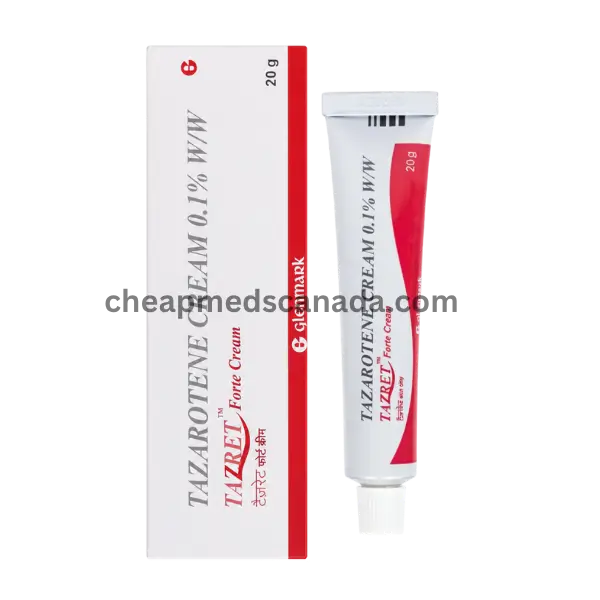
What Is Tazarotene Cream 0.1%?
Tazarotene is a topical retinoid — a man-made compound derived from vitamin A, similar in family to other retinoids but with its own distinct properties. The 0.1% cream formulation is approved in Canada for two main purposes:
- Acne vulgaris in adults and adolescents aged 12 and older
- Plaque psoriasis in adults
It comes as a thin, smooth cream applied directly to the skin once daily, typically in the evening. In Canada, it is most commonly sold under the brand name Tazorac, with generic tazarotene cream 0.1% also available.
This is a prescription-only medication. It is not something to pick up off a pharmacy shelf — your doctor needs to confirm it is appropriate for your specific skin condition and rule out anything that might make it unsuitable for you.
How Tazarotene Actually Works — The Science, Simplified
Here is where it gets genuinely interesting, because tazarotene does not work the way most people assume "acne creams" or "psoriasis creams" work.
Step 1: It enters the skin as a prodrug.
Tazarotene itself is technically inactive when it touches your skin. Once absorbed, your skin cells convert it into its active form — called tazarotenic acid. This conversion happens quickly and is part of what makes tazarotene effective at relatively low concentrations.
Step 2: It binds to specific receptors inside skin cells.
Tazarotenic acid attaches to retinoic acid receptors — specifically RAR-beta and RAR-gamma — found inside skin cells. These receptors act like switches that control how skin cells grow, divide, and mature.
Step 3: It normalizes how skin cells behave.
For psoriasis: In psoriatic skin, cells multiply far too quickly and do not mature properly before they reach the surface — this is what causes the thick, scaly plaques. Tazarotene slows this overproduction down and helps the cells mature normally again, which is why plaques gradually thin and flatten.
For acne: Inside hair follicles, dead skin cells are supposed to shed in an orderly way. In acne-prone skin, this shedding process becomes disordered, and dead cells clump together and clog the follicle — forming the basis of a comedone (blackhead or whitehead). Tazarotene normalizes this shedding process, helping keep follicles clear before they become blocked, while also reducing inflammation around existing blemishes.
Step 4: Anti-inflammatory effects kick in. Beyond just regulating cell growth, tazarotene has a direct anti-inflammatory action — which is part of why both the redness associated with psoriasis plaques and the inflamed, angry-looking acne lesions tend to calm down over time.
In short: tazarotene is not exfoliating dead skin off the surface like a scrub would. It is working inside the cell to change how new skin cells are made and how they behave — which is also why results take weeks, not days.
Your Tazarotene Journey — Week by Week
This is the part most product pages skip, and it is often the most useful thing to know before starting.
Week 1 — The Adjustment Phase
This is typically the hardest week. Your skin is encountering a new active ingredient, and most people experience some combination of:
- Mild redness
- Dryness or flaking
- A stinging or burning sensation shortly after application
- Skin that feels tighter than usual
This is normal and expected. It does not mean the cream is "not suiting" you — it means your skin is adjusting to the new cell turnover rate.
Weeks 2–4 — The "Things Might Look Worse Before Better" Phase
For acne specifically, some people experience what is sometimes called purging — because tazarotene speeds up cell turnover, blemishes that were forming beneath the surface can come up faster than they otherwise would. It can genuinely look like the acne is getting worse during this period.
For psoriasis, this period is when the visible reduction in plaque thickness typically begins. Many people start noticing the plaques becoming less raised and less scaly, even if the redness has not fully resolved yet.
Weeks 4–8 — Visible Improvement
This is generally when the real payoff becomes noticeable. Clinical research shows that most people using tazarotene for psoriasis see roughly a 50% reduction in symptoms within this window. For acne, breakouts typically become less frequent and less severe, though some active lesions may still be present.
3 Months and Beyond — Maintenance and Sustained Results
By this stage, skin has typically adjusted significantly to the medication, and side effects like burning and peeling are usually much less pronounced than in week one. Improvements in skin texture, plaque appearance, and acne frequency tend to be sustained as long as the medication continues to be used as directed.
How to Apply Tazarotene Cream 0.1% Correctly
Getting the application method right has a direct impact on both effectiveness and how much irritation you experience.
General application steps:
- Wash and dry the area first — for acne, gently cleanse the affected skin. For psoriasis, washing beforehand is not strictly necessary, but if you have just showered, make sure the skin is completely dry.
- Wait if you've used a moisturizer — if you applied moisturizer to the area, wait at least 1 hour before applying tazarotene. Applying it onto damp or moisturized skin increases absorption and irritation.
- Apply a thin layer only — this is genuinely one layer of cream covering the skin, not a thick application. More cream does not mean better or faster results — it significantly increases irritation without added benefit.
- For acne — apply to the entire affected area (not just individual pimples). This helps prevent new blemishes from forming, not just treat existing ones.
- For psoriasis — apply only to the plaques themselves, not the surrounding healthy skin. Tazarotene on unaffected skin increases irritation without therapeutic benefit. Some people use a cotton swab for precise application and apply a barrier (like plain petroleum jelly) to surrounding skin.
- Apply once daily, in the evening — tazarotene is photostable (it does not break down in sunlight), but evening application is standard practice and reduces the chance of applying sunscreen or makeup over freshly applied medication.
- Wash your hands after applying — unless your hands are part of the treatment area.
Side Effects — What's Normal vs What Isn't
Expected and Common (especially in the first few weeks)
- Redness
- Burning or stinging sensation
- Itching
- Dryness and peeling
- Skin feeling tight
These are the most frequently reported effects, particularly in people without other skin conditions, between the ages of 18 and 60. They typically reduce significantly after the first few weeks as your skin adjusts.
Managing Common Side Effects
- Use a gentle, fragrance-free moisturizer — but apply it at a different time than tazarotene (at least an hour apart)
- Start with application every other night if your skin is particularly sensitive, then build up to nightly use as tolerated
- Avoid combining with other potentially irritating products (exfoliating acids, other retinoids) unless specifically directed by your doctor
Less Common but Worth Knowing
- Increased sensitivity to sunlight — sunburn can occur more easily while using this medication
- Skin discoloration (lightening or darkening) in the treated area
- Worsening of psoriasis in rare cases — if this happens, contact your doctor rather than continuing
When to Stop and Contact Your Doctor
- Severe burning, blistering, or swelling
- Signs of an allergic reaction — hives, difficulty breathing, swelling of the face or throat
- Skin that becomes significantly more irritated rather than gradually adjusting
Important Precautions
Sun protection is non-negotiable. Tazarotene increases your skin's sensitivity to UV light. Daily sunscreen (broad-spectrum, SPF 30 or higher) on treated areas — and protective clothing when possible — is essential while using this medication, even on cloudy days.
Pregnancy — a significant consideration. Topical retinoids, including tazarotene, are generally not recommended during pregnancy. If you are pregnant, planning a pregnancy, or breastfeeding, this is one of the most important conversations to have with your doctor before starting treatment. Effective contraception is often discussed as part of the prescribing process for people who could become pregnant.
Avoid certain combinations. Using tazarotene alongside other products that dry out or irritate the skin — strong exfoliants, benzoyl peroxide in high concentrations, other retinoid products — can significantly increase irritation. Always check with your doctor or pharmacist before adding new skincare products to your routine.
Not for use on broken, sunburned, or eczema-affected skin unless specifically directed.
Wax hair removal should be avoided on treated areas, as it can pull off irritated skin layers.
Tazarotene for Psoriasis — Often Paired With Something Else
It is common for dermatologists in Canada to prescribe tazarotene alongside a topical corticosteroid for psoriasis. The reason is straightforward: tazarotene alone can cause noticeable irritation in psoriasis patients, and a corticosteroid helps offset that irritation while the tazarotene does its work on normalizing skin cell turnover. If your prescription includes both, the combination is intentional — not because tazarotene "isn't working" on its own.
Storage Information
- Store at room temperature, away from direct heat and light
- Do not freeze
- Keep the tube tightly closed when not in use
- Keep out of reach of children
- Discard any unused portion after the expiry date on the packaging
My acne looks worse after 2 weeks — should I stop using it?
This is commonly reported and is often referred to as a "purging" period, where blemishes that were forming beneath the skin surface come up more quickly due to increased cell turnover. Unless you are experiencing severe irritation or signs of an allergic reaction, most dermatologists recommend continuing treatment through this phase, as it often occurs before noticeable improvement.
Can I use tazarotene cream and a moisturizer in the same routine?
Yes, and for most people it is recommended to help manage dryness and irritation. The key is timing. Apply moisturizer either well before or after tazarotene rather than mixing them together, as applying both at the same time may increase absorption and the likelihood of irritation.
How is the cream different from the gel?
Both formulations contain tazarotene, but the cream is generally considered less drying than the gel. For this reason, the cream is often preferred for people with sensitive skin or for treating larger areas affected by psoriasis. Approved uses and prescribing recommendations may also vary between formulations and age groups.
Is 0.1% always the strength to start with?
Not necessarily. Some dermatologists begin treatment with a lower 0.05% strength to evaluate skin tolerance before increasing to 0.1% if needed. If you have been prescribed 0.1% from the start, your dermatologist has determined that this strength is appropriate for your specific condition and treatment goals.
How long will I need to use this for?
Tazarotene is generally used as a long-term treatment rather than a short-term course. For both acne and psoriasis, symptoms may gradually return if treatment is stopped because the underlying skin cell activity resumes. Your dermatologist will advise you on the appropriate duration based on your response to treatment.
Can I use this on my body, or only my face?
This depends on the condition being treated and your doctor's instructions. For facial acne, it is applied to the face. For psoriasis, it may be applied directly to affected areas of the body. Always follow the directions provided with your prescription regarding where and how to apply the medication.
Tazarotene Cream is a prescription topical retinoid used to treat acne and improve overall skin appearance. It works by promoting healthy skin cell turnover, helping to reduce clogged pores, blemishes, and acne breakouts. Regular use may also improve skin texture and support a smoother, clearer complexion when used as directed by a healthcare professional.
Reviews
There are no reviews yet.