
Description
What Is Tecta 40 mg?
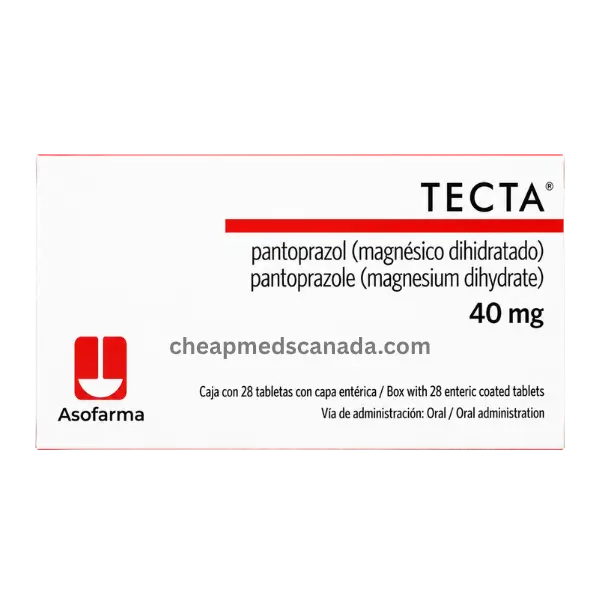
Tecta 40 mg is a prescription tablet that contains an active ingredient called pantoprazole magnesium. It belongs to a group of medications known as proton pump inhibitors — PPIs for short.
The job of a PPI is simple: reduce how much acid your stomach produces. Tecta 40 mg does this very effectively.
Each Tecta tablet is 40 mg and comes with a special enteric coating. That coating matters more than it might seem. It stops the tablet from breaking down in your stomach and makes sure it gets absorbed properly a little further down, in the small intestine. That's why you should never crush or chew a Tecta 40 mg tablet — you'd be destroying the very thing that makes it work right.
In Canada, Tecta is sometimes also written as Tecta DR 40 mg on prescriptions. "DR" just means delayed-release — it's the same tablet, same medication.
Tecta 40 mg vs Pantoloc — Are They Really That Different?
A lot of people getting prescribed Tecta 40 mg have previously taken Pantoloc and wonder what changed.
Both medications contain pantoprazole. Both reduce stomach acid. Both are PPIs. The difference comes down to one thing: the form of pantoprazole inside each tablet.
Pantoloc uses pantoprazole sodium. Tecta 40 mg uses pantoprazole magnesium.
That might sound like a tiny detail — but it has a real effect. The magnesium version stays active in the body for a longer period. As your stomach naturally regenerates the acid-producing cells it replaces every few days, Tecta continues to suppress those new cells for longer than Pantoloc would.
For some people, that extended coverage makes a noticeable difference — especially if they found their symptoms creeping back toward the end of the day with Pantoloc.
Clinically, both medications are effective. But Tecta's longer-lasting profile is the reason many doctors now choose it over Pantoloc for ongoing acid management.
What Conditions Does Tecta 40 mg Treat?
Tecta is used whenever the goal is to reduce how much acid the stomach produces. That applies to quite a few different conditions.
GERD (Gastroesophageal Reflux Disease): This is the most common reason Tecta gets prescribed. GERD happens when stomach acid repeatedly flows back into the esophagus — the tube connecting your throat to your stomach. The acid irritates and damages the esophageal lining over time. Tecta cuts acid production at the source so the lining can start recovering.
Reflux Esophagitis: This is what happens when GERD goes untreated or undertreated. The esophagus becomes inflamed, sometimes eroded. Tecta 40 mg is prescribed for 4 to 8 weeks to give the tissue a proper chance to heal.
Stomach Ulcers (Gastric Ulcers): Ulcers are open sores on the stomach lining. They hurt — especially when you eat or when your stomach is empty. Less acid means less irritation to those sores, which gives them space to heal. Tecta is typically prescribed for 4 to 8 weeks for this.
Duodenal Ulcers: These develop in the first section of the small intestine, right after the stomach. Same idea — reducing acid helps the sore heal and prevents it from getting worse.
H. pylori Infections: Many duodenal ulcers are caused by a bacterium called Helicobacter pylori. When that's the case, Tecta doesn't work alone — it's combined with two antibiotics in what's called triple therapy. The antibiotics clear the infection; Tecta reduces acid while healing happens.
Zollinger-Ellison Syndrome: This is a rare condition where tumors cause the stomach to produce dangerously high levels of acid. Tecta is used at higher doses for long-term management of this.
How Tecta Actually Works Inside Your Body
Your stomach lining contains millions of tiny pumps. They're called proton pumps, and their entire job is to pump acid into your stomach.
Tecta travels to those pumps and blocks them permanently. Not temporarily — the block is irreversible. Once a proton pump is shut down by pantoprazole, that specific pump cannot produce acid anymore. The stomach has to grow a brand new pump to replace it.
This is very different from how antacids work. Antacids just neutralize acid that's already there — they don't stop more from being made. Tecta stops production at the source.
And because Tecta 40 mg uses pantoprazole magnesium, which has a longer half-life than sodium-based pantoprazole, it keeps affecting newly formed pumps for a longer window of time. That's where the extended coverage comes from.
Tecta 40 mg Dosage — What's Standard
Always follow your doctor's instructions. The doses below are general guidelines, not a replacement for your prescription.
For GERD and acid reflux symptoms: 20 mg or 40 mg once daily, usually for 4 weeks. May continue for 8 weeks if needed.
For reflux esophagitis: 40 mg once daily for 4 to 8 weeks. Long-term maintenance at the lowest effective dose after that.
For gastric ulcers: 40 mg once daily for 4 to 8 weeks.
For duodenal ulcers: 40 mg once daily for 2 to 4 weeks.
For H. pylori eradication (triple therapy): Tecta 40 mg twice daily, combined with two antibiotics for 7 days. Your doctor will specify the exact antibiotic combination based on your situation.
How to take it: Take Tecta 40 mg in the morning, roughly 30 to 60 minutes before you eat. Swallow it whole with water. Don't break it, crush it, or chew it. Food doesn't prevent absorption, but taking it before a meal makes it more effective because the drug needs to be active when acid production gets triggered by eating.
Side Effects of Tecta 40 mg
The majority of people taking Tecta 40 mg don't experience significant side effects — especially at standard doses for short-term use. When side effects do happen, they're usually mild.
Mild side effects you might notice:
- Headache — the most commonly reported one
- Loose stools or diarrhea
- Nausea or stomach discomfort
- Gas or bloating
- Dizziness
- Constipation
- Dry mouth
Most of these settle down within the first week or two as your body gets used to the medication.
Side effects worth calling your doctor about:
- Diarrhea that's severe, watery, or doesn't stop after a few days — this can sometimes signal a C. difficile bacterial infection, which needs treatment
- Joint pain that's new or getting worse
- Muscle aches that don't have an obvious explanation
- Signs of low magnesium in the blood — unusual fatigue, muscle cramping, an irregular heartbeat, or feeling lightheaded
Stop taking Tecta 40 mg and get medical help right away if you experience:
- A serious skin reaction — widespread rash, blistering, or skin peeling
- Signs of a kidney problem — swelling, changes in how much you're urinating, or fever with back pain
- An allergic reaction — swelling of the face, lips, tongue, or throat; hives; difficulty breathing
- Muscle breakdown signs — unexplained muscle pain combined with dark or discoloured urine
These serious reactions are rare, but they need prompt attention.
What Happens With Long-Term Tecta 40 mg Use
Taking Tecta 40 mg for a few weeks to heal an ulcer or calm down esophagitis is straightforward. Long-term use — months or years — is a different situation and comes with things worth monitoring.
Your bones need attention Studies have shown that people who take PPIs for extended periods have a slightly higher chance of fractures — particularly in the hip, wrist, and spine. The reason is that stomach acid actually helps the body absorb calcium from food. Suppress that acid consistently, and calcium absorption takes a hit over time. If you're on Tecta 40 mg long-term, your doctor may suggest a calcium and Vitamin D supplement alongside it.
Magnesium levels can drop Long-term PPI use can quietly lower the magnesium level in your blood. This condition is called hypomagnesemia, and it doesn't always produce obvious symptoms until levels get quite low. Low magnesium can affect muscle function and heart rhythm. If you've been on Tecta 40 mg for over a year, your doctor will likely check your magnesium periodically.
Vitamin B12 absorption Stomach acid plays a role in releasing Vitamin B12 from food so your body can absorb it. Suppress acid over years, and B12 can gradually decline. This matters more for older adults and for anyone who eats little meat or dairy. A yearly B12 check is reasonable if you're on a long-term PPI.
The rebound effect when stopping Here's something many patients don't know until it catches them off guard: if you stop taking Tecta 40 mg abruptly after using it for months, your stomach can temporarily produce even more acid than before you started. This is called rebound acid hypersecretion. It's not dangerous, but it's uncomfortable — and it can make people think they "need" the PPI again when they don't. Tapering off slowly, with your doctor's guidance, helps reduce this.
Drug Interactions — What to Watch Out For
Tecta 40 mg affects how some other medications work. Make sure your doctor and pharmacist have a full list of everything you take.
Warfarin (blood thinner): Tecta 40 mg can increase warfarin's effect on the blood. Regular INR monitoring is important if you take both.
Clopidogrel (Plavix): This is a commonly used blood thinner after heart attacks or stents. Pantoprazole can reduce how well clopidogrel works. Some cardiologists prefer a different PPI for patients on clopidogrel — ask your doctor about this specifically.
Methotrexate: Tecta 40 mg may slow how quickly methotrexate is cleared from the body, potentially raising its levels to toxic ranges.
HIV medications (atazanavir, nelfinavir): These drugs need stomach acid to be absorbed properly. Tecta 40 mg makes them much less effective. Combining the two is generally avoided.
Antifungals (ketoconazole, itraconazole): Same issue — these need acid for proper absorption. Tecta 40 mg reduces their effectiveness.
Iron supplements: Stomach acid helps absorb iron. Take iron supplements at least 2 hours before or after Tecta 40 mg to get full benefit from both.
Tecta 40 mg Price in Canada — And How to Pay Less
Tecta 40 mg is a brand-name medication, and brand-name pricing in Canada can add up quickly — especially if you're taking it long-term without drug coverage.
The good news is that generic pantoprazole magnesium is available in Canada. It contains the exact same active ingredient at the same 40 mg dose. Health Canada requires generics to meet the same bioequivalence standards as brand-name drugs, which means the clinical effect is the same.
Switching to generic can reduce the cost substantially — sometimes by more than half.
A few ways to reduce what you spend on Tecta 40 mg:
- Ask your doctor if generic pantoprazole magnesium is appropriate for your situation
- Check your provincial drug benefit plan — many provinces cover generic pantoprazole
- Compare prices between pharmacies — Tecta 40 mg pricing varies more than most people realize
- Licensed Canadian online pharmacies often price both brand-name and generic versions lower than retail walk-in pharmacies, which is especially helpful for those paying out of pocket
Tecta 40 mg vs Other PPIs — A Simple Comparison
| Medication | Active Ingredient | Key Difference |
|---|---|---|
| Tecta 40 mg | Pantoprazole magnesium | Longer half-life, extended acid suppression |
| Pantoloc | Pantoprazole sodium | Same drug, shorter duration |
| Nexium | Esomeprazole | Strong efficacy, widely studied |
| Losec | Omeprazole | Oldest PPI, most generic options |
| Prevacid | Lansoprazole | Rapid onset |
| Pariet | Rabeprazole | Fewer drug interactions |
All PPIs work by blocking proton pumps. The differences are in how fast they work, how long they last, and how they interact with other drugs. Tecta's distinction is its longer duration compared to its direct predecessor, Pantoloc.
How fast does Tecta start working?
Many people notice improvement in heartburn and acid reflux symptoms within a few days of starting treatment. However, conditions such as esophagitis or stomach ulcers may require a full treatment course of 4 to 8 weeks, as symptom relief often occurs before complete healing of the affected tissues.
Is it okay to take Tecta every day?
Yes. Tecta is designed to be taken daily for the duration prescribed by your doctor. Whether used for a short-term treatment course or ongoing management of chronic acid-related conditions, consistent daily dosing helps achieve the best results.
What if I miss a dose?
Take the missed dose as soon as you remember on the same day. If it is almost time for your next scheduled dose, skip the missed dose and continue with your regular schedule. Do not take two doses at the same time to make up for a missed tablet.
Can I take antacids alongside Tecta?
Yes. Antacids may be used for temporary symptom relief while Tecta is working to reduce stomach acid production. These medications generally do not interfere with each other when used as directed.
Is Tecta safe during pregnancy?
The safety of pantoprazole during pregnancy has not been fully established. Tecta should only be used during pregnancy when your doctor determines that the potential benefits outweigh any possible risks. Discuss treatment options with your healthcare provider if you are pregnant or planning a pregnancy.
What does Tecta DR 40 mg mean exactly?
"DR" stands for delayed-release. This refers to the special coating on the tablet that allows it to pass through the stomach before releasing the medication in the intestine. This design helps protect the medication from stomach acid and improves its effectiveness.
Can I drink alcohol while taking Tecta?
Alcohol does not have a direct dangerous interaction with Tecta, but it can irritate the stomach lining and increase acid production. This may reduce the effectiveness of treatment and potentially delay healing of acid-related conditions. Limiting alcohol intake may help improve treatment outcomes.
The information provided about Tecta 40 mg is for educational purposes only and should not be considered medical advice. Tecta 40 mg contains pantoprazole and should be used only as prescribed by a qualified healthcare professional. Always follow your doctor's instructions regarding dosage and duration of treatment. Individual results may vary. Consult your healthcare provider if symptoms persist or worsen.

Reviews
There are no reviews yet.