
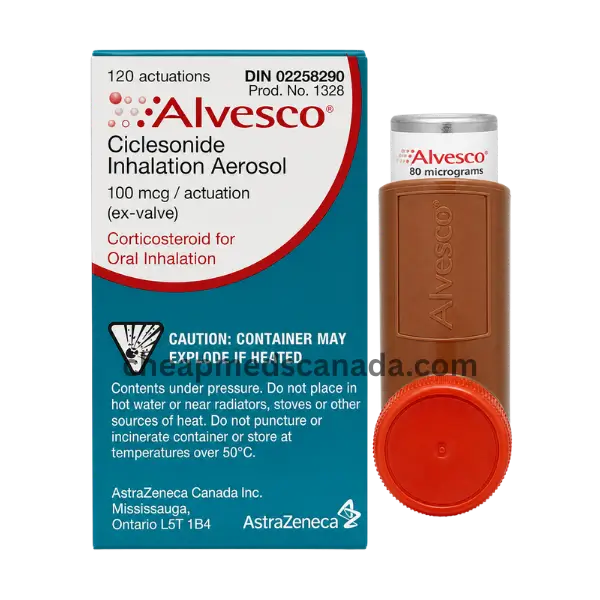
Description
Why Alvesco Works Differently Than Other Asthma Inhalers
If you have been prescribed Alvesco and are wondering why your doctor chose this particular inhaler over others like [Flovent (fluticasone)] or [Pulmicort (budesonide)], the answer lies in something most inhaler guides never bother to explain — Ciclesonide is not actually active when it enters your lungs.
That sounds counterintuitive, but it is one of Alvesco's most clinically important features. Ciclesonide is what pharmacologists call a prodrug — it is inhaled in an inactive form, and only converts into its active metabolite (des-ciclesonide) once it reaches the lung tissue itself. The enzyme responsible for this activation is found specifically in the bronchial cells.
What this means for patients is significant in two ways. First, the drug becomes concentrated where it is actually needed — in the airways — rather than being active throughout the mouth and throat during inhalation. Second, because the inactive form travels through the mouth and upper airways before activation, the risk of local side effects like oral thrush (fungal infection of the mouth) and throat irritation is meaningfully lower than with older inhaled corticosteroids that are active from the moment they are inhaled.
This same prodrug mechanism also contributes to Alvesco's low systemic absorption. Very little of the drug crosses into general circulation, which reduces the risk of the whole-body corticosteroid side effects — adrenal suppression, bone density loss, immune suppression — that can accumulate with long-term inhaled steroid use.
For Canadian patients managing persistent asthma on a long-term maintenance program, these characteristics make Alvesco a clinically interesting option worth understanding in detail.
What Alvesco Is — and What It Is Not
Alvesco 100 mcg is a maintenance inhaler. This single distinction shapes everything about how it is used and what patients should expect from it.
Maintenance inhalers work gradually. They reduce the underlying inflammation in the airways over days and weeks, making the lungs less reactive to triggers — dust, cold air, exercise, pet dander, pollen, smoke, respiratory infections — and reducing the frequency and severity of asthma episodes. They do not produce immediate bronchodilation. Taking an extra puff of Alvesco when you are already short of breath will not open your airways any faster.
Alvesco is not a rescue inhaler. During an acute asthma attack or sudden shortness of breath, you need a fast-acting bronchodilator — typically a [short-acting beta-agonist (SABA) like salbutamol (Ventolin)] or [levalbuterol]. If you do not have a rescue inhaler prescribed alongside Alvesco, this conversation needs to happen with your doctor before you need one in an emergency.
The distinction between these two types of inhalers is one of the most important things an asthma patient needs to understand clearly. Alvesco every morning and evening keeps your airways from becoming inflamed in the first place. Your rescue inhaler is what you reach for when an attack is already underway.
Alvesco 100 mcg — Dosing by Prior Treatment History
One of the more nuanced aspects of Alvesco prescribing is that the starting dose depends heavily on what you have been using to manage your asthma before. Your doctor will prescribe based on this history, but understanding the framework helps you have a more informed conversation.
| Prior Asthma Treatment | Starting Dose of Alvesco | Maximum Dose |
|---|---|---|
| Bronchodilators only (no previous ICS) | 100 mcg twice daily | 200 mcg twice daily |
| Previous inhaled corticosteroid use | 100 mcg twice daily | 400 mcg twice daily |
| Oral corticosteroids (e.g., prednisone) | 400 mcg twice daily | 400 mcg twice daily |
A note on the 100 mcg strength and how the inhaler works: When you press the actuator, the Alvesco canister releases 100 mcg of Ciclesonide into the actuator chamber. However, the amount that actually reaches deep into your lungs — the delivered dose — is approximately 80 mcg per actuation. This is because some medication deposits in the actuator and mouth regardless of technique. The inhaler is calibrated for this, so the labelled dose already accounts for what you receive therapeutically. Each Alvesco 100 mcg inhaler contains 120 actuations.
How long before it starts working? This is the question most patients ask first, and the honest answer is: not immediately. Full clinical benefit from Alvesco typically develops over 4 to 6 weeks of consistent twice-daily use. Some patients notice a modest improvement in symptoms within the first one to two weeks, particularly a reduction in nighttime coughing or morning chest tightness. But the full anti-inflammatory effect — the reduction in airway hyperresponsiveness that makes asthma more manageable day-to-day — takes time.
This is not a sign the medication is not working. It is how inhaled corticosteroids work. Do not stop using Alvesco because you do not feel an immediate difference.
Correct Inhaler Technique — Where Most Patients Go Wrong
Alvesco is a pressurised metered-dose inhaler (pMDI) — the classic canister-in-plastic-holder format. Unlike dry powder inhalers (DPIs) such as [Turbuhaler] or [Diskus], which require a fast, sharp inhalation, pMDIs require a slow and controlled breathing technique to ensure the medication reaches deep into the lungs rather than depositing at the back of the throat.
Priming the inhaler before first use: Before your very first dose, and any time the inhaler has not been used for more than 10 days, you must prime it. Shake the inhaler well, point it away from your face, and press the actuator to release 3 test sprays into the air. This ensures the valve is properly loaded and delivers a consistent dose.
Step-by-step inhalation technique:
- Remove the mouthpiece cap and shake the inhaler for 5 seconds
- Breathe out fully and gently — completely emptying your lungs
- Place the mouthpiece between your teeth and seal your lips around it — do not bite down
- Begin inhaling slowly and steadily through your mouth — this is the most common mistake; many patients inhale too fast, which causes the spray to impact the throat rather than reaching the bronchioles
- As you begin inhaling, press the canister down once to release one dose
- Continue inhaling slowly until your lungs are full
- Hold your breath for 10 seconds — this allows the fine particles to settle deep in the airways
- Exhale slowly through your nose
- Rinse your mouth with water and spit — this is non-negotiable and takes 10 seconds; it dramatically reduces the risk of oral thrush by washing away any medication that deposited in the mouth and throat
- Replace the mouthpiece cap
⏱️ If a second puff is needed: Wait at least 30 to 60 seconds before repeating the same process for a second actuation.
Using a spacer: A spacer (also called a valved holding chamber) is a cylinder that attaches between the inhaler and your mouth. It slows the spray, making it easier to coordinate inhalation with actuation — particularly helpful for patients who find the timing difficult, or for children over 12 using Alvesco. Ask your pharmacist whether a spacer is appropriate for you.
Side Effects of Alvesco 100 mcg — The Honest Picture
Because Ciclesonide's prodrug mechanism reduces activation in the mouth and throat, and because systemic absorption is low, Alvesco's overall side effect burden is generally considered favourable compared to older inhaled corticosteroids. However, side effects do occur and patients should know what to watch for.
Common — Usually Mild and Manageable
- Headache — reported in a meaningful proportion of patients; typically mild and resolves without intervention
- Nasal congestion or runny nose — upper respiratory effects that usually improve over the first few weeks
- Sore throat or throat irritation — reduced significantly by mouth rinsing after each dose; if persistent, contact your doctor
- Cough — usually mild; can occur in the first few weeks as the airways adjust
- Sinusitis or sinus congestion — may reflect the inflammatory response in adjacent nasal passages
- Joint or back pain — reported in clinical trials; typically mild
- Oral thrush (candidiasis) — white patches in the mouth, soreness, or altered taste. Occurs in more than 3% of patients. Prevention: rinse mouth with water after every dose. If you develop symptoms, contact your doctor; antifungal treatment (typically nystatin or fluconazole) is effective and you can usually continue Alvesco during treatment
Less Common — Report to Your Doctor
- Hoarse or changed voice — related to steroid deposition on the vocal cords; more common in people who use their voice professionally (teachers, singers). A spacer and mouth rinsing help
- Increased susceptibility to infections — Alvesco mildly suppresses local airway immunity; respiratory infections may last slightly longer
- Reactivation of latent infections — patients with a history of tuberculosis or herpes simplex should be monitored; these infections can reactivate under corticosteroid use
- Changes in taste or smell — uncommon but reported
Serious Side Effects — Require Medical Attention
Paradoxical bronchospasm: Rarely, inhaling Alvesco can trigger immediate worsening of breathing — wheezing, coughing, and chest tightness that begin immediately after a dose. This is called paradoxical bronchospasm. If this happens, stop using the inhaler, use your rescue inhaler immediately, and call your doctor. A different maintenance inhaler will likely be prescribed.
Eye complications (glaucoma and cataracts): Clinical trial data shows that minor changes in intraocular pressure occur in approximately 36% of Alvesco users — comparable to rates with other inhaled corticosteroids. More significant changes occur in roughly 8%, and the most serious changes in under 1%. Patients with a personal or family history of glaucoma or cataracts should have regular eye examinations while on long-term Alvesco therapy. Report any new vision changes — blurring, halos around lights, eye pain, or redness — to your doctor promptly.
Reduced bone mineral density: Long-term use of any inhaled corticosteroid carries a risk of gradual bone density reduction. This is dose-dependent and more relevant at higher doses (200–400 mcg twice daily) than at 100 mcg. Patients with osteoporosis risk factors — postmenopausal women, men over 65, smokers, those with low calcium intake or sedentary lifestyles — should discuss bone health monitoring (DEXA scan) with their physician. Adequate calcium and vitamin D intake is important for all long-term ICS users.
Adrenal insufficiency: At standard doses, Alvesco has low systemic absorption and is unlikely to suppress the adrenal glands meaningfully. However, patients transitioning from oral corticosteroids to Alvesco need careful monitoring — the adrenal glands may be suppressed from the oral steroid and require time to recover. During this transition period, physical stress (surgery, serious illness, significant injury) can trigger an adrenal crisis if the body cannot mount its usual cortisol response. Carry medical alert identification indicating corticosteroid use during this period.
Immune suppression and infection risk: Alvesco may reduce the body's ability to fight certain infections. Avoid close contact with people who have active chickenpox or measles if you have not been vaccinated or previously infected. If exposed, contact your doctor immediately — preventive treatment may be required. Alvesco does not directly cause these infections, but it may make them more severe if acquired.
Severe allergic reaction: Although rare, anaphylaxis to Ciclesonide or inhaler components has been reported. Symptoms include swelling of the lips, mouth, or tongue, difficulty breathing, widespread hives, and rapid heartbeat. This is a medical emergency — call 911 immediately.
Who Should Not Use Alvesco 100 mcg
Alvesco is not appropriate for everyone. Be honest with your prescribing physician about all of the following:
- Known allergy to Ciclesonide or any component of the inhaler — do not use
- Active or untreated fungal, bacterial, or viral infections of the respiratory tract — Alvesco may worsen them
- Status asthmaticus or acute asthma attacks — Alvesco will not help and must not be used as the sole treatment in this situation
- Patients under 12 years of age — Alvesco is not approved for children younger than 12 in Canada
- Glaucoma or cataracts — use with caution and regular ophthalmological monitoring
- Tuberculosis (active or latent) — requires physician assessment before starting Alvesco
Alvesco and Special Populations
Adolescents (12 to 17 years): Alvesco is approved for patients from age 12 upward. Dosing is identical to the adult schedule. However, long-term use of inhaled corticosteroids in adolescents has been associated with a small reduction in final adult height — approximately 1 centimetre on average based on clinical trial data. This effect is dose-dependent. Your child's physician will monitor height at regular intervals and aim for the lowest effective dose that maintains good asthma control. This modest potential growth effect is weighed against the well-established risks of poorly controlled asthma, which include more severe risks to lung development.
Seniors (65+): Older adults are not excluded from Alvesco use. However, they may be at higher baseline risk for the bone density effects of long-term corticosteroid use and should have appropriate monitoring in place. The risk of glaucoma is also worth discussing given the higher background prevalence of this condition in older Canadians.
Pregnancy: The safety of Ciclesonide during human pregnancy is not fully established. Animal studies using injectable ciclesonide showed evidence of fetal harm, though inhaled use produces far lower systemic exposure. That said, uncontrolled asthma during pregnancy carries its own significant risks to both mother and baby — including preeclampsia, preterm delivery, and fetal oxygen restriction. Most respiratory specialists advise continuing inhaled corticosteroid therapy in pregnant women whose asthma is otherwise well controlled on it. Discuss the specific risk-benefit balance with your obstetrician and pulmonologist or respirologist.
Breastfeeding: It is not known whether Ciclesonide passes into human breast milk in clinically significant amounts. Given its low systemic absorption profile, the theoretical exposure to a nursing infant is expected to be minimal. Discuss with your physician before continuing or starting Alvesco while breastfeeding.
Alvesco vs. Other Inhaled Corticosteroids — How It Fits in Canadian Asthma Treatment
Canadian asthma management follows the Canadian Thoracic Society (CTS) guidelines, which recommend inhaled corticosteroids as the cornerstone of maintenance therapy for persistent asthma at all severity levels. Several ICS options are available in Canada — here is where Alvesco sits:
| Inhaled Corticosteroid | Active Ingredient | Prodrug? | Approved Age | Available as Combination ICS/LABA? |
|---|---|---|---|---|
| Alvesco | Ciclesonide | Yes | 12+ | No |
| [Flovent HFA] | Fluticasone propionate | No | 4+ | Via [Advair] |
| [Pulmicort] | Budesonide | No | 6+ | Via [Symbicort] |
| [Qvar] | Beclomethasone dipropionate | Partially | 5+ | No |
| [Asmanex] | Mometasone furoate | No | 12+ | Via [Dulera] |
One practical consideration for patients: Alvesco is currently available as a standalone ICS only. If your asthma requires the addition of a long-acting bronchodilator (LABA) to an ICS — a step up in therapy recommended by CTS guidelines for moderate-to-severe asthma — your physician may transition you to a combination inhaler like [Symbicort (budesonide/formoterol)] or [Advair (fluticasone/salmeterol)] rather than adding a separate inhaler alongside Alvesco.
Drug Interactions — What to Tell Your Doctor Before Starting
Alvesco has a limited but important interaction profile:
Ketoconazole (antifungal medication): This is the most documented drug interaction with Alvesco. Ketoconazole inhibits CYP3A4 — the liver enzyme responsible for metabolising des-ciclesonide (Alvesco's active metabolite). When taken together, levels of the active metabolite increase, potentially amplifying both efficacy and side effects. Your physician will not necessarily change your Alvesco dose if you need short-term ketoconazole, but they should be aware of the combination.
Other strong CYP3A4 inhibitors that may produce a similar interaction include: itraconazole, ritonavir (HIV medication), clarithromycin, and certain other antifungals or HIV protease inhibitors. Mention all medications — including over-the-counter products, herbal supplements, and vitamins — to your physician and pharmacist before starting Alvesco.
Oral corticosteroids: If you are currently on oral steroids such as [prednisone] for asthma or another condition, transitioning to Alvesco requires a carefully managed taper of the oral steroid — not an abrupt switch. Your physician will typically begin Alvesco, allow 1 to 2 weeks for it to establish its effect, then gradually reduce the oral steroid dose over weeks to months under close monitoring. Abrupt cessation of oral corticosteroids in patients who have been using them long-term can precipitate adrenal crisis.
Storing and Disposing of Your Alvesco Inhaler
- Store at room temperature — ideally 25°C; acceptable between 15°C and 30°C
- Keep away from open flame and heat sources — the canister is pressurised; exposure to temperatures above 49°C can cause it to burst
- Do not refrigerate or freeze — cold temperatures can cause the pressurised canister to perform erratically
- Store with the mouthpiece cap on to prevent dust and debris from blocking the actuator
- Do not use past the expiry date on the packaging
- Track remaining doses using the dose counter if your inhaler includes one; if not, mark your start date on the box — each inhaler contains 120 doses
- Dispose of used inhalers safely through your pharmacy's medication return program rather than household recycling — pressurised canisters should not be punctured or incinerated
Why does my Alvesco inhaler feel like it is releasing very little spray compared to my old inhaler?
This is a common observation. Alvesco uses an HFA propellant that produces a softer, finer mist than some older inhalers. The lighter spray does not mean you are receiving less medication. In fact, the fine particles are designed to reach deeper into the airways, making proper slow inhalation technique especially important.
Can I use Alvesco and a rescue inhaler at the same time?
Yes. Alvesco is a maintenance inhaler used to control airway inflammation, while a rescue inhaler is used to relieve sudden asthma symptoms. Many patients use both as part of their asthma management plan. If you find yourself needing your rescue inhaler frequently, consult your healthcare provider to review your asthma control.
I missed a dose — should I take two at my next scheduled time?
No. If you remember the missed dose within a short time, take it as soon as possible. If it is nearly time for your next dose, skip the missed dose and continue with your normal schedule. Do not take a double dose to make up for a missed one.
How do I know if Alvesco is working?
Signs that Alvesco is working include fewer asthma symptoms, reduced need for a rescue inhaler, fewer nighttime awakenings, improved ability to exercise and perform daily activities, and better overall asthma control. It may take several weeks of consistent use to experience the full benefit.
What should I do if I accidentally take too many puffs?
An accidental extra dose is unlikely to cause serious problems for most people. However, if you believe you have taken significantly more than prescribed or develop unusual symptoms, contact your doctor, pharmacist, or local poison control centre for advice.
Can Alvesco replace my oral prednisone for asthma?
In some cases, inhaled corticosteroids such as Alvesco may help reduce the need for oral corticosteroids. However, any change to prednisone treatment must be carefully supervised by a healthcare provider. Never stop or reduce oral prednisone without medical guidance.
Reviews
There are no reviews yet.