
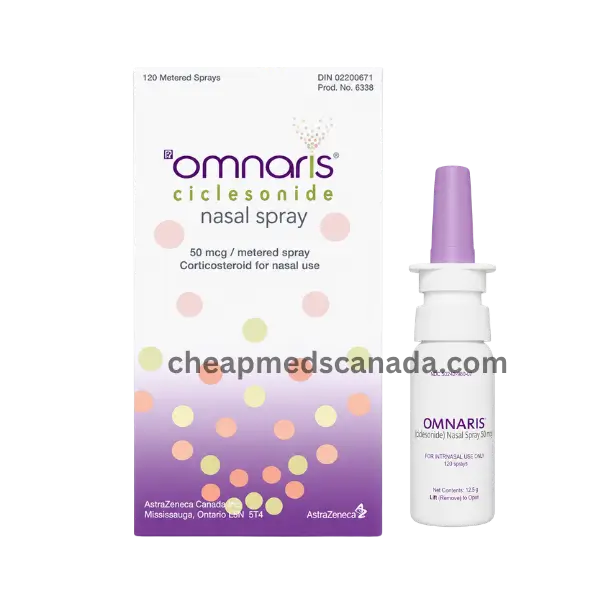

Description
Omnaris Nasal Spray (Ciclesonide) — Prescription Nasal Corticosteroid for Seasonal and Year-Round Allergies
Allergy season in Canada is no small thing. From the tree pollen that hits southern Ontario in April to the ragweed that blankets the prairies through August and September — and the indoor allergens that cause symptoms year-round regardless of what's happening outside — millions of Canadians spend months managing a nose that won't cooperate. Congestion, runny nose, sneezing, that constant itchy pressure behind the eyes. For people with moderate to severe allergic rhinitis, antihistamines often aren't enough on their own.
Omnaris Nasal Spray is a prescription corticosteroid nasal spray containing Ciclesonide 50 mcg per spray that addresses allergic rhinitis directly at the source — the inflamed nasal lining — rather than simply masking symptoms downstream. It's approved in Canada for adults and adolescents aged 12 and older, for both seasonal allergic rhinitis (hay fever) and perennial allergic rhinitis (year-round allergies).
What Makes Omnaris Different From Other Nasal Steroid Sprays
This is worth understanding before getting into the standard details, because it's the part most product pages skip entirely.
Ciclesonide — the active ingredient in Omnaris — is what's called a prodrug. That means it's delivered to the nasal tissue in an inactive form and only converts into its active form once it's inside the nasal mucosa itself. The enzyme responsible for that conversion (esterase) exists in nasal tissue but not significantly in most other body tissues.
Why does that matter? Because it means the active drug is largely confined to where it's supposed to work — the nasal lining. The amount of biologically active steroid that makes it into systemic circulation is extremely low compared to many other nasal corticosteroids. Studies have consistently shown that Ciclesonide has minimal measurable systemic exposure at recommended doses, which translates to a lower risk of the hormonal side effects sometimes associated with long-term nasal steroid use — including effects on growth in adolescents, adrenal suppression, or bone density changes.
For a medication that many patients use continuously for months during allergy season — or year-round for perennial allergic rhinitis — that pharmacological profile is a genuine clinical advantage. It's not marketing language; it's why Ciclesonide is specifically recommended in some Canadian allergy guidelines for patients needing ongoing nasal steroid therapy.
What Omnaris Is Prescribed For
Omnaris is indicated for allergic rhinitis in adults and adolescents 12 years of age and older. This covers two distinct patterns:
Seasonal allergic rhinitis — what most people call hay fever. Symptoms are triggered by outdoor allergens with defined seasons: tree pollen in spring, grass pollen in early summer, ragweed in late summer and fall. Across Canada, ragweed season runs roughly from mid-August through the first frost, with peak concentrations in southern Quebec and Ontario among the highest on the continent. Omnaris is typically started one to two weeks before the expected season for best effect.
Perennial allergic rhinitis — year-round symptoms triggered by indoor allergens that don't disappear when temperatures drop. Dust mites, pet dander, mould spores, and cockroach allergens are the main culprits. For patients dealing with congestion and sneezing regardless of the calendar, Omnaris provides continuous daily control without requiring a seasonal start-stop approach.
The symptoms addressed by Omnaris include nasal congestion, runny nose, post-nasal drip, sneezing, and nasal itching. It does not treat eye symptoms directly — if ocular itching and redness are a major part of the picture, an eye-specific treatment may be needed alongside it.
How Ciclesonide Works in the Nasal Passages
When an allergen — say, ragweed pollen — contacts the nasal lining in a sensitised person, the immune system responds by releasing inflammatory chemicals including histamine, leukotrienes, and prostaglandins. These chemicals cause blood vessels in the nasal tissue to dilate, fluid to accumulate, mucus production to increase, and nerve endings to become hypersensitive. The result is the full constellation of rhinitis symptoms: congestion, discharge, itching, sneezing.
Ciclesonide, once activated in nasal tissue, binds to glucocorticoid receptors inside nasal cells and suppresses this entire inflammatory cascade — not just histamine, but the full range of chemical mediators driving the reaction. This is why nasal corticosteroids are consistently ranked above antihistamines in clinical allergy guidelines for moderate-to-severe rhinitis: they address a broader range of the underlying inflammation rather than blocking one pathway.
The effect builds gradually. Most patients notice meaningful improvement in runny nose and sneezing within one to two days. Congestion relief typically takes a bit longer — often three to five days of consistent use. Full benefit is usually established within two weeks. This is not a medication you take and feel working within an hour — it requires consistent daily use to maintain the suppression of nasal inflammation.
How to Use Omnaris Nasal Spray
Standard dose: Two sprays in each nostril once daily. That's the full recommended daily dose — four sprays total, 200 mcg of Ciclesonide per day. Do not exceed this amount.
Timing: Once daily, at the same time each day. Morning administration is generally preferred so the medication is active during the period of highest allergen exposure for most patients, though evening use works too if that fits your routine better. Consistency matters more than timing.
Correct technique — this is where a lot of patients go wrong:
- Gently blow your nose before applying to clear any mucus from the nasal passages
- Shake the bottle gently before each use
- Hold the bottle upright with your thumb at the base and two fingers on the nozzle
- Tilt your head slightly forward — not back. Tilting back causes the spray to run down the throat rather than coat the nasal lining
- Insert the nozzle into one nostril while closing the other, aim slightly outward (toward the outer wall of the nasal passage, away from the nasal septum), and spray while breathing in gently through the nose
- Breathe out through your mouth after spraying, then repeat for the second spray in the same nostril before switching sides
- Avoid sneezing or blowing your nose for a few minutes after application
Priming the pump: Before first use and if the spray hasn't been used for more than 4 days, prime it by spraying into the air until a fine mist appears (usually 3–4 actuations).
Cleaning the nozzle: Wipe the nozzle with a clean dry cloth after each use. Never rinse the nozzle under water.
Side Effects of Omnaris
The low systemic exposure characteristic of Ciclesonide means that systemic corticosteroid side effects are uncommon at recommended doses. Most side effects reported with Omnaris are local — occurring in or near the nasal passages.
Common local side effects — typically mild:
- Headache — the most frequently reported side effect in clinical studies
- Nosebleeds (epistaxis) — usually minor and related to technique; aiming the nozzle away from the nasal septum reduces this significantly
- Nasal dryness, burning, or irritation inside the nasal passages
- Decreased sense of smell or taste — usually temporary
- Sore throat or mild post-nasal irritation
- Dry mouth
Less common — worth mentioning to your doctor:
- Nasal ulcers or crusting, particularly with long-term use or dry nasal passages
- Nasal septal perforation — rare, but associated with long-term high-dose nasal steroid use; the risk is minimised by correct application technique (aiming away from the septum)
Uncommon but serious — seek medical attention:
- Signs of fungal infection in the nose or throat — white patches, persistent soreness, or unusual discharge. Nasal corticosteroids can occasionally permit opportunistic fungal colonisation, similar to how inhaled steroids can cause oral thrush
- Allergic reaction to the medication itself — rapid-onset swelling of the face, lips, tongue, or throat; difficulty breathing; hives. This is distinct from the allergic rhinitis being treated
Systemic effects — rare at standard doses but possible with long-term high-dose use: Adrenal suppression, growth effects in adolescents, or effects on bone density are unlikely at recommended Omnaris doses given Ciclesonide's low systemic bioavailability. However, patients using multiple corticosteroid products simultaneously — for example, an inhaled steroid for asthma alongside Omnaris — should ensure their prescriber is aware of the combined steroid load.
Warnings and Precautions
Active nasal infections: Omnaris should not be used when an untreated bacterial, fungal, or viral infection is present in the nasal passages. Corticosteroids suppress local immune activity and can allow infections to worsen. If you develop an upper respiratory infection during treatment, speak to your doctor about whether to pause Omnaris temporarily.
Recent nasal surgery or injury: Do not use Omnaris until the nasal passages have healed following surgery, injury, or nasal septal repair. The anti-inflammatory action can interfere with normal wound healing.
Children under 12: Omnaris is not approved for use in children under 12 years of age in Canada. Paediatric allergic rhinitis has separate treatment options that should be discussed with a paediatrician or allergist.
Pregnancy and breastfeeding: Omnaris should only be used during pregnancy when clearly necessary and under medical supervision. While systemic absorption is low, any corticosteroid use during pregnancy requires a careful benefit-risk discussion with your physician. There is limited data on Ciclesonide in breast milk; consult your doctor before use while breastfeeding.
Liver disease: Ciclesonide is metabolised in the liver. Patients with significant liver impairment may experience higher systemic exposure than expected at standard doses, which warrants closer monitoring.
Vision: Long-term use of nasal corticosteroids has been associated with rare cases of increased intraocular pressure and cataracts. If you experience vision changes at any point during treatment, have it assessed promptly.
Drug Interactions
Omnaris has a small number of clinically meaningful drug interactions, all related to medications that affect how Ciclesonide is metabolised in the liver:
- Ketoconazole and itraconazole (antifungal medications) — these are strong inhibitors of the CYP3A4 enzyme that processes Ciclesonide, and can significantly increase systemic exposure. Concurrent use should be discussed with your doctor
- Ritonavir and nelfinavir (HIV antiretroviral medications) — same mechanism; these drugs can substantially raise Ciclesonide blood levels
- Other corticosteroids — simultaneous use of inhaled, oral, topical, or other nasal corticosteroids adds to the total steroid burden and increases the risk of systemic effects. Always disclose all corticosteroid products to your prescribing doctor
How long does one bottle of Omnaris last?
Each bottle contains 120 metered sprays. At the commonly prescribed dose of two sprays in each nostril once daily, a bottle typically lasts about 30 days. Patients using one spray per nostril daily may get up to 60 days of treatment from a single bottle.
Can I use Omnaris every day for months at a time?
Yes. Omnaris is intended for regular daily use during allergy seasons or throughout the year for persistent allergic rhinitis. When used as directed, it is considered suitable for long-term management of allergy symptoms.
Why isn't Omnaris working immediately?
Omnaris is a nasal corticosteroid that works by gradually reducing inflammation in the nasal passages. Many patients notice improvement within a few days, but the full benefit may take up to two weeks of consistent daily use.
Can I use Omnaris and an antihistamine at the same time?
Yes. Omnaris is often used together with oral antihistamines to help manage moderate to severe allergy symptoms. Because these medications work in different ways, they may provide additional symptom relief when used together. Consult your healthcare provider before combining treatments.
What happens if I stop using Omnaris suddenly?
Unlike oral corticosteroids, Omnaris does not typically require gradual dose reduction when discontinued. However, allergy symptoms may gradually return after stopping treatment as the anti-inflammatory effects wear off.
Is there a generic version of Omnaris available in Canada?
Yes. Generic ciclesonide nasal sprays are available and approved for use in Canada. These products contain the same active ingredient and are expected to provide similar therapeutic benefits to brand-name Omnaris.
This product information is provided for reference only. Omnaris Nasal Spray contains ciclesonide, a corticosteroid used to manage allergy symptoms. Use only as directed by your healthcare provider. Do not start, stop, or change your treatment without professional medical advice. If symptoms persist, worsen, or unexpected side effects occur, contact your healthcare professional promptly. Keep out of reach of children and use only for the condition for which it was prescribed.


Reviews
There are no reviews yet.