
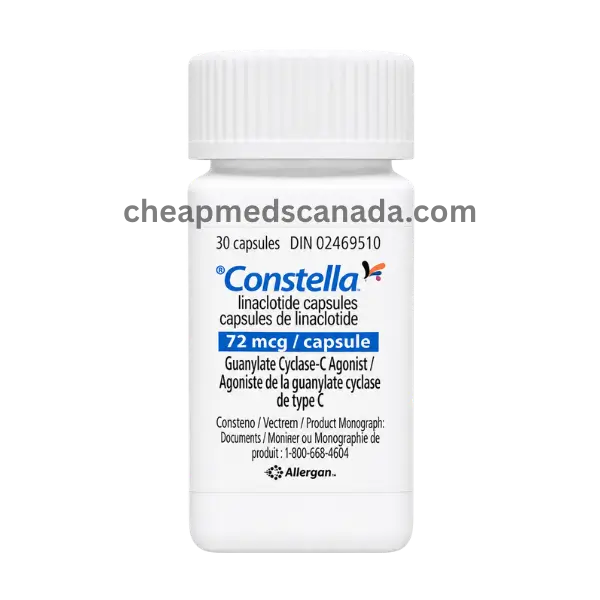
Description
What to Know Before You Start
If your doctor just prescribed Constella for IBS-C or chronic constipation, you're probably wondering three things: how is this different from a regular laxative, how long until it actually works, and is the diarrhea side effect as common as the internet makes it sound. All three deserve straight answers — plus one safety point that matters more than most people realize if there's a child or teenager in the house.
It's Not Just Moving Things Along — It's Also Treating the Pain
Most constipation treatments do one job: get things moving. Constella (linaclotide) does two. It's a guanylate cyclase-C agonist, which is a fancy way of saying it binds to receptors lining your intestine and raises levels of a molecule called cyclic GMP. That rise in cGMP does two separate things at once — it pulls fluid (chloride and bicarbonate) into the intestine to soften stool and speed up transit, and it quiets down the pain-signaling nerve fibers in the gut wall.
That second part is the whole reason Constella gets prescribed specifically for IBS-C rather than a plain stool softener. The abdominal pain that comes with IBS-C isn't a side effect being ignored — it's a symptom the drug is actually built to address.
Two Conditions, Slightly Different Dosing
Constella covers two approved uses, and people switching between the two are often confused about why the dose looks different:
For chronic idiopathic constipation (CIC): doctors sometimes start at 72 mcg, particularly for patients who are more sensitive to diarrhea, moving up to 145 mcg if needed.
For IBS-C: 145 mcg is the typical standard dose. A 290 mcg strength exists and is used more commonly outside Canada — if you're prescribed this dose, it's worth confirming with your pharmacist that it matches your specific indication rather than assuming higher is simply better.
There's currently no generic linaclotide available, so brand pricing applies no matter where you fill it.
Timing Is Not Optional
Take Constella on an empty stomach, at least 30 minutes before your first meal. This isn't a "preferably" instruction — taking it with food genuinely increases how much of the drug your body absorbs, and that directly correlates with worse diarrhea. If you've heard from someone that Constella "destroyed their stomach," there's a decent chance timing was the missing piece, not the drug itself.
Capsules should be swallowed whole. If that's difficult, they can be opened and mixed into a small amount of applesauce or water right before taking — but don't chew or crush them directly.
The Two-Speed Timeline
Here's something that trips people up: the constipation relief and the pain relief don't arrive on the same schedule.
Bowel movement frequency for CIC often improves within the first week. But if you're taking it for IBS-C and it's the abdominal pain and bloating you're hoping to see change, that typically takes longer — most clinical guidance points to a full 12-week trial before judging whether it's actually working. Stopping after four or five days because the pain hasn't budged is jumping the gun; give it the full window before deciding.
The Warning That Deserves More Attention Than It Gets
Constella carries a boxed warning — the most serious safety label a drug can carry — against use in children under 6. This isn't a mild caution. It's based on deaths recorded in juvenile animal studies tied to severe dehydration, and the concern extends to teenagers too: patients aged 6-17 are generally advised to avoid this medication, since younger patients appear more vulnerable to the fluid-loss effects in a way that can become dangerous quickly given their smaller body size.
If Constella is ever being discussed for anyone under 18, this warning needs to be the first thing raised with a doctor — not a detail buried in the fine print.
Side Effects Worth Knowing
Diarrhea is the most commonly reported side effect and the number one reason people stop taking Constella. Gas, bloating, and general abdominal discomfort round out the common list.
Watch for anything more serious — persistent or severe diarrhea, dizziness, unusually low urination, dry mouth, or unusual thirst (all dehydration signs), rectal bleeding, or severe abdominal pain. Any of these warrant contacting your doctor rather than waiting it out, especially given how directly linaclotide's mechanism ties into fluid loss.
When Constella Isn't the Right Fit
- Children under 6 shouldn't take it at all; ages 6-17 generally shouldn't either
- Anyone with a known or suspected mechanical bowel obstruction
- Known hypersensitivity to linaclotide
- Pregnant or breastfeeding — talk to your doctor first, since safety data here is limited
How It Stacks Up Against Similar Drugs
Plecanatide (Trulance) works through a nearly identical GC-C mechanism, so the choice between the two often comes down to individual tolerance and cost rather than a meaningful efficacy gap. Lubiprostone (Amitiza) takes a different route entirely, working through a chloride channel rather than the GC-C pathway, and isn't primarily positioned around treating IBS-C pain the way Constella is. If diarrhea tolerance is your main concern, that's usually the deciding factor your doctor will weigh between these options.
Filling It in Canada
Constella is prescription-only, manufactured by Allergan, and still has no generic alternative on the Canadian market. Provincial coverage varies by plan, and since there's no generic to fall back on for cost savings, it's worth comparing pricing across licensed Canadian pharmacies before committing to a long-term fill.
What should I do if I miss a dose of Constella?
If you miss a dose, skip it and take your next dose at the usual scheduled time. Do not take two doses together, as this can increase the risk of diarrhea and other digestive side effects.
Is Constella the same as Linzess?
Yes. Constella and Linzess both contain the same active ingredient, linaclotide. The medication is marketed as Constella in Canada and many European countries, while Linzess is the brand name used in the United States.
Can I take Constella long-term?
Yes. Constella is intended for the long-term management of chronic idiopathic constipation (CIC) and irritable bowel syndrome with constipation (IBS-C). Your doctor will periodically review your treatment to ensure it continues to work well for you.
Why should I take Constella on an empty stomach?
Constella should be taken at least 30 minutes before your first meal of the day. Taking it with or immediately after food may increase the likelihood of diarrhea, loose stools, and stomach discomfort.
How long does Constella take to start working?
Some people notice an improvement within the first few days of treatment, while for others it may take 1 to 2 weeks of regular use before bowel habits improve. Continue taking it as prescribed unless your doctor advises otherwise.
Constella should be used only under the supervision of a qualified healthcare professional. It is intended for adults with chronic idiopathic constipation or IBS-C and should not be used in children unless specifically prescribed. Follow the recommended dosage and seek medical attention if you experience severe diarrhea, dehydration, or other serious side effects.


Reviews
There are no reviews yet.