
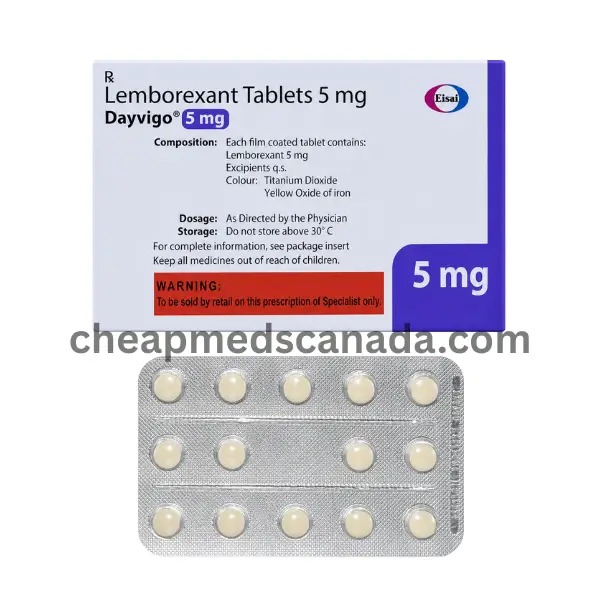
Description
Dayvigo (Lemborexant): Uses, Dosage, and Important Safety Information
Dayvigo works on a completely different brain pathway than older sleep medications, which is exactly why it's worth understanding properly rather than treating it like "just another sleeping pill." Here's what lemborexant actually does, how the two available strengths differ, and a few safety points — including one specific warning class — that get glossed over on most product listings.
What Dayvigo Actually Is
Dayvigo (lemborexant) belongs to a drug class called dual orexin receptor antagonists (DORAs) — the same class as suvorexant (Belsomra). This is a meaningfully different mechanism from older sleep medications like the "Z-drugs" (zopiclone, zolpidem) or benzodiazepines, which work by broadly enhancing GABA activity in the brain. Lemborexant instead targets the orexin system specifically, which is why its effect on sleep architecture and its side effect profile differ from older options.
How It Works: The Orexin System
Orexin (also called hypocretin) is a neuropeptide that promotes wakefulness and alertness. Orexin neurons signal through two receptor types, OX1R and OX2R, to keep the brain in a wake state. Lemborexant blocks both receptors, dialing down the wake-promoting signal rather than sedating the brain broadly. In practice, this means Dayvigo works with the brain's own sleep-wake switching mechanism rather than forcing sedation on top of it — which is the theoretical basis for it having a different next-day and dependence profile compared to benzodiazepines.
Dayvigo Strengths: 5mg vs 10mg
| Status | 5mg | 10mg |
|---|---|---|
| Typical starting dose | Yes — standard starting point for most adults | Used if 5mg doesn't provide adequate benefit |
| Elderly patients (65+) | Often preferred as the maintenance dose long-term | Used cautiously; higher next-day impairment risk |
| Next-day effects | Lower risk | Meaningfully higher risk of residual drowsiness |
| Women specifically | Standard | Clearance is slower in women on average, raising next-day exposure at this dose |
Moving to 10mg isn't a simple "it works better" upgrade — it comes with a real increase in next-day impairment risk, which is worth weighing against how much additional benefit you're actually getting at 5mg.
How to Take It
- Take immediately before getting into bed, not hours in advance — onset is fast, typically within a few minutes to half an hour
- Only take it when you have a full 7 hours available to sleep before you need to be awake; taking it with less time available significantly raises next-day impairment risk
- Avoid taking it with or immediately after a heavy or fatty meal, which delays onset
- Limit to one dose per 24-hour period
The Warning Most Listings Skip: Complex Sleep Behaviors
This is a real, labeled safety concern for the entire DORA and Z-drug class, and it deserves more than a passing mention. Lemborexant has been associated with complex sleep behaviors — sleepwalking, sleep-driving, preparing and eating food, or having conversations, all while not fully conscious and with no memory of it afterward. These events are uncommon but serious, and risk appears to increase with higher doses, when combined with alcohol or other central nervous system depressants, or when the full 7-hour sleep window isn't available. If you or someone else notices any of these behaviors, that's a reason to stop the medication and speak with a doctor, not something to monitor and wait out.
Next-Day Effects and Driving
Even when you feel fully awake, lemborexant can impair driving and coordination the next morning — this isn't just subjective grogginess, it reflects measurable psychomotor impairment in clinical testing, particularly at the 10mg dose. This risk is higher in women (due to slower drug clearance), in anyone who didn't get the full 7-hour sleep window, and when combined with other sedating substances. Avoid driving or operating machinery until you're certain the drug's effects have fully worn off, not just until you feel awake.
Side Effects
Common:
- Daytime sleepiness or drowsiness
- Headache
- Nightmares or unusual, vivid dreams
- Dizziness
Less common but serious:
- Complex sleep behaviors (see above)
- Worsening depression or emergence of suicidal thoughts (rare, but reported with this drug class)
- Sleep paralysis or temporary muscle weakness on waking
- Signs of allergic reaction — swelling of face, lips, tongue, or throat
Drug Interactions
Lemborexant is broken down primarily by the CYP3A4 liver enzyme, which makes interactions with CYP3A4 inhibitors and inducers clinically significant rather than a minor footnote:
- Strong CYP3A4 inhibitors (certain antifungals like ketoconazole, some antibiotics, some antiviral medications) can significantly raise lemborexant blood levels — combined use is generally avoided
- Grapefruit and grapefruit juice inhibit CYP3A4 as well and can meaningfully increase drug exposure
- CYP3A4 inducers (certain anticonvulsants, rifampin) can reduce lemborexant's effectiveness by speeding up its clearance
- Alcohol and other CNS depressants compound sedation and raise the risk of both next-day impairment and complex sleep behaviors
Always give your pharmacist a complete medication and supplement list before starting.
Who Shouldn't Take Dayvigo
- Narcolepsy — this is a specific contraindication. Since lemborexant suppresses the same orexin system that's already deficient in narcolepsy, it can worsen the underlying condition rather than simply being ineffective
- Severe hepatic impairment
- Known hypersensitivity to lemborexant
- Pregnant or breastfeeding women should discuss use with a doctor first, as safety data in these groups is limited
Dayvigo vs Other Sleep Medications
Compared to benzodiazepines and Z-drugs like zopiclone or zolpidem, lemborexant's orexin-targeted mechanism is associated with a different dependence profile and less disruption to natural sleep architecture in clinical studies, though it's not free of risk — the complex sleep behavior warning applies to this entire medication category, not just older drugs. Compared to suvorexant (Belsomra), the two DORAs are similar in mechanism, with differences mainly in half-life and specific dosing guidance rather than a fundamentally different approach.
Why does Drysol 20% sting more than the lower-strength version?
Drysol 20% contains a higher concentration of aluminum chloride, which makes it more effective at reducing excessive sweating but also more likely to cause temporary stinging, burning, or skin irritation. Many people begin with a lower strength before moving to 20% if needed.
Can I use Drysol on my palms or the soles of my feet?
Yes. Drysol can be used on the palms and soles to help control excessive sweating. However, these areas may be more prone to irritation, so follow your doctor's instructions and consider starting with less frequent applications.
Can Drysol become less effective over time?
Most people continue to benefit from Drysol with regular maintenance use. If sweating gradually returns, your doctor may recommend adjusting how often you apply it rather than stopping the treatment.
Can I shave before applying Drysol?
No. Avoid applying Drysol to freshly shaved skin. Wait at least 24 hours after shaving before using the product to reduce the risk of burning, stinging, and skin irritation.
How often should I use Drysol once my sweating is under control?
After your symptoms improve, many people only need to apply Drysol once or twice a week to maintain results. Your doctor can recommend the best maintenance schedule based on your condition.
Drysol is for external use only and should be applied exactly as directed by a healthcare professional or according to the product instructions. Avoid contact with the eyes, mouth, and broken or irritated skin. If severe irritation, burning, rash, or an allergic reaction occurs, discontinue use and seek medical advice. Keep out of the reach of children.



Reviews
There are no reviews yet.