

Description
Aklief Cream (Trifarotene 0.005%): Price, Reviews & What to Expect
Most people land on this page with one of a few specific questions in mind — what it costs, whether it actually works, and how long results take. Rather than burying those answers under a standard drug monograph, here's what to know, organized around exactly what people are usually trying to find out.
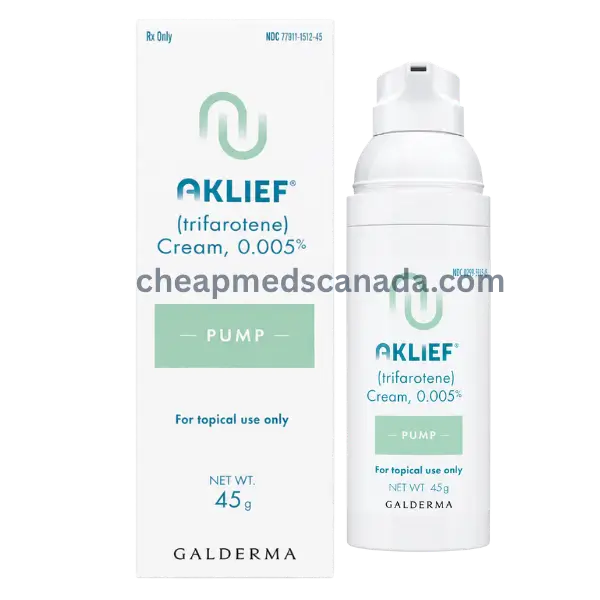
What Is Aklief Cream, Briefly
Aklief contains trifarotene, a retinoid that specifically targets RAR-γ — the most common retinoic acid receptor found in skin. It's the first new topical retinoid molecule approved for acne in roughly two decades, and it's approved for use on both the face and trunk (chest, shoulders, back), which sets it apart from many older retinoids formulated mainly for facial use. It's prescribed for acne vulgaris in people aged 9 and up, applied once daily in the evening.
Aklief Cream Price in Canada
Trifarotene is a newer, patent-protected retinoid, and pricing reflects that — in the US, retail cost for a single pump without insurance or a discount card commonly runs several hundred dollars or more. Ordering through a Canadian pharmacy is generally where the cost advantage shows up most clearly, since Canadian drug pricing tends to run meaningfully lower than US retail for patent-protected prescription products.
A few things that affect the actual price you'll see at checkout:
- Tube size — Aklief is typically available in smaller and larger sizes, and the per-gram cost usually improves with the larger option
- Country of manufacture, which affects applicable tariffs on shipments to the US
- Whether it's ordered as a single tube or a multi-month supply, since per-unit cost tends to drop with larger orders
Because pricing shifts with supply, tariffs, and promotions, the most accurate number is always the one shown at checkout rather than a fixed figure quoted here — but broadly, ordering through a Canadian pharmacy is the reason most people are comparing prices in the first place.
What Reviews and Patient Experience Tend to Say
Patient experience with Aklief follows a fairly consistent pattern, and it's worth knowing before starting rather than being surprised by it partway through:
- The first 2–4 weeks are often the hardest. Dryness, peeling, redness, and mild stinging are common as skin adjusts, and this is frequently the point where people mistakenly conclude the product "isn't working" or is "too harsh"
- Improvement tends to build gradually, not suddenly. Clinical trials measuring effectiveness over 12 weeks are a reasonable real-world expectation — most people don't see dramatic change in the first two weeks, but do see meaningful improvement by the two-to-three-month mark
- Consistency matters more than intensity. Skipping applications during the rough early weeks, then trying to "catch up," tends to produce worse irritation than steady daily use with proper moisturizing support
- A moisturizer isn't optional. The pattern in patient feedback is clear: people who pair Aklief with regular moisturizing from day one report less irritation than those who don't
None of this is unique to Aklief — it's a fairly standard adjustment pattern for potent topical retinoids generally. But going in with realistic expectations tends to make the difference between sticking with treatment through the rough patch and giving up too early.
Before and After: A Realistic Timeline
- Weeks 1–2: Skin often looks and feels worse before it looks better — dryness, flaking, and increased redness are common as the skin turns over more quickly
- Weeks 3–4: Irritation typically starts to settle for most people as the skin adjusts; this is also when some early improvement in inflammatory acne may start becoming visible
- Weeks 6–8: More noticeable reduction in active breakouts and inflammation for many users
- Weeks 8–12: This is roughly where clinical trial data shows the fuller effect — meaningful reduction in both inflammatory and non-inflammatory acne lesions compared to when treatment started
Results vary by individual, by acne severity, and by how consistently the cream is used — but the general shape of this curve, slow start followed by gradual improvement, is a reliable pattern to expect rather than an exception.
How to Apply It Correctly
- Cleanse the treatment area with a mild, soap-free cleanser and pat dry — applying to damp or freshly-washed irritated skin increases stinging
- Wait until skin is fully dry before applying
- Use a pea-sized amount (roughly one pump) for the face; a similar amount typically covers the upper back or chest depending on area size
- Apply a thin layer only — more product does not mean faster results, and tends to increase irritation instead
- Avoid the eyes, lips, and creases around the nose
- Follow with a fragrance-free moisturizer, especially during the first month
Precautions Worth Knowing
- Increases sun sensitivity — daily sunscreen and limited sun exposure are genuinely important, not just a formality
- Avoid waxing, electrolysis, and chemical hair removal on treated skin
- Use caution combining with other topical acne products containing sulfur, resorcinol, or salicylic acid, since layering multiple irritants compounds dryness
- Not established as safe for use during pregnancy; tell a prescriber if pregnant, planning to become pregnant, or breastfeeding
- Tell a prescriber about any history of eczema or particularly sensitive skin before starting, since that history can shape how the adjustment period goes
Comparing Aklief to Other Retinoid Options
Trifarotene isn't the only retinoid used for acne, and how it compares to more familiar options is a common question:
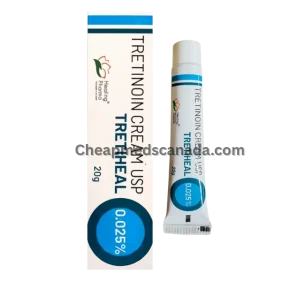
- Versus tretinoin: trifarotene's selectivity for the RAR-γ receptor is thought to give it a more targeted acne effect, though tolerance varies by individual
- Versus adapalene: adapalene is available over the counter at lower strengths and tends to be gentler, often used as a starting point before stepping up to prescription strength
- Versus isotretinoin: an oral medication reserved for more severe, treatment-resistant acne, with a different risk and monitoring profile; Aklief is a topical option for milder to moderate cases
None of this replaces an individual assessment — acne treatment is often a process of finding what a particular person's skin tolerates, sometimes over more than one attempt.
Is Aklief cream more expensive than other acne treatments?
Aklief is a newer prescription retinoid and is generally more expensive than older generic acne medications. However, purchasing it through a Canadian pharmacy may help reduce the overall cost compared with prices in some other countries.
How long does it take to see results from Aklief cream?
Some skin irritation is common during the first 2 to 4 weeks of treatment. Noticeable improvement in acne usually develops after 8 to 12 weeks of consistent daily use.
Why does my acne look worse after starting Aklief?
A temporary worsening of acne, sometimes called "purging," can occur as Aklief increases skin cell turnover. This is a common early treatment response and usually improves with continued use and proper moisturizing.
Can Aklief cream be used on the body as well as the face?
Yes. Aklief is approved for treating acne on the face, chest, shoulders, and back, making it suitable for both facial and truncal acne when used as directed.
Do I need a prescription to buy Aklief cream?
Yes. Aklief is a prescription-only topical retinoid and is not available over the counter. A valid prescription from a licensed healthcare provider is required.
Aklief Cream is a prescription medication and should be used only under the supervision of a qualified healthcare professional. Apply exactly as directed and avoid excessive sun exposure during treatment. This information is provided for educational purposes only and is not a substitute for professional medical advice, diagnosis, or treatment.
Reviews
There are no reviews yet.