
Description
What Is Vagifem and Who Is It For?
Menopause is one of those chapters of life that nobody really prepares you for fully. Hot flashes and mood changes get talked about a lot — but the vaginal symptoms? Those tend to get brushed under the rug, even though they're incredibly common and genuinely disruptive to daily life and intimacy.
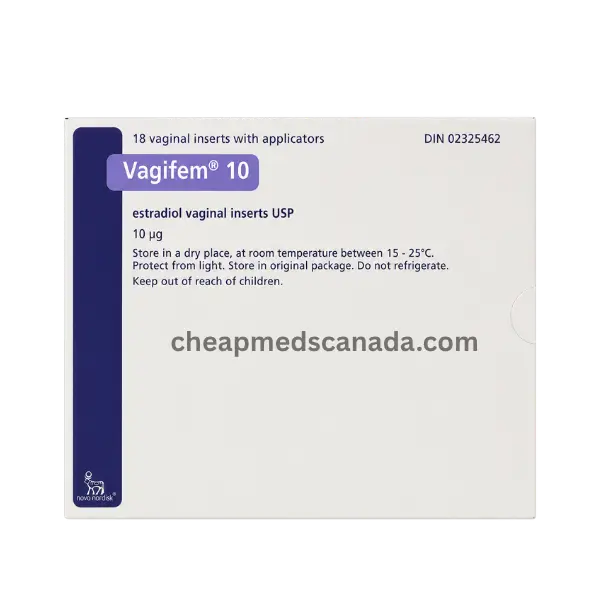
Vagifem is a prescription vaginal insert designed specifically for postmenopausal women dealing with these localized symptoms. When estrogen levels drop after menopause, the tissues of the vagina gradually lose moisture, elasticity, and thickness. That process — medically called vaginal atrophy or genitourinary syndrome of menopause (GSM) — is what Vagifem addresses directly.
The key thing about Vagifem is how targeted it is. Rather than flooding your whole system with hormones through a pill, patch, or injection, it works locally. The insert dissolves right where it's needed, releasing a low dose of estradiol (10 mcg) into the vaginal tissue. Very little of that estrogen makes it into the broader bloodstream, which is a meaningful distinction when it comes to safety — especially for women who want the benefits of local estrogen therapy without the risks associated with systemic HRT.
Vagifem is approved by both the FDA (United States) and Health Canada for postmenopausal women experiencing moderate to severe vaginal symptoms including dryness, burning, irritation, and painful intercourse.
What Does Vagifem Treat?
Vagifem 10 mcg is used to treat the vaginal symptoms of menopause, specifically:
- Vaginal dryness — one of the most common complaints after menopause, caused by thinning and reduced moisture in the vaginal lining
- Vaginal burning and irritation — the uncomfortable day-to-day friction and discomfort that comes with atrophied tissue
- Painful intercourse (dyspareunia) — thinning vaginal walls and lack of lubrication make sex painful for many postmenopausal women
- Vaginal itching — persistent irritation from tissue that's become thin and fragile
- Urinary discomfort — some urinary symptoms related to the same tissue changes also respond to local estrogen therapy, though this varies from person to person
These symptoms don't improve on their own without intervention. In fact, they tend to get worse over time if left untreated, because the drop in estrogen that causes them is permanent after menopause.
How Vagifem Works
Estradiol is the most biologically active form of natural estrogen the body produces. Before menopause, the ovaries make it in substantial amounts. After menopause, that production drops sharply — and the vaginal tissue, which depends on estrogen to stay healthy, starts to thin, dry out, and lose flexibility.
Vagifem delivers a precisely measured 10 mcg dose of estradiol directly to the vaginal tissue through a small, pre-loaded applicator. Once inserted, the tablet dissolves and the estradiol is absorbed locally. It essentially tops up the estrogen supply in exactly the area that needs it, encouraging the vaginal lining to thicken, produce more natural moisture, and restore a healthier pH balance.
Because the dose is so small and the delivery is so local, systemic absorption is minimal — meaning the rest of your body is exposed to very little of the estrogen. This is precisely why vaginal estrogen therapy is generally considered safer than systemic HRT options for women who only need to address vaginal symptoms.
Most women start noticing some improvement within the first few weeks, though noticeable relief from the main symptoms typically comes between 8 and 12 weeks of consistent use.
Vagifem 10 Mcg Dosage — How to Use It
Getting the application right takes a few tries at first, but it becomes straightforward quickly. Here's what the standard protocol looks like:
Initial two weeks (loading dose): Insert one Vagifem tablet into the vagina once daily for 14 consecutive days.
Maintenance dose (ongoing): After the first two weeks, reduce to one insert twice per week — typically on two set days (for example, Tuesday and Saturday) to keep the schedule consistent.
How to insert correctly:
- Wash your hands thoroughly before handling the applicator
- Remove the Vagifem insert pre-loaded in its single-use applicator from the packaging
- Find a comfortable position — lying on your back with knees bent, or standing with one foot raised works for most people
- Hold the applicator and gently slide the narrow end into the vagina as far as it goes comfortably — similar to inserting a tampon
- Press the plunger at the other end to release the tablet inside the vagina
- Dispose of the applicator — it's single use and shouldn't be reused
- Wash your hands again after
Timing: Vagifem can be used at any time of day, though many women find bedtime most convenient — inserting it while lying down reduces the chance of the tablet being displaced before it has a chance to dissolve fully.
Missing a dose: If you miss a dose on your scheduled day, insert it as soon as you remember — but skip it if it's almost time for your next scheduled day and just carry on from there. Never insert two tablets to compensate for a missed one.
Pros and Cons of Vagifem — An Honest Look
This is something a lot of women want to know before they start, and it's worth laying out clearly rather than glossing over either side.
Pros of Vagifem
- Targeted, local treatment — works directly in the vaginal tissue rather than affecting the whole body, which reduces systemic exposure to estrogen
- Low dose — at 10 mcg, Vagifem is among the lowest-dose estrogen options available for vaginal symptoms
- Minimal systemic absorption — blood estrogen levels stay near menopausal baseline, which is reassuring for women concerned about HRT risks
- Clinically proven — decades of research and widespread use back its effectiveness for vaginal atrophy
- Discreet and easy to use — the pre-loaded applicator makes each use simple and self-contained
- Doesn't interfere with most daily medications — because so little estrogen enters the bloodstream, interactions with other medications are rare
- Available in Canada — widely prescribed and covered by many provincial drug plans
- No mess — unlike creams or rings, the insert dissolves cleanly without residue
Cons of Vagifem
- Requires consistent use — this isn't a one-and-done treatment; it needs to be used on an ongoing, long-term basis to maintain results, because symptoms return when you stop
- Prescription only — you can't pick it up over the counter; a doctor's visit and prescription are required
- Applicator irritation in some women — particularly those with more severe atrophy, inserting the applicator can occasionally cause mild vaginal irritation, especially in the early weeks
- Not for systemic symptoms — Vagifem only addresses vaginal and some urinary symptoms; it doesn't help with hot flashes, sleep disruption, or mood changes, which require systemic HRT
- Cost — without insurance coverage, the ongoing cost of twice-weekly inserts adds up over time
- Not suitable during pregnancy — Vagifem is for postmenopausal women only
- Women with a uterus may need additional monitoring — while the risk with local vaginal estrogen is considered low, women with an intact uterus should discuss endometrial monitoring with their doctor
Vagifem Side Effects — What to Know
Common Vagifem Side Effects
Most side effects people experience are mild and often settle down as the body adjusts. The ones reported most often include:
- Headache
- Breast tenderness or discomfort
- Irregular vaginal bleeding or spotting (especially in the early weeks)
- Nausea
- Abdominal bloating or cramping
- Hair thinning
- Mild fluid retention
- Vaginal yeast infection
- Back pain
- Diarrhea
These don't affect every woman and they tend to be most noticeable during the initial loading dose phase.
Serious Side Effects — Contact Your Doctor Promptly
While serious side effects are uncommon with local vaginal estrogen at this dose, they're important to know about. Get in touch with your healthcare provider right away if you experience:
- New or unexplained vaginal bleeding (especially after periods have stopped)
- Breast lumps or changes
- Sudden vision changes, blurred vision, or speech difficulties
- Severe or new headaches, particularly with any neurological symptoms
- Chest pain, shortness of breath, or pain in the legs — these could indicate blood clot issues
- Signs of stroke — sudden numbness, weakness on one side of the body, sudden confusion
- Yellowing of the skin or eyes (jaundice)
These are rare with a locally applied, ultra-low-dose product like Vagifem, but they align with known risks of estrogen therapy and shouldn't be ignored if they occur.
A Note on Cancer Risk
The concern about estrogen and cancer — particularly endometrial and breast cancer — is something many women ask about. It's a fair question. Most of the elevated risk associated with estrogen therapy applies to systemic HRT (pills, patches, injections), where estrogen circulates throughout the body at significantly higher concentrations.
Vagifem 10 mcg, at its ultra-low local dose, has not been shown to meaningfully raise estradiol levels in the blood beyond normal menopausal levels. Clinical data suggests the endometrial and breast cancer risks associated with systemic estrogen do not apply in the same way to low-dose vaginal preparations like Vagifem. That said, any woman with a personal or strong family history of hormone-sensitive cancers should discuss this carefully with her doctor before starting.
Who Should NOT Use Vagifem
Vagifem is not appropriate for everyone. Do not use it if you:
- Are pregnant or trying to become pregnant — Vagifem is for postmenopausal women only
- Have undiagnosed vaginal bleeding — always get unusual bleeding investigated before starting estrogen
- Have a history of breast cancer, uterine/cervical cancer, or other hormone-sensitive cancers
- Have liver disease or liver function test abnormalities
- Have a history of heart attack, stroke, or blood clot (including deep vein thrombosis or pulmonary embolism)
- Have a blood clotting disorder (such as protein C or protein S deficiency)
- Have untreated endometrial hyperplasia
- Are allergic to estradiol or any ingredients in Vagifem (including lactose monohydrate, hypromellose, maize starch, magnesium stearate, or polyethylene glycol 6000)
Drug Interactions
Because Vagifem acts locally with minimal systemic absorption, its interaction profile is much simpler than oral estrogen products. Still, a few things are worth flagging:
- Other vaginally applied treatments — using Vagifem alongside other vaginal creams, lubricants, or medications may affect how well the insert dissolves and how effectively the estradiol absorbs. Always ask your doctor or pharmacist before combining vaginal products.
- Grapefruit and grapefruit juice — known to interfere with how the body processes estradiol; it's best avoided while using any estrogen-containing medication
- Smoking — while the systemic risk with vaginal estrogen is lower than with pills or patches, smoking still increases cardiovascular risk and interacts poorly with estrogen therapy in general
The list of potential interactions is considerably shorter than for oral HRT because so little estrogen enters the bloodstream — but always disclose every medication and supplement you take to your prescriber before starting.
Vagifem in Canada — What You Should Know
Vagifem is available by prescription across Canada and is covered under many provincial drug formularies, though coverage specifics vary by province and individual drug plan. It's manufactured by Novo Nordisk and sold in Canada under the same Vagifem brand name.
Canadian prescribing guidelines support the use of low-dose vaginal estrogen therapy like Vagifem as a first-line treatment for localized vaginal symptoms of menopause — particularly in women who don't require or want systemic HRT for other menopausal symptoms.
If you're ordering through a licensed Canadian online pharmacy, a valid Canadian prescription is required. The inserts are typically shipped in their original tamper-evident packaging.
Vagifem vs Other Vaginal Estrogen Options
| Status | Vagifem 10 mcg | Premarin Vaginal Cream | Estring (Vaginal Ring) | Imvexxy |
|---|---|---|---|---|
| Form | Pre-loaded insert/tablet | Cream with applicator | Flexible silicone ring | Soft capsule insert |
| Active ingredient | Estradiol 10 mcg | Conjugated estrogens | Estradiol 7.5 mcg/day | Estradiol 4 or 10 mcg |
| Application | Every day x 2 weeks, then twice weekly | Typically daily or cyclically | Replaced every 90 days | Same schedule as Vagifem |
| Applicator required | Yes (pre-loaded, single use) | Yes (reusable) | No | No |
| Mess factor | None — dissolves cleanly | Can be messy | None | None |
| Prescription | Yes | Yes | Yes | Yes |
All of these are effective options — the differences come down to personal preference, convenience, and what your doctor recommends based on your health history.
Storage Instructions
- Store at room temperature, between 15°C and 30°C
- Keep away from direct sunlight and heat
- Do not freeze
- Keep in original packaging — the individual applicators are sealed for a reason; don't remove them early
- Store out of reach of children
- Check the expiry date before each use — do not use expired inserts
- Return unused or expired medication to your local pharmacy for proper disposal
How long does Vagifem take to work?
Some women notice improvement within 2 to 4 weeks of starting Vagifem. However, the greatest relief from vaginal dryness, burning, and discomfort during intercourse often develops after 8 to 12 weeks of regular use. Continue using the medication as prescribed before evaluating its full effect.
Do I need to use Vagifem long-term?
For many women, yes. Vaginal atrophy is a long-term condition that can return after treatment is stopped. Your doctor will review your symptoms regularly and advise how long you should continue using Vagifem.
Can I use Vagifem if I have had breast cancer?
Possibly, but only under the guidance of your oncologist or healthcare provider. Vagifem contains a very low dose of vaginal estrogen, and while systemic absorption is minimal, the decision to use it depends on your medical history and cancer treatment.
Can I use Vagifem with vaginal lubricants?
Yes. Water-based lubricants are generally safe to use with Vagifem. However, it is best to allow the vaginal tablet to dissolve completely before applying other vaginal products. If you are unsure which lubricant is appropriate, ask your pharmacist or doctor.
Will Vagifem affect my partner during intercourse?
No. Vagifem delivers a very small amount of estradiol directly to the vaginal tissues, and there is no evidence of meaningful transfer to a sexual partner during intercourse.
Is there a generic version of Vagifem available in Canada?
Yes. Generic estradiol vaginal inserts are available in Canada and contain the same active ingredient and strength as Vagifem. They are considered therapeutically equivalent to the brand-name product.
Can I use Vagifem if I still have my uterus?
Yes. Many women with an intact uterus use Vagifem safely. Because the medication has very low systemic absorption, the risk to the uterine lining is much lower than with systemic estrogen therapy, but your doctor may recommend periodic monitoring.
What should I do if the Vagifem applicator feels uncomfortable to use?
Some discomfort can occur when starting treatment, especially if vaginal tissues are very dry or thin. Try inserting the applicator while relaxed and follow the instructions carefully. If discomfort continues after several weeks, speak with your doctor about alternative treatment options.
Vagifem is a prescription medication and should only be used under the supervision of a qualified healthcare professional. Follow your prescribed treatment plan and report any unusual vaginal bleeding, breast changes, or allergic reactions to your doctor. This information is for educational purposes only and is not a substitute for professional medical advice, diagnosis, or treatment.


Reviews
There are no reviews yet.