
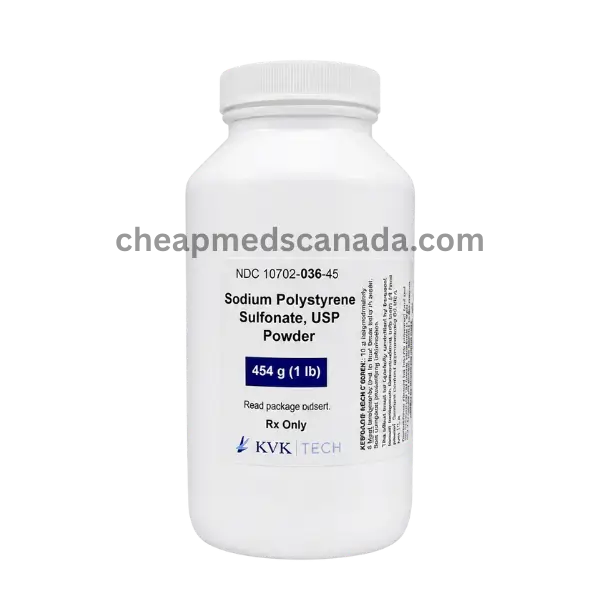
Description
Kayexalate (Sodium Polystyrene Sulfonate): The Warning That Changed How This Drug Is Used
Kayexalate has been used to treat high potassium levels for decades, but its safety profile shifted significantly in 2009, when the FDA added a warning that changed standard practice around how it's given. If you're taking or administering this medication, this is the single most important thing to understand about it.
Quick Reference
| Detail | Information |
|---|---|
| Active ingredient | Sodium polystyrene sulfonate |
| Drug class | Potassium binder (cation-exchange resin) |
| Used for | Hyperkalemia (elevated blood potassium) |
| Forms | Oral powder, oral suspension |
| Manufacturer | Sanofi Aventis (brand: Kayexalate); generic (Solystat, Pendopharm) |
The Warning: Sorbitol and Intestinal Necrosis
Kayexalate was historically often mixed with sorbitol, a laxative, specifically to counteract the constipation the resin itself tends to cause. That combination seemed logical — until case reports began linking it to intestinal necrosis, a serious and sometimes fatal breakdown of intestinal tissue, along with bleeding, ischemic colitis, and bowel perforation.
In 2009, the FDA issued a formal warning against combining Kayexalate with sorbitol, and current prescribing information explicitly states that concomitant use is not recommended due to this risk. It's worth being clear about something the warning itself makes clear too: intestinal necrosis has also been reported in cases without sorbitol involved, particularly in patients with impaired bowel motility, recent GI surgery, or other risk factors — so avoiding sorbitol reduces risk, but doesn't eliminate the need for caution around bowel function generally.
What this means practically: if a pharmacy or hospital is still using a pre-mixed sorbitol-Kayexalate formulation, that's worth specifically asking about. Confirm with your doctor or pharmacist that you're not receiving this combination, and flag any severe abdominal pain, distension, or bleeding immediately rather than assuming it's ordinary constipation.
Two More Safety Details Worth Knowing
Aspiration risk: Cases of bronchitis or bronchopneumonia caused by inhaling sodium polystyrene sulfonate particles have been reported, particularly in patients with an impaired gag reflex, altered consciousness, or a tendency to regurgitate. This is specifically why the medication should be taken sitting upright, not lying down.
Timing with other medications: Kayexalate can bind to other oral medications in the gut, reducing how well they're absorbed. The standard guidance is to take other oral medications at least 3 hours before or after Kayexalate — patients with gastroparesis (delayed stomach emptying) may need an even longer separation, sometimes up to 6 hours.
How It Works
Sodium polystyrene sulfonate is a cation-exchange resin — a compound designed to trade one type of charged particle for another as it moves through the gut. In this case, it releases sodium and picks up potassium in exchange, binding that excess potassium in the intestine so it gets eliminated through stool rather than absorbed into the bloodstream. It's a mechanical exchange process rather than something that affects the kidneys or hormones directly, which is part of why it works even in patients whose kidneys aren't functioning well enough to clear potassium on their own.
How to Take It
- Shake the oral suspension well before each use.
- If using the powder, mix it thoroughly with clean water as directed before taking it.
- Use the specific measuring device provided or prescribed — not a regular kitchen spoon, since dosing accuracy matters here.
- Typical frequency is 1 to 4 times daily, as directed by your doctor.
- Take while sitting upright.
- Don't use potassium supplements without your doctor's specific input, since that works directly against the medication's purpose.
One more detail from the prescribing information: Kayexalate shouldn't be heated, as heat can alter the resin's exchange properties and reduce its effectiveness.
Side Effects
Common:
- Constipation
- Nausea and vomiting
Serious — contact your doctor right away:
- Irregular heartbeat
- Muscle spasms
- Severe abdominal pain or swelling
- Severe constipation
Seek emergency care immediately for:
- Signs of an allergic reaction
- Any signs suggesting intestinal necrosis — severe abdominal pain, distension, rectal bleeding, or signs of shock
Who Needs to Flag Their History First
- History of intestinal disorders — inflammatory bowel disease, intestinal obstruction, ulcers
- Kidney problems
- Liver disease
- History of depression or seizures
- Pregnancy or plans to become pregnant
- Breastfeeding or plans to breastfeed
Sodium polystyrene sulfonate doesn't pass into breast milk in a way that's expected to harm a nursing infant, though it's still worth confirming with your doctor before breastfeeding. It's not intended for use in children.
Drug Interactions
| Combined With | The Concern |
|---|---|
| Sorbitol | Increased risk of intestinal necrosis — not recommended |
| Cation-donating antacids (aluminum, calcium, magnesium-containing) | May reduce the resin's potassium-binding capability, raising the risk of systemic alkalosis |
| Digitalis (digoxin) | Low potassium can worsen digitalis's effects on heart rhythm, even when digoxin levels appear normal |
| Other oral medications generally | Absorption can be reduced if taken too close to a Kayexalate dose — separate by at least 3 hours |
A Note on Severe, Rapid Hyperkalemia
Kayexalate lowers potassium gradually — its effect can take hours to days to fully develop. For hyperkalemia severe enough to be a medical emergency, or situations involving rapid tissue breakdown (like burns or acute renal failure), Kayexalate alone may not act fast enough, and other measures — including dialysis — are typically considered alongside or instead of it.
Should I be concerned about the sorbitol warning with Kayexalate?
The sorbitol warning mainly applies to certain pre-mixed formulations of Kayexalate. Your doctor or pharmacist can tell you whether your product contains sorbitol. Do not use sorbitol-containing laxatives unless your healthcare provider specifically advises you to do so.
Why do I need to separate Kayexalate from my other medications?
Kayexalate can bind to certain medications in the digestive tract and reduce how well they are absorbed. To help prevent interactions, take other oral medications at least 3 hours before or after Kayexalate, or longer if your doctor recommends it.
How long does Kayexalate take to lower potassium levels?
Kayexalate works gradually, and it may take several hours to days to significantly lower potassium levels. It is not intended as the sole treatment for a life-threatening high potassium emergency.
Can I take potassium supplements while using Kayexalate?
No. Potassium supplements should only be taken if your doctor specifically instructs you to do so. Since Kayexalate is prescribed to reduce high potassium levels, taking extra potassium could interfere with your treatment.
Kayexalate is a prescription medication and should only be used as directed by a qualified healthcare provider. Regular monitoring of electrolyte levels is recommended during treatment. This information is not a substitute for professional medical advice.



Reviews
There are no reviews yet.