
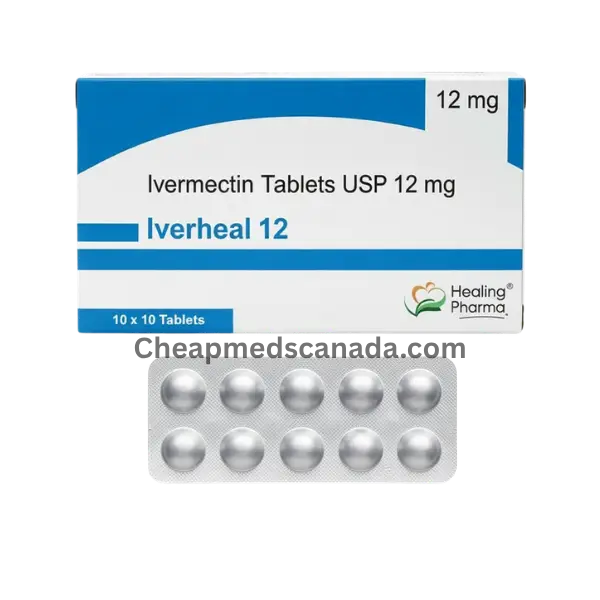
Description
Why 12 mg — Not 3 mg or 6 mg?
This question comes up constantly, and it deserves a clear answer.
Ivermectin is not prescribed in a flat dose. The amount needed depends entirely on how much a person weighs. The standard treatment dose for most conditions is 200 micrograms per kilogram of body weight.
Do the math for an average adult:
- Someone weighing 55 kg needs approximately 11 mg → 2 tablets of 6 mg, or close to 1 tablet of 12 mg
- Someone weighing 65 kg needs approximately 13 mg → 1 tablet of 12 mg plus a small supplementary dose
- Someone weighing 80 kg needs approximately 16 mg → 1 tablet of 12 mg plus additional
The 12 mg tablet exists to make this weight-based dosing practical. Instead of asking a patient to swallow four 3 mg tablets or two 6 mg tablets, one 12 mg tablet handles the bulk of the calculation — with fewer tablets, fewer errors, and better compliance.
What Iverheal 12 mg Actually Treats
Strongyloidiasis — The Worm That Refuses to Leave
Strongyloides stercoralis is, without exaggeration, one of the most underestimated parasitic worms in medicine. It infects through the skin — walking barefoot on contaminated soil is enough. Once inside, it travels to the small intestine and begins reproducing.
Here is the part that separates it from other intestinal parasites: it can reinfect the same host from inside. Larvae produced in the gut penetrate back through the intestinal wall, re-enter the bloodstream, and restart the cycle. This is called autoinfection — and it means the worm can survive inside one person for decades without them ever getting reinfected from an outside source.
Mild cases cause vague symptoms — occasional stomach discomfort, intermittent diarrhea, a mysterious rash that appears and vanishes. Severe disseminated cases, especially in people on steroids or chemotherapy, can be fatal. The infection spreads to the lungs, liver, heart, and brain.
A single weight-based dose of Iverheal 12 mg clears the intestinal infection. Clinical trials report cure rates of 64% to 100% following one dose. A follow-up stool examination 2 to 4 weeks later confirms whether the infection is gone.
Onchocerciasis — A Disease That Steals Sight Slowly
River blindness affects millions of people across sub-Saharan Africa, parts of Latin America, and Yemen. The cause — Onchocerca volvulus — is a filarial worm transmitted by blackflies that breed in fast-flowing rivers.
Adult worms live beneath the skin for up to 15 years, producing millions of microscopic larvae called microfilariae. These larvae migrate through the skin constantly. When they reach the eyes — and they do — the body's immune response to the larvae causes cumulative, irreversible damage. First comes itching and light sensitivity. Then clouding. Eventually, complete blindness.
Iverheal 12 mg kills the larvae but cannot touch the adult worms — they are embedded too deeply in subcutaneous tissue. This is why treatment must continue every 6 to 12 months for years. Stopping early allows larval levels to rebuild and the damage resumes.
Scabies — Including the Form Most Treatments Cannot Reach
Ordinary scabies involves a small colony of mites — typically 10 to 15 — that burrow into the outer skin layer to lay eggs. The hallmark symptom is intense itching, worst at night, caused by an allergic reaction to the mites and their waste products rather than the mites themselves.
Oral ivermectin is prescribed for scabies when:
- The rash covers a large area of the body
- Topical treatment has been tried and failed
- Multiple household members need treating simultaneously — oral medication is far more practical than applying cream to an entire household
- Crusted (Norwegian) scabies is present — a severe form where immune suppression allows mite populations to explode into the hundreds of thousands or millions, creating thick skin crusts that topical creams cannot penetrate
Head Lice — When the Usual Treatments Stop Working
Head lice resistance to pyrethroid-based shampoos and lotions has been well-documented for years. In many regions, a significant proportion of lice populations are now resistant to over-the-counter treatments. Patients and parents who have gone through two or three failed topical treatments often feel like they have run out of options.
They have not. A single oral dose of Iverheal 12 mg, repeated after 10 days to catch any newly hatched lice, consistently breaks resistant infestations without any topical application at all.
Lymphatic Filariasis
Caused by mosquito-transmitted worms including Wuchereria bancrofti, lymphatic filariasis leads to the blockage of lymphatic vessels. In advanced cases, it causes the extreme swelling known as elephantiasis. Iverheal 12 mg is used as part of combination treatment programs — typically alongside albendazole — to kill the circulating microfilariae.
Dosage — The Numbers, Clearly Laid Out
Standard Dose for Strongyloidiasis, Scabies, Head Lice: 200 mcg of ivermectin per kg of body weight — single oral dose
Standard Dose for Onchocerciasis: 150 mcg of ivermectin per kg of body weight — single oral dose, repeated every 6 to 12 months
| Body Weight | Dose Required (200 mcg/kg) | Iverheal 12 mg Tablets |
|---|---|---|
| 36 – 50 kg | ~9 mg | 1 tablet (discuss with doctor) |
| 51 – 65 kg | ~12 mg | 1 tablet |
| 66 – 79 kg | ~15 mg | 1 tablet + Iverheal 3 mg |
| 80 – 99 kg | ~18 mg | 1 tablet + Iverheal 6 mg |
| 100 kg + | Doctor calculates | As prescribed |
These figures are reference points. Your doctor confirms the exact number of tablets based on your weight and condition at the time of prescription.
How to Take Iverheal 12 mg — The Right Method
This matters more than most patients realize. The absorption of ivermectin changes significantly based on what is in the stomach when the tablet is taken.
The correct sequence:
Step 1 — Make sure your stomach is completely empty. This means at least 1 to 2 hours after your last meal — or take it first thing in the morning before eating anything.
Step 2 — Swallow the tablet whole. Do not break it, crush it, or chew it. Take it with a full glass of water — at least 250 ml.
Step 3 — Wait at least 1 hour before eating anything after the dose. Water is fine; food is not.
Step 4 — If your prescribed dose involves more than one tablet — take all of them at the same time. Splitting the dose across different hours of the day is not the correct method.
What to avoid on the day of taking Iverheal 12 mg:
- Alcohol — worsens dizziness and nausea significantly
- Grapefruit or grapefruit juice — interferes with liver enzyme activity and alters ivermectin blood levels
- High-fat meals — fat dramatically increases ivermectin absorption, pushing blood levels beyond the therapeutic range
- Driving or operating heavy machinery — dizziness can impair reaction time for several hours after dosing
Side Effects — A Realistic Assessment
Mild — Typically Settle Within 24 to 48 Hours:
Most people who take Iverheal 12 mg correctly experience minimal side effects. When reactions do occur, they are usually:
- Headache — the most commonly reported side effect
- Dizziness or lightheadedness, particularly when standing quickly (orthostatic hypotension)
- Nausea or mild stomach discomfort
- Loose stools or mild diarrhea
- Muscle aches
- Fatigue or drowsiness on the day of dosing
- Mild itching or rash — often a sign the medication is working as parasites die off
The Mazzotti Reaction — River Blindness Patients Only:
Patients being treated for onchocerciasis should know about this reaction before taking the tablet. As ivermectin kills large numbers of microfilariae quickly, the body's immune system responds to the mass die-off. This causes a distinct set of symptoms in the first 1 to 4 days:
- Fever and chills
- Intense, widespread skin itching
- Swollen and tender lymph nodes
- Redness and swelling of the eyes
- Joint and muscle pain
- Rapid heartbeat
- Low blood pressure in more severe cases
This is not an allergic reaction to the tablet — it is the immune system reacting to dead parasite material. It fades on its own within a few days. Your doctor may prescribe antihistamines or a mild anti-inflammatory to manage the symptoms. Do not stop the medication without calling your doctor first.
Go to Emergency Care Immediately If You Experience:
- Seizures
- Severe confusion or loss of consciousness
- Swelling of the face, lips, or throat
- Difficulty breathing
- Skin blistering or peeling
- Sudden significant vision changes
Who Should Not Take Iverheal 12 mg
People with known ivermectin allergy Previous allergic reactions to ivermectin — in any formulation, topical or oral — rule out the use of Iverheal 12 mg.
Patients co-infected with Loa loa This is the most critical safety warning. Patients from Central and West African regions where Loa loa is endemic face a serious risk of encephalopathy — brain inflammation — if given ivermectin while carrying high microfilarial loads. Documented cases have resulted in coma and permanent neurological damage. Loa loa screening before prescribing is not optional in at-risk populations.
Pregnant women Not recommended. Use only when the doctor determines that the untreated infection poses a greater risk to the patient than the medication does.
Children under 15 kg Safety has not been established in very small children. Minimum weight of 15 kg is required.
People with significant liver disease Ivermectin is processed by the liver. Impaired liver function can lead to drug accumulation and increased side effect risk.
Immunocompromised patients People on long-term steroids, chemotherapy, or living with HIV may need multiple treatment courses and closer follow-up. A single dose may be insufficient to fully clear the infection.
Drug Interactions Worth Knowing
Before taking Iverheal 12 mg, tell your doctor if you are currently taking:
- Warfarin — ivermectin increases its blood-thinning effect. INR levels must be monitored closely if both are used together.
- Macrolide antibiotics (azithromycin, erythromycin, clarithromycin) — these can raise ivermectin concentration in the blood.
- Anti-seizure medications — some interactions with ivermectin metabolism have been reported.
- Cyclosporine or tacrolimus — immunosuppressants that may interact with drug processing.
- St. John's Wort — this herbal supplement can reduce ivermectin effectiveness by accelerating its breakdown.
This list is not exhaustive. Give your doctor and pharmacist a complete picture of everything you take — prescription, over-the-counter, supplements, and herbal products.
Iverheal 12 mg vs Other Ivermectin Brands — Is There a Difference?
A common question: is Iverheal 12 mg the same as Ivecop 12 mg, Ivermac 12 mg, or other brand-name ivermectin tablets?
The answer is yes — with a qualification. All brands containing 12 mg of ivermectin have the same active ingredient at the same dose. The mechanism of action, the conditions treated, and the general safety profile are identical.
What differs is the manufacturer, the excipients (inactive ingredients in the tablet), and the quality control standards of each company. Healing Pharma, which makes Iverheal, is a reputable Indian pharmaceutical manufacturer with international export approvals. For patients concerned about brand quality, checking the manufacturer's certifications is always a reasonable step.
Storage Instructions
- Temperature: Below 30°C — room temperature storage is fine
- Light: Away from direct sunlight
- Moisture: Keep away from humidity — bathroom cabinets are not ideal
- Packaging: Leave tablets in the original blister pack until use
- Children: Store in a location completely inaccessible to children and pets
- Expiry: Check the date on the pack before every use. Do not use expired medication under any circumstances.
The itching got worse after taking Iverheal 12 mg. Should I be worried?
Usually not. Temporary worsening of itching can occur after treatment, especially for scabies, as the body reacts to dead mites and parasite debris. Symptoms generally improve over the following weeks.
Can Iverheal 12 mg be taken with food to reduce nausea?
Iverheal 12 mg is typically taken on an empty stomach with water. Food, particularly high-fat meals, may affect how the medication is absorbed. Speak with your doctor if nausea is a concern.
Can I use Iverheal 12 mg for my pet's parasite treatment?
No. Iverheal 12 mg is formulated specifically for human use and should never be used as a substitute for veterinary medications.
How long does ivermectin stay in the body after one dose?
Ivermectin remains active in the body for several days after administration. The exact duration varies between individuals and depends on factors such as metabolism and the condition being treated.
Can I buy Iverheal 12 mg without a prescription?
In many countries, ivermectin tablets require a valid prescription. Always obtain medication from a licensed healthcare provider and reputable pharmacy.
The information provided on this page is intended for general educational and informational purposes only and should not be considered medical advice, diagnosis, or treatment. Iverheal 12 Mg contains Ivermectin, a prescription medication that should be used only under the supervision of a qualified healthcare professional.
Before taking Iverheal 12 Mg, consult your doctor to determine whether it is appropriate for your condition. Your healthcare provider should be informed about any existing medical conditions, allergies, or medications you are currently taking to help avoid potential interactions or complications.

Reviews
There are no reviews yet.