
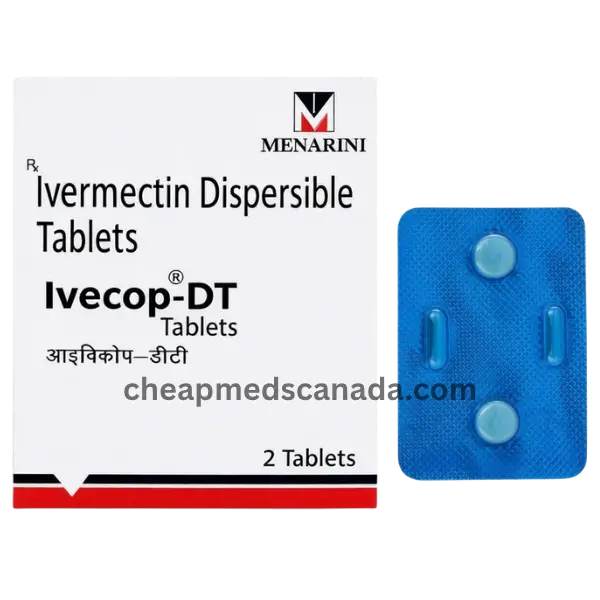
Description
Why Ivecop 3 mg Specifically Exists
Most people do not realize ivermectin comes in multiple strengths — 3 mg, 6 mg, and 12 mg — and the reason is simple math.
Ivermectin dosing is calculated by body weight. The standard dose for most infections is 200 micrograms per kilogram of body weight. For a child weighing 25 kg, that works out to just 5 mg total. For an adult weighing 50 kg, it is 10 mg. The 3 mg tablet exists so that doctors can prescribe precise doses — especially for children and lighter adults — without having to cut larger tablets.
This is not a weaker version of Ivecop 6 mg or 12 mg. It contains the same active ingredient at the same quality — the dose is simply smaller to allow accurate weight-based dosing.
What Ivecop 3 mg Treats
Strongyloidiasis — Intestinal Roundworm Infection
Strongyloides stercoralis is a roundworm that lives in the small intestine. Unlike most intestinal parasites that are swallowed as eggs, this worm has the ability to re-infect the same person from within — a process called autoinfection. This means without treatment, the infection can persist for decades.
Symptoms are often mild or completely absent for years — occasional stomach discomfort, mild diarrhea, skin rash in the areas where larvae travel. In people with a weakened immune system however, the infection can spread throughout the body and become life-threatening.
Ivecop 3 mg treats this infection completely. It is one of the few medications effective against both the intestinal and tissue stages of this worm.
Onchocerciasis — River Blindness
This disease is transmitted through the bite of blackflies that breed near fast-flowing rivers — hence the name. The worm responsible, Onchocerca volvulus, releases millions of larvae (microfilariae) that migrate through the skin and eyes. It is the accumulation of these larvae in the eyes that eventually causes vision loss and blindness.
Ivecop 3 mg kills these microfilariae — not the adult worms — which is why treatment must be repeated every 6 to 12 months for as long as the adult worms remain alive (which can be 10 to 15 years).
Scabies
The mite Sarcoptes scabiei burrows into the outer layer of skin to lay eggs. The result is relentless itching — worst at night — and a distinctive rash in the folds of the skin, between fingers, around the wrists, and on the trunk.
While topical treatments are the first option, oral Ivecop 3 mg is prescribed when:
- The infestation is widespread across the body
- Multiple people in a household need treating at the same time
- Topical treatments have not worked
- The patient has crusted (Norwegian) scabies — a severe form where millions of mites are present
Head Lice
Oral ivermectin has become an important option when over-the-counter lice shampoos and treatments stop working — which happens more often than people expect, due to lice developing resistance to pyrethroids. A single weight-based dose of Ivecop 3 mg, repeated after 10 days, breaks the lice lifecycle effectively.
Ivecop 3 mg Dosage — The Complete Weight Chart
Because each tablet is 3 mg, the number of tablets per dose follows a clear pattern based on body weight.
For Strongyloidiasis (200 mcg/kg — single dose):
| Body Weight | Dose Required | Tablets Needed |
|---|---|---|
| 15 – 24 kg | 3 mg | 1 tablet |
| 25 – 35 kg | 6 mg | 2 tablets |
| 36 – 50 kg | 9 mg | 3 tablets |
| 51 – 65 kg | 12 mg | 4 tablets |
| 66 – 79 kg | 15 mg | 5 tablets |
| 80 kg and above | 200 mcg/kg | As calculated by doctor |
For Onchocerciasis (150 mcg/kg — single dose, repeated every 6–12 months):
| Body Weight | Dose Required | Tablets Needed |
|---|---|---|
| 15 – 25 kg | 3 mg | 1 tablet |
| 26 – 44 kg | 6 mg | 2 tablets |
| 45 – 64 kg | 9 mg | 3 tablets |
| 65 – 84 kg | 12 mg | 4 tablets |
| 85 kg and above | 150 mcg/kg | As calculated by doctor |
These numbers are based on standard clinical guidelines. Your doctor will confirm the exact number for you — do not self-calculate from this chart alone.
How to Take Ivecop 3 mg — The Right Way
The method of taking this tablet directly affects how well it works. These are not optional instructions.
✔ Take on a completely empty stomach — wait at least 1 hour after the last meal before taking it
✔ Swallow whole with a full glass of water — at least 240 ml (roughly one full standard glass)
✔ Do not eat or drink anything except water for 1 hour after taking the tablet
✔ Do not crush, break, or chew — swallowing the tablet intact ensures proper absorption
✔ Take all tablets in the prescribed dose at once — do not split a multi-tablet dose across different times
✔ Avoid grapefruit on the day of the dose — grapefruit can raise ivermectin levels in the blood unpredictably
✔ Avoid alcohol on the day of treatment — it increases the risk of dizziness and nausea
Side Effects — The Full, Honest Picture
Side Effects You Might Experience (Mild — Usually Pass on Their Own):
- Headache — common, usually mild, settles within a few hours
- Dizziness — especially when standing up quickly; move slowly after taking the dose
- Nausea — more likely if taken with food or on a partially full stomach
- Stomach discomfort — mild cramping or bloating that passes within a day
- Loose stools or diarrhea — temporary and usually mild
- Tiredness — some people feel low energy for the rest of the day after dosing
- Mild itching or skin rash — can occur as parasites die and the immune system reacts
Side Effects Specific to Onchocerciasis Treatment — Mazzotti Reaction
Patients being treated for river blindness may experience a distinct set of reactions within the first 1 to 4 days. This is not a drug side effect in the traditional sense — it is the body's immune response to millions of dying microfilariae.
Mazzotti reaction symptoms include:
- Fever and chills
- Intense skin itching and rash
- Swollen, tender lymph nodes
- Swelling and redness of the eyes
- Joint and muscle pain
- Low blood pressure in severe cases
This reaction is expected and is actually a sign the medication is working. It typically settles within a few days. However, if symptoms are severe — particularly eye swelling or very low blood pressure — contact your doctor.
Stop the Medication and Seek Emergency Care If You Notice:
- Seizures or uncontrolled shaking
- Severe confusion or inability to stay awake
- Swelling of the face, lips, or throat
- Difficulty breathing
- Blistering or peeling skin
- Sudden significant vision changes
Who Should Be Extra Careful — Precautions
Children under 15 kg: The safety of ivermectin in very small children has not been well-established. Ivecop 3 mg should only be used in children weighing 15 kg or more.
Pregnant Women: Ivecop 3 mg is not recommended during pregnancy. Limited data exists on its safety for the developing fetus. Use only when a doctor has determined that the risk of the parasitic infection is greater than the potential risk of the medication.
Breastfeeding Mothers: Ivermectin does pass into breast milk, but at low concentrations. Current evidence suggests this does not pose significant risk to the infant. However, consult your doctor before taking it while breastfeeding.
People with Loa loa Co-infection: This is a critical safety point. People from parts of sub-Saharan Africa who may carry Loa loa — a filarial worm that can affect the brain — face a risk of severe neurological complications when given ivermectin. In some cases, this can lead to encephalopathy (brain dysfunction). A Loa loa assessment is essential in these patients before prescribing.
Liver Problems: Ivermectin is processed by the liver. People with significant liver disease may have altered drug levels in the blood. A dose adjustment or extra monitoring may be needed.
Weakened Immune System: People with HIV/AIDS or those on immunosuppressant medications may need more than one round of treatment, since their immune system may not effectively clear the infection after the first dose.
Drug Interactions — What Not to Take Together
Some medications affect how ivermectin works or increase the risk of side effects:
- Warfarin (blood thinner): Ivermectin can increase warfarin's blood-thinning effect, raising the risk of bleeding. INR monitoring is recommended if both are used.
- Macrolide antibiotics (azithromycin, erythromycin): These can raise ivermectin levels in the blood, potentially increasing side effects.
- Anti-epileptic medications: Some seizure drugs interact with ivermectin metabolism.
- Other antiparasitic drugs: Taking multiple antiparasitic agents together without medical supervision is not advisable.
Always give your doctor a full list of everything you are currently taking — including supplements, herbal products, and over-the-counter medications.
Ivecop 3 mg vs Ivecop 6 mg vs Ivecop 12 mg — What Is the Difference?
A question that comes up often — and the answer is simpler than most people expect.
| Feature | Ivecop 3 mg | Ivecop 6 mg | Ivecop 12 mg |
|---|---|---|---|
| Active Ingredient | Ivermectin | Ivermectin | Ivermectin |
| Strength per Tablet | 3 mg | 6 mg | 12 mg |
| Best For | Children, lighter adults | Average weight adults | Heavier adults, fewer tablets |
| Same Conditions Treated? | Yes | Yes | Yes |
| Prescription Required | Yes | Yes | Yes |
The only difference is the amount of ivermectin per tablet. The conditions treated, the mechanism of action, the safety profile — all identical. The right strength to use depends entirely on your weight and how your doctor wants to structure the dose.
Storage Instructions
- Store below 30°C — room temperature is fine
- Keep away from direct sunlight and moisture
- Do not refrigerate or freeze
- Keep in the original blister packaging until use
- Store out of reach of children and pets
- Do not use after the expiry date printed on the pack
Not usually. Temporary worsening of itching can occur as parasites die and the immune system reacts to them. This is especially common when treating scabies. Symptoms generally improve within a few days to a couple of weeks.
The itching got worse after taking Ivecop 3 mg. Is something wrong?
No. Ivecop 3 mg is a prescription medication, and the correct dose depends on your body weight, medical history, and the infection being treated. Always consult a healthcare professional before use.
Can I take Ivecop 3 mg without seeing a doctor first?
Yes. Both contain ivermectin as the active ingredient. The primary difference is the brand name and manufacturer, while the therapeutic effect remains the same.
Is Ivecop 3 mg the same as Stromectol?
Take the missed dose as soon as you remember unless your doctor advises otherwise. Do not take two doses at the same time. If a significant amount of time has passed, contact your healthcare provider for guidance.
What should I do if I miss a follow-up dose?
Ivecop 3 mg is generally recommended on an empty stomach with water. High-fat meals can affect how the medication is absorbed. If nausea is a concern, speak with your doctor before changing how you take it.
Can Ivecop 3 mg be taken with food to reduce nausea?
Ivecop 3 Mg contains Ivermectin and should only be used under the supervision of a qualified healthcare professional. The information provided on this page is for educational purposes only and is not intended to replace medical advice, diagnosis, or treatment.
Always consult your healthcare provider before starting, stopping, or changing any medication. If you experience severe side effects, allergic reactions, vision changes, or unusual symptoms, seek immediate medical attention.

Reviews
There are no reviews yet.