
Description
What Is Atrovent HFA and Who Is It For?
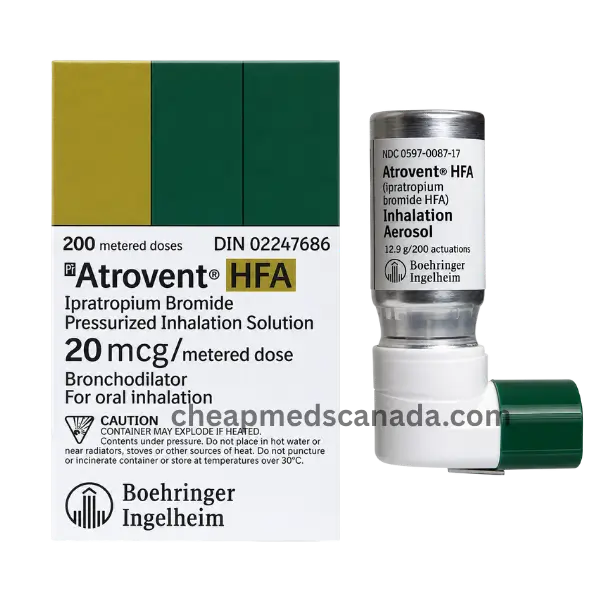
Atrovent HFA is a prescription-only inhaler that helps people with chronic lung disease breathe more freely day to day. The active ingredient, Ipratropium Bromide, works by relaxing the muscles around your airways — not by stimulating them like a [salbutamol or albuterol-based inhaler] does — which makes it a distinctly different tool in managing lung conditions.
It is most commonly prescribed for adults living with Chronic Obstructive Pulmonary Disease (COPD), a category that includes:
- Chronic bronchitis — persistent airway inflammation causing daily cough and mucus production
- Emphysema — progressive damage to the air sacs in the lungs that reduces oxygen exchange
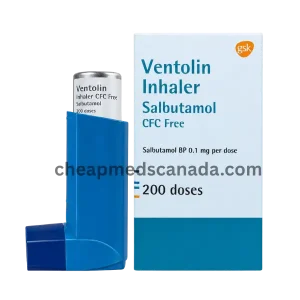
What Atrovent does not do is equally important to understand. It is not a rescue inhaler. If you are reaching for it during an acute shortness-of-breath episode, that is a medical situation requiring a fast-acting [reliever inhaler like Ventolin]. Atrovent is a maintenance medication — taken on a fixed schedule to keep your airways open and prevent symptoms from flaring in the first place.
Canadians diagnosed with COPD are often familiar with this inhaler because Health Canada has approved Ipratropium Bromide as a first-line maintenance bronchodilator for moderate to severe obstructive airway disease. Many provincial drug benefit programs across Ontario, British Columbia, and Alberta include it on their formularies, which speaks to how established and trusted this medication is within Canadian respiratory care guidelines.
How Ipratropium Bromide Actually Works
The science behind the relief:
Your lungs have smooth muscle wrapped around the bronchial tubes. In people with COPD, those muscles tend to contract more than they should — tightening the airways and making every breath feel like work. This tightening is triggered partly by a chemical messenger called acetylcholine, which binds to muscarinic receptors in the airway walls.
Ipratropium Bromide is an anticholinergic agent, meaning it competes with acetylcholine for those same receptors. By blocking them, it prevents the signal that causes the airways to constrict. The result: the smooth muscle relaxes, the bronchial tubes widen, and airflow improves — typically within 15 to 30 minutes of inhalation, with effects lasting 4 to 6 hours.
Unlike beta-2 agonists (the class that includes [salbutamol and formoterol]), Ipratropium acts specifically on the parasympathetic nervous system. This makes it particularly useful for patients who do not respond well to beta-agonists or who benefit from combining both drug types for broader bronchodilation, a combination seen in products like [Combivent, which combines Ipratropium with albuterol].
Because systemic absorption after inhalation is minimal — bioavailability is approximately 7% — the drug acts mostly where it is needed: in the lungs. This is a key reason its side effect profile tends to be more manageable than older oral anticholinergics.
Atrovent HFA Dosage and How to Use the Inhaler Correctly
Getting the right amount of medication into your lungs depends entirely on your technique. Many patients — and studies in Canadian respiratory clinics confirm this — use their inhalers incorrectly, which means the drug deposits in the throat rather than reaching the bronchioles where it is needed.
Standard adult dosage:
- 2 puffs (40 mcg), 3 to 4 times daily
- Maximum: 12 puffs in any 24-hour period
- Doses should be spaced as evenly as possible throughout the day
Step-by-step inhaler technique:
- Remove the mouthpiece cap and shake the inhaler gently
- If using for the first time (or after more than 3 days of non-use), prime the inhaler with 2 test sprays into the air, away from your face
- Breathe out completely to empty your lungs
- Place the mouthpiece in your mouth and seal your lips around it
- Begin inhaling slowly and deeply, then press the canister down to release the spray
- Continue inhaling until your lungs are full
- Hold your breath for approximately 10 seconds, then exhale slowly
- Wait at least 1 minute before taking a second puff
- Replace the cap and store at room temperature
Do not exceed 12 puffs in 24 hours under any circumstances. If you find yourself needing more than your prescribed dose to control symptoms, contact your doctor — this may indicate your COPD is progressing and your treatment plan needs to be reviewed.
For patients using a nebulizer: Ipratropium Bromide is also available as nebuliser solution (0.25 mg/mL). Doses are administered every 6 to 8 hours. [Nebuliser-compatible ipratropium products] may be listed separately on your provincial drug formulary.
Atrovent HFA Side Effects — What to Expect
Like all medications, Atrovent can cause side effects, though not everyone experiences them. Most are mild and related to its anticholinergic properties.
Common side effects (generally manageable):
| Side Effect | Why It Happens | What to Do |
|---|---|---|
| Dry mouth | Anticholinergic effect reduces saliva | Sip water frequently; sugar-free gum can help |
| Bitter or unusual taste | Medication contacts taste buds during inhalation | Normal; improves with correct technique |
| Headache | Mild and transient | Over-the-counter analgesics if needed |
| Dizziness | Rare, mild | Avoid driving until you know your response |
| Throat irritation or cough | Mild airway response | Rinse mouth with water after each dose |
| Nausea | Uncommon | Usually resolves without intervention |
Serious side effects — seek medical attention immediately:
- Paradoxical bronchospasm — if your breathing suddenly becomes worse immediately after using the inhaler, stop using it and call 911 or your local emergency number. This rare reaction requires prompt evaluation
- Eye symptoms — accidental spray in the eyes can cause blurred vision, eye pain, redness, or halos around lights, which may indicate increased intraocular pressure. Rinse immediately with water and seek medical care
- Urinary retention — particularly relevant for men with enlarged prostates; difficulty urinating after starting Atrovent should be reported to your doctor without delay
- Signs of allergic reaction — swelling of the throat, lips, or face; hives; sudden difficulty breathing. This is a medical emergency
These are not the only possible side effects. Always read the Canadian product monograph included with your medication and discuss any concerns with your pharmacist.
Important Warnings Before Starting Atrovent
Before your first dose, your prescribing physician needs a complete picture of your medical history. Be sure to disclose:
- Glaucoma (especially narrow-angle glaucoma) — Atrovent can increase intraocular pressure; extra monitoring may be needed
- Enlarged prostate (benign prostatic hyperplasia) — raises the risk of urinary retention
- Bladder neck obstruction — for similar reasons as above
- Known allergy to atropine or any atropine-like drugs — Ipratropium is structurally related to atropine; cross-sensitivity is possible
- Cystic fibrosis — some patients experience gastrointestinal side effects
- Pregnancy or breastfeeding — Atrovent falls under Pregnancy Category B; use only if clearly necessary under physician guidance
Drug Interactions — Medications That May Not Mix Well With Atrovent
Ipratropium Bromide is generally well tolerated with most COPD medications. In fact, it is commonly prescribed alongside [long-acting beta-agonists (LABAs) like salmeterol] and [inhaled corticosteroids like fluticasone or budesonide] as part of a multi-drug COPD management approach.
However, there are interactions to be aware of:
- Other anticholinergic medications — (including some antihistamines, bladder medications, or antidepressants) — combining them can amplify anticholinergic side effects like dry mouth, urinary retention, and confusion, particularly in older adults
- Diphenhydramine (Benadryl) — has anticholinergic properties and may enhance side effects
- Diuretics like furosemide — no direct interaction, but COPD patients using furosemide for heart failure should be monitored for electrolyte shifts that could affect lung function overall
Always give your pharmacist — whether Canadian or otherwise — a complete list of every medication, supplement, and vitamin you take. Drug interactions are sometimes subtle and take weeks to become apparent.
Atrovent vs. Generic Ipratropium Bromide — Is There a Difference?
This is one of the most common questions patients ask when filling their COPD prescriptions.
The short answer: the active ingredient is identical. Generic Ipratropium Bromide HFA contains the same 20 mcg per actuation dose, uses the same HFA propellant technology, and must meet the same Health Canada bioequivalence standards as the brand-name Atrovent HFA manufactured by Boehringer Ingelheim.
Where generics differ slightly:
- Inhaler device appearance — colour and shape of the plastic actuator may vary
- Inactive ingredients — minor differences in excipients, which is relevant only if you have known sensitivities to specific compounds
- Price — generics are typically significantly less expensive
[Generic Ipratropium Bromide inhalers] are approved by Health Canada and are dispensed by licensed Canadian pharmacies. For patients managing COPD on a long-term basis, the cost savings over months and years can be substantial without any compromise in clinical effectiveness.
Storage and Disposal of Atrovent HFA
Proper storage keeps your inhaler working as it should:
- Store at room temperature — ideally between 15°C and 25°C
- Keep away from direct heat, open flames, and direct sunlight
- Never refrigerate or freeze the canister
- Keep the mouthpiece cap on when not in use to prevent blockages
- Do not puncture or incinerate the canister — it is pressurised and can be dangerous if exposed to excessive heat
- Dispose of the inhaler when the dose counter reaches zero, even if the canister still feels like it has product in it — you may be inhaling propellant without medication at that point
Proper disposal: In Canada, many pharmacies participate in take-back programs for used inhalers. Boehringer Ingelheim also runs an inhaler recycling initiative. Check with your local pharmacy about responsible disposal rather than placing pressurised canisters in household recycling.
Can I use Atrovent HFA during a COPD flare-up or acute attack?
No. Atrovent HFA is not considered a rescue inhaler for sudden breathing emergencies. Acute COPD flare-ups are typically treated with a fast-acting bronchodilator, such as salbutamol, as directed by a healthcare provider. Speak with your doctor to ensure you have an appropriate rescue medication available if needed.
How long does it take for Atrovent to start working?
Many patients begin to notice improved airflow within about 15 minutes after inhalation. Maximum bronchodilation generally occurs within 1 to 2 hours, and the effects typically last for approximately 4 to 6 hours.
Is Atrovent the same as Spiriva?
No. Both medications belong to the anticholinergic bronchodilator class, but they contain different active ingredients. Atrovent contains ipratropium bromide and is short-acting, while Spiriva contains tiotropium bromide and is long-acting. Your doctor will determine which treatment is most appropriate for your condition.
Can I use Atrovent if I have asthma?
Atrovent is primarily indicated for the management of COPD. Although ipratropium may sometimes be used in specific asthma treatment situations, it is not generally considered a first-line maintenance treatment for asthma. Consult your healthcare provider for guidance based on your diagnosis.
What happens if I accidentally spray Atrovent in my eyes?
Rinse your eyes immediately with plenty of clean water. Accidental eye exposure may cause blurred vision, eye discomfort, redness, or increased eye pressure. Seek medical attention if symptoms persist or worsen, especially if you have glaucoma or other eye conditions.
Does Atrovent HFA still contain CFC propellants?
No. Atrovent HFA uses a hydrofluoroalkane (HFA) propellant rather than older chlorofluorocarbon (CFC) propellants. The HFA formulation is designed to be more environmentally friendly while delivering the medication effectively.
Can I drink alcohol while taking Atrovent?
There is no known direct interaction between Atrovent HFA and alcohol. However, if you have concerns about alcohol consumption and your respiratory condition or medications, discuss them with your healthcare provider.
Atrovent HFA Inhaler contains ipratropium bromide and should be used only under the supervision of a qualified healthcare professional. Use this medication exactly as prescribed and do not exceed the recommended dose. Inform your doctor about any existing medical conditions, including glaucoma, prostate problems, or bladder disorders, before starting treatment. If breathing problems worsen or you experience serious side effects, seek medical attention immediately.
Reviews
There are no reviews yet.