

Description
Anoro Ellipta (Umeclidinium/Vilanterol): A Symptom-Indexed Guide
COPD doesn't show up as one uniform problem. It's morning tightness, it's breathlessness on the stairs, it's waking up to cough, it's the fear of the next flare-up. Anoro Ellipta combines two bronchodilators working through different mechanisms, and rather than explain them in the abstract, it's more useful to walk through which part of that daily experience each one is actually addressing.
What's Actually in the Inhaler
Anoro Ellipta delivers two long-acting bronchodilators from a single once-daily dose:
- Umeclidinium, a long-acting anticholinergic (LAMA) that blocks a nerve signal (acetylcholine) that would otherwise cause airway muscles to tighten
- Vilanterol, a long-acting beta2-agonist (LABA) that directly relaxes airway smooth muscle through a different receptor pathway
They're not redundant — combining two different relaxation mechanisms produces a more complete bronchodilating effect than either drug alone, which is the core rationale for dual-bronchodilator COPD therapy.
Morning Tightness and Chest Congestion
For many people with COPD, mornings are the hardest part of the day — airways that have been relatively still overnight feel tight and congested on waking. Because Anoro is dosed once daily and its effects are sustained across a full 24-hour period, the goal is steady airway relaxation through the early morning hours rather than symptoms building back up overnight and needing to be "caught up on" each day.
What this means practically: taking the dose at a consistent time — ideally one that works with the daily routine long-term — matters more than which specific time of day is chosen, since consistency is what maintains steady coverage through the next morning.
Exertional Breathlessness
Shortness of breath during activity — climbing stairs, carrying groceries, walking uphill — is often the symptom that most limits daily life in COPD. Both umeclidinium and vilanterol work to keep airways more open at rest and during exertion, and clinical trials of the combination have shown measurable improvements in exercise tolerance and daily activity capacity compared to either component alone.
Worth knowing: improvement in exertional symptoms tends to build gradually over the first few weeks of consistent use rather than appearing immediately after the first dose, so early impressions shouldn't be the final word on whether it's working.
Nighttime Symptoms and Sleep Disruption
Nighttime cough, waking up short of breath, or disrupted sleep from airway tightness are common but often under-reported COPD symptoms. The sustained 24-hour bronchodilation from a once-daily dose is specifically intended to carry symptom control through the night, not just the waking hours — this is part of why missing or significantly delaying a dose can show up as worse nighttime symptoms even before it's noticeable during the day.
Flare-Up (Exacerbation) Risk
COPD exacerbations — periods of significantly worsened symptoms, sometimes requiring hospitalization — are one of the more serious long-term risks of the disease. Maintenance bronchodilator therapy, taken consistently rather than intermittently, is associated with fewer exacerbations over time in clinical studies. This is a meaningful distinction from how many people think about inhalers: Anoro isn't there to be used when things get bad — it's there so things are less likely to get bad in the first place.
Important: Anoro Ellipta is not a rescue inhaler and won't help during an acute flare-up already in progress. A separate fast-acting bronchodilator is needed for that, and increasing reliance on a rescue inhaler is itself a signal to check in with a prescriber about whether the maintenance plan needs adjusting.
Using the Ellipta Device Correctly
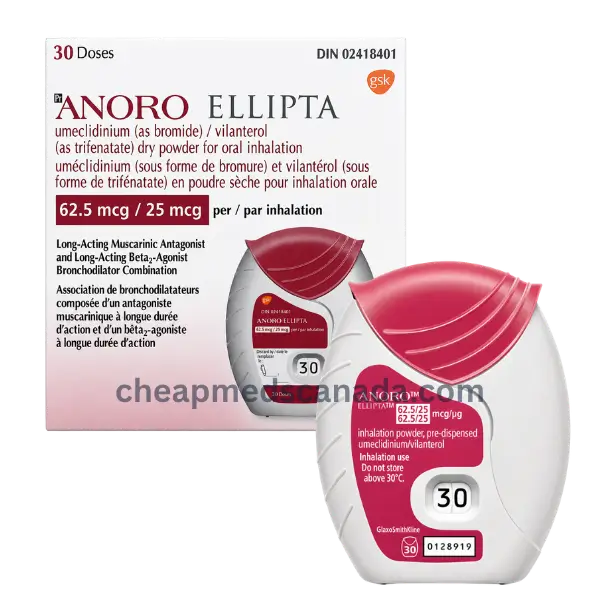
- The inhaler has a dose counter and a cover that, when slid open, automatically prepares the dose — no separate priming step is needed
- Inhale steadily and deeply through the mouthpiece; this is a dry powder device, so a forceful, sustained breath (not a quick puff) is what draws the medication into the lungs
- Do not exhale into the mouthpiece after opening the cover, as this can disperse the dose before inhalation
- Rinse the mouth after use as a general good habit with inhaled medications
- Store at room temperature, away from moisture, and keep the cover closed when not in use to protect the powder from humidity
Who Should Use Caution or Avoid Anoro Ellipta
- Anyone with a severe milk protein allergy — the powder formulation uses a lactose carrier that contains trace milk proteins
- Anyone with narrow-angle glaucoma or urinary retention, given umeclidinium's anticholinergic effects
- Anyone with significant cardiovascular disease, since LABA medications can affect heart rate
- Not established as safe or effective for asthma, and not intended for acute bronchospasm
A Note on the LABA Boxed Warning
Anoro Ellipta's label carries a boxed warning noting that long-acting beta agonists like vilanterol increase the risk of asthma-related death — a warning that applies to the entire LABA drug class based on data from asthma trials of a different medication. It's worth understanding why this appears on a COPD-only product: Anoro isn't approved for asthma in the first place, and the safety concern behind the warning is specific to LABA use in asthma treatment, not COPD. It's a class-wide labeling requirement rather than a signal specific to how this medication performs in the condition it's actually prescribed for, but it's still worth discussing with a prescriber, especially for anyone with a mixed asthma-COPD presentation.
Common Side Effects Worth Recognizing
- Headache and nasopharyngitis (cold-like symptoms) are among the most commonly reported effects in clinical trials
- Dry mouth and cough can occur, related to the anticholinergic component
- Rapid heartbeat or palpitations, particularly worth reporting given the cardiovascular caution above
- Any new or worsening urinary difficulty, especially in men with a history of prostate enlargement, should be raised with a prescriber promptly
Can Anoro Ellipta be used for asthma?
No. Anoro Ellipta is approved for maintenance treatment of COPD and is not approved as an asthma treatment. Its safety and effectiveness for asthma have not been established.
Can Anoro Ellipta be used during a sudden COPD flare-up?
No. Anoro Ellipta is a maintenance medication designed for regular daily use and is not intended to provide rapid relief during a sudden worsening of COPD symptoms. A fast-acting rescue bronchodilator should be used as prescribed for acute symptoms.
How long does Anoro Ellipta take to start working?
Some bronchodilating effect can begin after the first dose, but noticeable improvements in breathing and activity-related symptoms may build over the first few weeks of consistent daily treatment.
Do I need to prime the Anoro Ellipta inhaler before using it?
No. Anoro Ellipta does not require a separate priming step. Opening the inhaler cover prepares the dose for inhalation, so follow the device instructions carefully and do not open the cover until you are ready to take the dose.
Anoro Ellipta is a prescription maintenance inhaler for COPD and is not intended for the immediate relief of sudden breathing problems. Use it exactly as prescribed by your healthcare professional. This information is for educational purposes only and does not replace professional medical advice, diagnosis, or treatment.
Reviews
There are no reviews yet.