
Description
What Is Vasostrict?
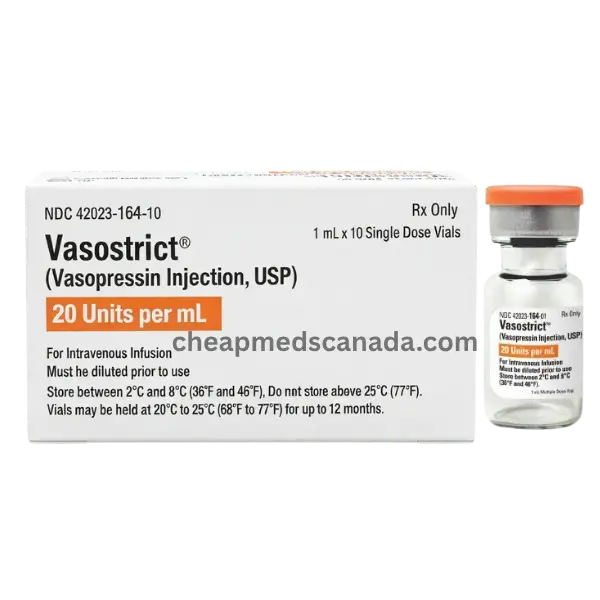
Vasostrict is a prescription-only injectable medication used exclusively in hospital intensive care units. It contains Vasopressin — a synthetic version of the antidiuretic hormone (ADH) naturally produced by the pituitary gland. When blood pressure collapses in critically ill patients despite IV fluids and standard vasopressors like norepinephrine, Vasostrict is added to help restore vascular tone and bring blood pressure back to a safe range.
It is FDA-approved to increase blood pressure in adults with vasodilatory shock who remain dangerously hypotensive after fluids and catecholamines have already been given. The two most common situations where this applies are septic shock — where overwhelming infection causes blood vessels to dilate uncontrollably — and post-cardiotomy vasodilatory shock following open-heart surgery.
In Canada, generic vasopressin injection is widely used in hospitals as a cost-effective equivalent to the branded Vasostrict.
How Vasostrict Works
Vasopressin acts on V1 receptors found on vascular smooth muscle throughout the body. When it binds to these receptors, blood vessels constrict — peripheral vascular resistance increases and blood pressure rises. This mechanism is completely separate from how catecholamines like norepinephrine work, which is precisely why vasopressin is effective when norepinephrine alone isn't enough.
Patients in prolonged septic shock often develop a relative vasopressin deficiency — their bodies have depleted natural supplies. Vasostrict replaces what the body can no longer produce in sufficient amounts.
The pressor effect begins rapidly and peaks within 15 minutes of starting the infusion. When the infusion is stopped, the effect fades within 20 minutes — giving clinical teams precise control over the blood pressure response. Importantly, there is no tachyphylaxis — the effect doesn't weaken with continued use.
Vasopressin also acts on V2 receptors in the kidneys, promoting water reabsorption and reducing urine output — its antidiuretic function.
Dosage and Administration
Vasostrict is never given as a bolus. It's administered as a continuous IV infusion through a central line, diluted in normal saline (0.9% NaCl) or D5W before use.
| Indication | Starting Dose | Maximum Dose |
|---|---|---|
| Septic Shock | 0.01–0.03 units/minute | 0.07 units/minute |
| Post-Cardiotomy Shock | 0.03 units/minute | 0.1 units/minute |
Titrate to the lowest effective dose. After the target blood pressure has been maintained for 8 hours without catecholamines, begin tapering by 0.005 units/minute per hour as tolerated.
Diluted solution must be discarded after 18 hours at room temperature or 24 hours refrigerated.
Side Effects
Common:
- Slow heart rate (bradycardia)
- Decreased cardiac output
- Nausea and abdominal cramping
- Headache and pallor
- Low sodium (hyponatremia) from water retention
Serious — notify the medical team immediately:
- Peripheral or limb ischemia — pale, cold, painful extremities from excessive vasoconstriction
- Mesenteric ischemia — abdominal pain or distension suggesting reduced bowel blood flow
- Myocardial ischemia — chest pain, ECG changes
- Water intoxication — drowsiness, confusion, seizures from severely low sodium
- Skin necrosis — if the IV infiltrates into surrounding tissue
Contraindications and Cautions
Do not use Vasostrict in patients allergic to vasopressin. Use with caution in patients with:
- Coronary artery disease — risk of angina or myocardial ischemia
- Epilepsy or migraine — fluid retention can worsen both conditions
- Heart failure — rapid water retention can overload an already stressed system
- Asthma — bronchospasm has been reported
Pregnancy: Vasopressin clearance increases in the second and third trimester, so higher doses may be needed. At high doses, uterine contractions are a risk. Breastfeeding: Pump and discard breast milk for approximately 1.5 hours after receiving vasopressin.
Pediatric use: Safety and effectiveness for vasodilatory shock have not been established in children.
Storage
- Refrigerate between 2°C and 8°C — do not freeze
- After opening a 10 mL vial, refrigerate and discard after 30 days
- Inspect for particulate matter before use — do not use if cloudy or discoloured
What is Vasostrict used for?
Vasostrict is a prescription medication containing vasopressin that is used in hospital settings to help raise blood pressure in adults with severe vasodilatory shock when other treatments alone are not enough. It is administered by continuous intravenous infusion under close medical supervision.
How is Vasostrict administered?
Vasostrict is given as a continuous IV infusion by trained healthcare professionals in a hospital or intensive care unit. The dose is carefully adjusted based on your blood pressure and overall response to treatment.
Can Vasostrict be used outside the hospital?
No. Vasostrict is intended only for use in hospitals under continuous medical monitoring. It requires careful dose adjustment and monitoring of blood pressure, heart function, and circulation.
What are the common side effects of Vasostrict?
Possible side effects include changes in blood pressure, reduced blood flow to the hands or feet, irregular heartbeat, stomach discomfort, and low sodium levels. Because Vasostrict is used in critically ill patients, healthcare providers closely monitor for any adverse effects during treatment.
Can Vasostrict be stopped suddenly?
Vasostrict should only be reduced or discontinued under the supervision of a healthcare professional. Stopping the infusion too quickly may cause blood pressure to fall, so the medication is typically tapered according to your clinical condition.
Vasostrict (vasopressin) is a prescription medication intended for use by qualified healthcare professionals in a clinical setting. It should be administered only as directed and requires appropriate monitoring. This information is for educational purposes only and does not replace professional medical advice, diagnosis, or treatment. Always consult a healthcare professional for guidance regarding its use, dosage, risks, and potential side effects.

Reviews
There are no reviews yet.