
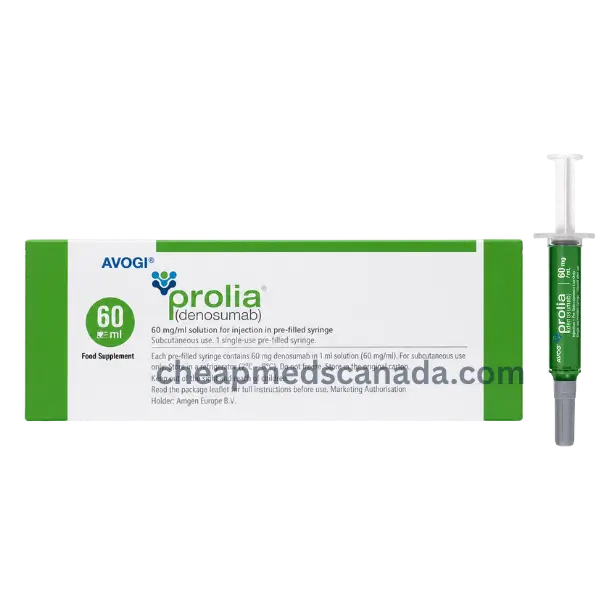

Description
Prolia (Denosumab): The Twice-a-Year Commitment
Most medications, if you stop taking them, simply stop working — you're back where you started, no worse off. Prolia is different, and it's the single most important thing to understand before the first injection: this is a drug that asks for a long-term commitment, and stepping away from it without a plan can leave you in a worse position than if you'd never started. This page is built around that reality rather than treating Prolia like a typical prescription.
What You're Committing To
Prolia contains denosumab, a monoclonal antibody that works differently from older osteoporosis drugs like bisphosphonates. It binds to and neutralizes RANKL, a signaling protein that drives the formation and survival of osteoclasts — the cells responsible for breaking down bone. By blocking RANKL, Prolia slows bone loss and allows bone density to build back up over time.
It's approved for:
- Postmenopausal women at high risk of fracture
- Men with osteoporosis at high fracture risk
- Bone loss related to certain hormone-suppressing cancer treatments
The dosing schedule is simple on paper — one 60mg injection under the skin, once every six months, given by a healthcare provider. What's not simple is what happens if that schedule slips.
The Injection Itself
- Administered in a clinical setting, typically in the upper arm, upper thigh, or abdomen
- Requires refrigerated storage before use — this isn't a medication that tolerates being left at room temperature for extended periods, which matters for anyone considering self-administration or unusual sourcing
- Calcium and vitamin D supplementation is typically required alongside treatment, since Prolia can lower blood calcium levels, sometimes significantly
- Dental evaluation before starting is often recommended, given the associated risk of osteonecrosis of the jaw with long-term use
What Happens If a Dose Is Missed or Delayed
This is where Prolia diverges sharply from most medications. Research tracking patients who missed or delayed injections — including during COVID-era disruptions — found a clear pattern: delayed dosing was associated with a measurably higher fracture risk. Once bone remodeling that had been suppressed by the drug reactivates, it can happen quickly, and inconsistently timed injections leave a window where that protection isn't there.
Practically, this means:
- The six-month schedule isn't a loose guideline — it's a clinical timeline worth protecting with reminders, calendar alerts, or a standing appointment
- If a dose is going to be delayed for any reason, that's worth a call to the prescribing office rather than simply waiting for the next available slot
- Anyone anticipating a disruption to care — a move, an insurance gap, a supply issue — should raise it with a provider well before a scheduled dose, not after it's already been missed
The Exit Plan: Why Stopping Needs a Plan, Not Just a Decision
If Prolia is ever going to be discontinued — whether because treatment goals have been met, side effects are a concern, or a patient simply wants to stop — this needs to happen as a planned transition, not a quiet lapse.
What the evidence shows:
- Stopping denosumab after two or more injections is associated with a rebound in bone turnover, meaning bone breakdown can temporarily exceed even the pre-treatment rate
- This rebound effect typically begins several months after the last injection and can result in a meaningful loss of the bone density gained during treatment
- The most serious consequence is an elevated risk of multiple vertebral fractures, occurring in a meaningful minority of patients who stop without a follow-up plan
- Current guidance from bone health specialists generally recommends transitioning to another antiresorptive medication, often a bisphosphonate, timed closely after the final Prolia dose to blunt this rebound effect
The takeaway: discontinuing Prolia is a medical decision that deserves the same planning as starting it — not something to do quietly between appointments, and not something to stop simply because a dose was missed and momentum was lost.
Serious Risks Worth Understanding Upfront
- Hypocalcemia — low blood calcium, which is why supplementation and monitoring matter, especially for anyone with kidney impairment
- Osteonecrosis of the jaw — rare but serious, with risk increasing with treatment duration; dental health and any planned oral surgery should be discussed with both a prescriber and dentist
- Atypical femoral fractures — unusual thigh bone fractures associated with long-term antiresorptive use; new hip or thigh pain during treatment warrants prompt evaluation
- Serious infections and skin reactions — Prolia suppresses part of immune-related bone signaling, and dermatologic reactions have been reported
Monitoring While on Treatment
- Regular blood calcium checks, particularly important for anyone with reduced kidney function
- Periodic bone density scans to track treatment response
- Dental check-ins, especially before any invasive dental work
- Ongoing conversation about treatment duration — long-term use beyond several years is an active area of clinical guidance, and the plan may evolve over time
A Note on Who This Medication Tends to Suit
Prolia is generally considered for people at genuinely high fracture risk — a prior fragility fracture, very low bone density, or a strong risk profile that makes the ongoing commitment worthwhile. It's less often the first choice for someone with only mildly reduced bone density, where a bisphosphonate's more forgiving discontinuation profile may be preferable, particularly for anyone who anticipates gaps in consistent medical follow-up. This isn't a judgment on any individual situation — it's simply the kind of context worth raising directly with a prescriber when weighing Prolia against other options, since the right choice depends heavily on how confident someone feels about staying on schedule for the years the treatment plan requires.
What happens if I stop taking Prolia?
Stopping Prolia after two or more injections can lead to rapid bone loss and an increased risk of vertebral fractures within several months of the last dose. If treatment needs to be discontinued, your healthcare provider will usually recommend transitioning to another osteoporosis medication to help protect your bones.
Is it dangerous to miss or delay a Prolia injection?
Yes. Delaying a scheduled Prolia injection may increase your risk of fractures. The injection is intended to be given every six months, so it is important to stay on schedule and contact your healthcare provider if you miss an appointment.
Why does Prolia need to be refrigerated?
Prolia contains denosumab, a biologic monoclonal antibody that must be stored under refrigeration to maintain its stability, safety, and effectiveness until it is administered.
How long can I stay on Prolia?
Prolia has been studied for long-term use of up to 10 years and beyond in appropriate patients. The duration of treatment depends on your fracture risk, response to therapy, and your healthcare provider's ongoing assessment of the benefits and risks.
How is Prolia different from bisphosphonates?
Prolia works by blocking RANKL, a protein involved in the formation and activity of bone-resorbing cells called osteoclasts. Bisphosphonates reduce bone breakdown through a different mechanism by binding to bone tissue. Because they work differently, the approach to stopping treatment also differs between these medications.
Prolia is a prescription medication and should only be administered under the supervision of a qualified healthcare professional. This information is provided for educational purposes only and is not a substitute for professional medical advice, diagnosis, or treatment. Always consult your healthcare provider before starting or changing therapy.

Reviews
There are no reviews yet.