
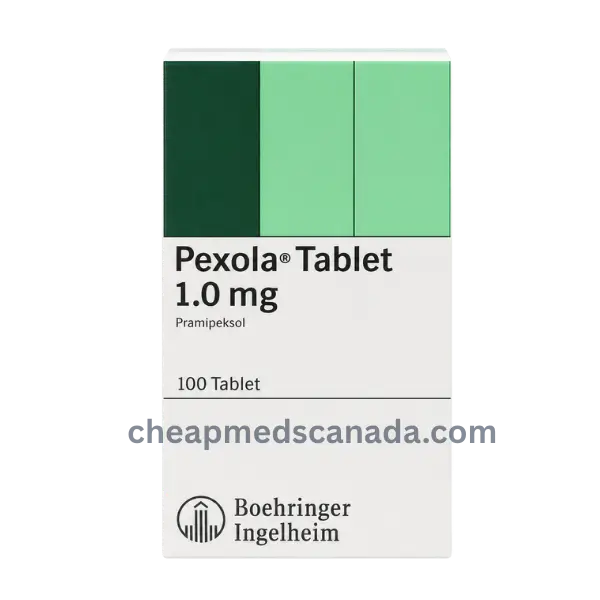
Description
Pexola 1mg (Pramipexole): An Informed Consent Companion
Before starting most medications, a doctor walks through what to expect — what it does, what it doesn't, and what to watch for. Pramipexole is one of the few drugs where that conversation genuinely matters more than usual, because some of its risks aren't things a person would necessarily connect back to a pill. This page is built around that conversation rather than a standard feature list, so nothing important gets buried under dosing tables.
What You're Agreeing To Treat
Pexola contains pramipexole, a non-ergot dopamine agonist. Unlike levodopa-based medications, it doesn't get converted into dopamine — it directly stimulates the same dopamine receptors dopamine would normally activate. This makes it useful for two distinct conditions:
- Parkinson's disease — improving tremor, rigidity, and slowness of movement, either as an early standalone treatment or alongside levodopa-based therapy as the disease progresses
- Restless legs syndrome (RLS) — at meaningfully lower doses than the Parkinson's range, easing the urge to move the legs that disrupts sleep
These are genuinely different treatment paths on the same drug, which is why dosing looks so different depending on which condition it's prescribed for.
The Benefit You Should Reasonably Expect
For Parkinson's disease, most people notice improved movement and reduced tremor within the first few weeks of reaching an effective dose, with benefits typically building gradually rather than arriving all at once. For RLS, relief tends to show up faster — often within days — though doses used for RLS are a fraction of Parkinson's-range dosing, which matters for the risk conversation below.
The Risk That Deserves Its Own Conversation
Every medication has a side effect list. Pramipexole has one specific risk category that's worth separating out entirely, because it doesn't feel like a typical "side effect" when it happens — it feels like a personality shift, and it's easy to miss until real damage is done.
Impulse control disorders have been reported with pramipexole and other dopamine agonists, including:
- Compulsive gambling
- Compulsive shopping or spending
- Binge eating
- Hypersexuality or unusually increased sex drive
These aren't rare curiosities — they're documented often enough that regulatory bodies require warnings on the label, and they can develop in people with no prior history of any of these behaviours. The person experiencing them often doesn't recognize the connection to their medication; it's frequently a family member or partner who notices first.
What this means practically: anyone starting Pexola, and the people close to them, are worth letting in on this risk ahead of time — not after something has already gone wrong. If new compulsive behaviour shows up at any point during treatment, that's a reason to call the prescriber, not something to wait out or feel embarrassed about.
Other Risks Worth Knowing Before Day One
- Sudden sleep attacks — falling asleep without warning, even during activities like driving, sometimes without feeling drowsy beforehand
- Orthostatic hypotension — a drop in blood pressure on standing, causing dizziness or fainting, especially when a dose is first started or increased
- Hallucinations or confusion — more common in older adults, particularly at higher doses
- Augmentation (RLS specifically) — a phenomenon where symptoms start appearing earlier in the day or spreading to other body parts over time, which can mean the dose needs to be reduced rather than increased
Questions Worth Bringing to the Prescribing Conversation
- "Given my history, am I at higher or lower risk for impulse control issues?"
- "Should I avoid driving until I know how this affects me?"
- "What symptoms would tell me my RLS is getting worse from augmentation rather than the disease itself?"
- "Are there interactions with anything else I'm currently taking?" — this is particularly relevant with other CNS depressants, antipsychotics, or medications that affect dopamine
- "What does the monitoring schedule look like once I start?"
What Monitoring Actually Looks Like
- Follow-up appointments are typically closer together during initial dose titration, then space out once a stable dose is found
- Blood pressure checks, especially early on, to catch orthostatic hypotension before it causes a fall
- Open check-ins about mood, sleep, and behaviour changes — not just movement symptoms — since these are the ones most likely to go unreported otherwise
- For RLS patients, tracking whether symptoms are staying confined to the evening or creeping earlier into the day
Who Tends to Do Well on This Medication, and Who Might Not
No medication is a universal fit, and dopamine agonists in particular tend to suit some situations better than others:
- Often well-suited: younger patients earlier in a Parkinson's diagnosis, where delaying levodopa-based therapy is a treatment goal, or people with RLS whose symptoms are clearly evening-focused and disruptive to sleep
- Worth extra caution: anyone with a personal or family history of impulse control issues, compulsive behaviours, or substance use, given the documented risk profile above
- Often reconsidered: older adults more prone to confusion or blood pressure swings, where the side effect profile may outweigh the benefit compared to other options
None of this is a substitute for an individual assessment — it's simply the kind of context that makes the prescribing conversation more productive.
Taking It as Prescribed
- Immediate-release tablets are typically taken multiple times daily, at gradually increasing doses under medical supervision
- Can be taken with or without food; taking it with food may help if nausea is an issue, particularly when starting out
- Never stop abruptly — discontinuation should be tapered under medical guidance, since stopping suddenly has been linked to a withdrawal-like syndrome in some patients
- Avoid alcohol, which compounds both the sedation and blood pressure risks
Ordering Pexola Through CheapMedsCanada
| Strength | Typical Use | Supply Options |
|---|---|---|
| 0.125mg | RLS, low-dose Parkinson's titration | 30/90 count |
| 0.25mg | Parkinson's titration | 30/90 count |
| 1mg | Established Parkinson's dosing | 30/90 count |
- Orders ship in discreet, unmarked packaging
- A valid prescription specifying strength and condition being treated is required, since dosing differs meaningfully between RLS and Parkinson's use
- Related options are available on our [Parkinson's Disease Medications] and [Restless Legs Syndrome] pages if a dose adjustment or medication switch is being considered
Is Pexola the same as Mirapex?
Yes. Pexola and Mirapex are both brand names for pramipexole. They contain the same active ingredient and work the same way, but are marketed under different brand names in different regions.
Can Pexola be used for both Parkinson's disease and restless legs syndrome (RLS)?
Yes. Pexola is prescribed for both conditions, but the dosing differs. Restless legs syndrome is typically treated with much lower doses, while Parkinson's disease usually requires higher doses that are increased gradually over time.
What should I do if I notice new compulsive behaviours while taking Pexola?
Contact your healthcare provider promptly. Pramipexole can occasionally cause impulse control problems, such as compulsive gambling, shopping, eating, or increased sexual urges. Your doctor may adjust your dose or recommend a different treatment if these side effects occur.
Why is Pexola taken at night for some people but during the day for others?
It depends on the condition being treated. For restless legs syndrome, Pexola is usually taken in the evening before symptoms begin. For Parkinson's disease, doses are generally divided throughout the day to provide more consistent symptom control.
Is it safe to drive while taking Pexola?
Use caution until you know how Pexola affects you. Pramipexole can cause drowsiness and, in rare cases, sudden sleep episodes without warning. Avoid driving or operating machinery until you're confident the medication does not impair your alertness.
Pexola 1mg is a prescription medication and should be used only under the supervision of a qualified healthcare professional. Take it exactly as prescribed. This information is provided for educational purposes only and is not a substitute for professional medical advice, diagnosis, or treatment. Always consult your healthcare provider before starting or changing treatment.




Reviews
There are no reviews yet.