
Description
Allergy Season in Canada Is No Joke
From the birch pollen clouds of April in Ontario to the ragweed season that blankets the prairies every August and September, Canadian allergy sufferers deal with some of the most intense seasonal pollen exposures in the world. And while runny noses and sneezing get most of the attention, the eyes often take the worst of it — relentless itching, watering, redness, and that maddening urge to rub that only makes everything worse.
Over-the-counter antihistamine drops help some people. For others, the relief they provide simply does not last long enough or cut deep enough. That is where Pazeo comes in. It is a prescription-strength antihistamine eye drop designed specifically for allergic conjunctivitis — and its once-daily dosing sets it apart from most of the alternatives.
At a Glance — What Is Pazeo?
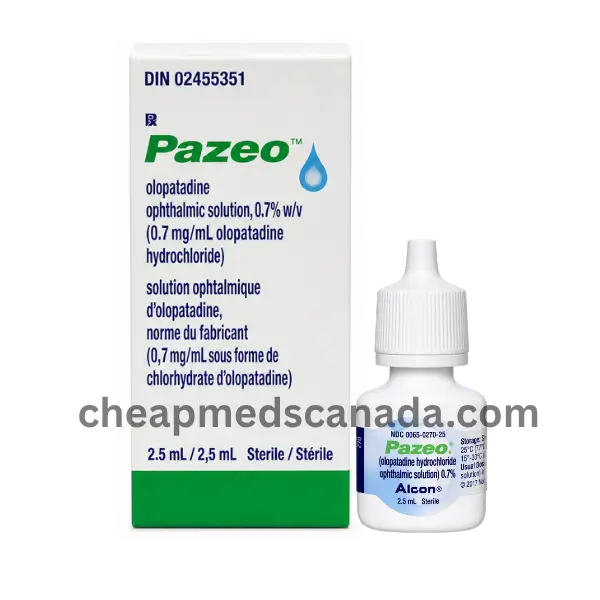
Pazeo is a prescription eye drop containing olopatadine hydrochloride at 0.7% — the highest concentration of olopatadine available in any ophthalmic formulation. It is manufactured by Novartis and is available through licensed Canadian pharmacies in a 2.5 ml bottle.
Olopatadine is not new. It has been used in lower-concentration eye drops for years. What makes Pazeo distinct is that its 0.7% strength is specifically formulated to deliver full 24-hour coverage from a single daily dose — something the 0.1% and 0.2% formulations cannot reliably achieve.
There is currently no generic version of Pazeo available. The brand-name product from Novartis remains the only option in this strength.
What Pazeo Treats
Pazeo is prescribed for the treatment of ocular itching associated with allergic conjunctivitis in patients aged 2 years and older.
Allergic conjunctivitis occurs when the eyes are exposed to allergens — pollen, pet dander, dust mites, mold spores — and the immune system reacts by flooding the conjunctiva (the clear membrane covering the white of the eye) with inflammatory cells and chemicals. The result is itching, redness, tearing, and a burning or gritty sensation that ranges from mildly annoying to genuinely disabling.
In Canada, allergic conjunctivitis affects a significant portion of the population. The seasons vary by region — tree pollens hit first in spring, grasses follow through early summer, and ragweed dominates late summer and fall across much of southern Canada. For patients with perennial allergies — triggered year-round by indoor allergens like pet dander or dust — the problem never fully goes away.
Pazeo addresses the eye symptoms of this condition directly and effectively. It does not treat nasal symptoms or systemic allergic responses — only the ocular component. For patients with both nasal and eye symptoms, Pazeo is often prescribed alongside a nasal antihistamine spray or corticosteroid nasal spray.
The Science Behind How It Works
Olopatadine works through two distinct mechanisms, which is part of why it outperforms simple antihistamines in clinical use.
Mechanism One — Histamine Receptor Blockade
When an allergen enters the eye, mast cells in the conjunctiva release histamine. Histamine binds to H1 receptors on the surface of cells in the eye's lining, triggering the itch response, the redness, and the watering. Olopatadine is a highly selective H1 receptor antagonist — it occupies those receptors before histamine can, blocking the signal that causes symptoms.
Mechanism Two — Mast Cell Stabilization
This is where olopatadine goes beyond what a standard antihistamine drop does. It also stabilizes the mast cells themselves — making them less likely to release histamine and other inflammatory chemicals in the first place. Rather than only reacting after the histamine is already released, it works upstream to reduce how much gets released at all.
The combination of these two actions is why Pazeo provides broader, longer-lasting relief than antihistamine-only formulations. The 0.7% concentration sustains this dual action across a full 24-hour period with a single morning drop.
Dosage and How to Use Pazeo
Prescribed Dose: One drop in each affected eye, once daily.
That is it. One application in the morning covers the entire day. For patients who have previously used twice-daily or four-times-daily antihistamine drops, the convenience of Pazeo's dosing schedule is a meaningful practical improvement.
Step-by-Step Application Guide:
Step 1 — Hands first: Wash both hands thoroughly with soap and water before touching the bottle or your eyes.
Step 2 — Contact lenses out: If you wear contact lenses, remove them before applying Pazeo. Do not skip this step — the preservative in Pazeo can be absorbed by soft contact lenses and cause irritation.
Step 3 — Prepare to apply: Tilt your head back gently. With one finger, pull the lower eyelid downward to create a small well.
Step 4 — Instil the drop: Hold the bottle tip close to the eye without letting it touch the eye or eyelid. Squeeze gently to release one drop into the lower eyelid well. One drop per eye is the correct dose — more does not improve the effect.
Step 5 — Close gently: Close the eye softly and either press a finger lightly against the inner corner of the eye (near the nose) for about 60 seconds, or keep the eye gently closed for a minute. This reduces how much of the drop drains into the tear duct and throat, improving how much stays in the eye.
Step 6 — Wait before reinserting lenses: Allow at least 10 minutes to pass before putting contact lenses back in.
Step 7 — Replace cap securely: Keep the bottle tightly closed when not in use. Do not touch the dropper tip to any surface — contamination of eye drops is a genuine infection risk.
Storage: Store at room temperature — between 15°C and 25°C. Do not refrigerate or freeze. Keep out of reach of children.
Missed Dose: Apply as soon as you remember on the same day. If you do not remember until the next day, skip the missed dose and continue your normal once-daily schedule. Never apply two doses to catch up.
Side Effects of Pazeo
Most patients tolerate Pazeo well. Because it is applied directly to the eye in a small volume, the amount that reaches the general bloodstream is very low. Side effects are predominantly local.
Commonly Reported — Usually Mild and Temporary:
- Temporary blurred vision immediately after instillation — clears within a few minutes for most patients
- Eye discomfort on application — a brief stinging or burning sensation when the drop first contacts the eye
- Eye dryness — some patients notice increased dryness, particularly in low-humidity environments
- Eyelid swelling — usually mild and resolves on its own
- Foreign body sensation — a feeling that something is in the eye, unrelated to any actual particle
- Headache — occasionally reported, likely related to minor systemic absorption
Less Common — Worth Mentioning to Your Doctor:
- Nasal dryness or congestion
- Increased sensitivity to light
- Taste disturbances — a mild bitter taste if the drop drains into the throat via the tear duct
- Fatigue or drowsiness — rare with topical use but reported in some patients
Serious — Stop Use and Seek Medical Attention Promptly:
- Severe eye redness, pain, or swelling that worsens after starting Pazeo rather than improving
- Significant vision changes that do not resolve within minutes of application
- Signs of a serious allergic reaction:
- Hives or rash spreading beyond the eye area
- Swelling of the face, lips, tongue, or throat
- Difficulty breathing or swallowing
- Dizziness or feeling faint
- Call 911 immediately if these occur
Warnings — Important Before You Start
Contact Lens Use: Pazeo contains benzalkonium chloride as a preservative. This compound is known to be absorbed by soft contact lenses and can cause ocular irritation over time. Always remove lenses before applying the drops and wait a minimum of 10 minutes before reinserting them.
Driving and Machinery: Temporary blurred vision is a common and expected effect immediately after application. Do not drive, cycle, or operate equipment until your vision is completely clear after each dose.
Pregnancy: Pazeo should only be used during pregnancy when the treating physician has determined it is clearly necessary. Animal studies have shown some effects at high systemic doses, but the clinical relevance for low-volume topical eye use is uncertain. Disclose your pregnancy or plans to conceive to your doctor before starting.
Breastfeeding: Whether olopatadine passes into human breast milk from topical ophthalmic use is not fully established. The systemic absorption from eye drops is very low, but discuss the use of Pazeo with your doctor if you are currently nursing.
Paediatric Use: Pazeo is approved for use in children aged 2 years and older. It should not be used in infants under 2 years of age.
Allergy to Olopatadine: Do not use Pazeo if you have a known allergy to olopatadine hydrochloride or any of the other ingredients in the formulation. Always mention previous drug allergies to your pharmacist and doctor.
Drug Interactions
Because Pazeo is applied topically to the eye in a very small volume, the risk of systemic drug interactions is low. Clinically significant interactions with oral medications are uncommon.
| Product or Medication | Guidance |
|---|---|
| Other prescription eye drops | Space applications by at least 5 minutes to prevent dilution of either medication |
| Over-the-counter lubricating eye drops | Safe to use alongside Pazeo — apply lubricants first and wait 5 minutes before Pazeo |
| Contact lens solutions | Remove lenses before Pazeo; wait 10 minutes before reinserting |
| CNS depressants or sedating antihistamines | Minor additive sedation theoretically possible with systemic absorption; unlikely to be clinically relevant at eye drop doses |
| Other antihistamines (oral or topical) | No significant interaction expected, but inform your doctor of all allergy medications you are using |
As always, provide your pharmacist and doctor with a full and current medication list — including vitamins and herbal supplements — before starting any new prescription product.
Managing Eye Allergies in Canada — Beyond the Drops
Pazeo is highly effective at controlling the eye symptoms of allergic conjunctivitis, but pairing it with some practical habits gives your eyes the best possible chance at staying comfortable through allergy season.
Track the pollen forecast. Environment and Climate Change Canada and several provincial health agencies publish daily pollen counts during allergy season. On high-count days, taking extra precautions — keeping windows closed, limiting time outdoors during peak pollen hours between 10 am and 3 pm — significantly reduces your allergen load.
Rinse your eyes with preservative-free saline after outdoor exposure. Physically washing allergen particles off the ocular surface before they trigger a full mast cell response is one of the most underrated allergy management tools available. Preservative-free saline is inexpensive and available at any Canadian pharmacy without a prescription.
Cold compresses provide fast itch relief. When the itching is intense, a clean cold compress held over closed eyes for a few minutes relieves the immediate sensation and reduces the blood vessel dilation contributing to redness. It works quickly and has no side effects.
Avoid rubbing. This one is genuinely difficult when the itching is intense, but rubbing the eyes releases more histamine from mast cells — making the reaction worse and prolonging it. Cold compresses and the drops themselves are better alternatives to the temporary relief rubbing seems to offer.
Change your pillowcase frequently during allergy season. Pollen and pet dander accumulate on bedding overnight. Washing pillowcases two to three times per week rather than once a week during peak season meaningfully reduces the allergen exposure that happens during 7 to 8 hours of sleep — right next to your eyes.
Shower before bed during pollen season. Hair traps an enormous amount of pollen throughout the day. Showering in the evening removes that accumulation before you bring it to your pillow.
Questions Canadian Patients Ask About Pazeo
How is Pazeo different from Pataday or Patanol?
All three eye drops contain olopatadine, but at different strengths. Patanol contains 0.1% olopatadine and is usually used twice daily. Pataday contains 0.2% and is used once daily. Pazeo contains 0.7% olopatadine — the highest concentration — designed to provide stronger, longer-lasting symptom control throughout the full day.
Can Pazeo be used year-round for allergies?
Yes. Although commonly prescribed during seasonal allergy periods, Pazeo may also be used year-round for perennial allergic conjunctivitis caused by allergens such as dust mites, pet dander, or mold. Your doctor will determine the safest and most appropriate treatment duration.
Is there a generic version of Pazeo available in Canada?
Currently, Pazeo 0.7% ophthalmic solution is mainly available as the brand-name product. Lower-strength generic olopatadine eye drops may exist, but they are not considered direct equivalents to the 0.7% Pazeo formulation.
Can I wear contact lenses while using Pazeo?
No. Contact lenses should be removed before applying the drops. The preservative in Pazeo can be absorbed by soft lenses and may cause irritation. Wait at least 10 minutes after application before reinserting your lenses.
Is Pazeo safe for children?
Pazeo is approved for children aged 2 years and older. However, a pediatrician or eye specialist should evaluate whether it is appropriate for your child’s specific symptoms and allergy condition.
How quickly does Pazeo start working?
Many patients notice itch relief within minutes of applying the drops. Continued daily use helps reduce ongoing allergic inflammation, and most people experience noticeable overall improvement within the first few days of treatment.
The information provided on this page is intended for educational purposes only and is not a substitute for professional medical advice, diagnosis, or treatment. Pazeo is a prescription medication — always consult a licensed Canadian healthcare provider or eye care specialist before starting or adjusting this medication.

Reviews
There are no reviews yet.