
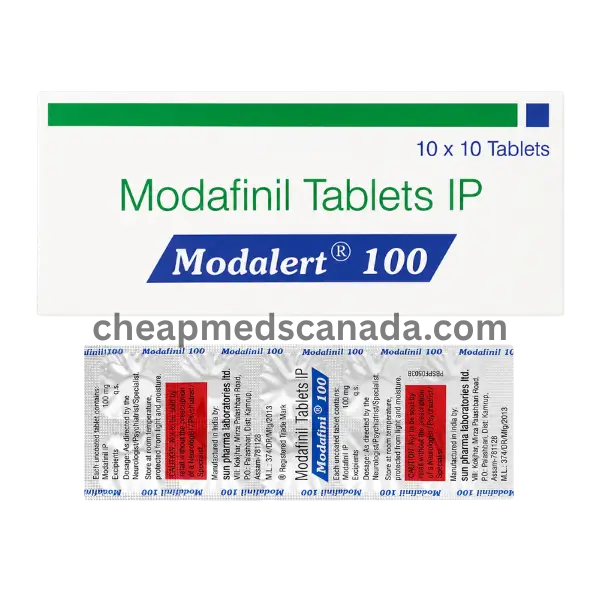
Description
What Modalert 100 mg Is Used For
Modafinil has three distinct clinical indications, and it's worth understanding each separately — because the dosing timing and practical approach differs across them.
Narcolepsy is a neurological condition in which the brain loses the ability to properly regulate the sleep-wake cycle. People with narcolepsy experience excessive daytime sleepiness, sudden muscle weakness triggered by emotion (cataplexy), and sometimes episodes of sleep paralysis. The excessive sleepiness is persistent — it doesn't respond to a full night's sleep the way normal tiredness would. Modafinil reduces the frequency and severity of these sleep attacks, helping patients maintain wakefulness through the day.
Obstructive sleep apnea (OSA) Causes breathing to repeatedly stop during sleep, resulting in fragmented, non-restorative rest even for patients who spend adequate hours in bed. The primary treatment for OSA is CPAP therapy — Modafinil doesn't replace that. What it does is address the residual excessive daytime sleepiness that persists in some patients even after their airway obstruction is being managed. In Canadian clinical practice, Modafinil for OSA is typically adjunctive — meaning it's added to CPAP therapy when sleepiness remains problematic, not substituted for it.
Shift work sleep disorder (SWSD) Develops when a person's work schedule runs contrary to their natural circadian rhythm — overnight shifts, early morning starts, or rotating schedules that change week to week. The brain has difficulty staying alert during working hours because those hours fall in what the circadian clock still interprets as sleep time. Modafinil taken before the shift begins helps sustain wakefulness through the working period.
Why 100 mg — Not 200 mg
This is a question that comes up regularly, because Modalert 200 mg is more widely prescribed and more commonly referenced in clinical literature. Understanding why 100 mg exists and when it's the appropriate choice matters for patients trying to understand their prescription.
The 200 mg dose is the standard reference dose in most clinical trials and the strength most prescribers reach for first. The 100 mg dose is used in specific situations: patients who are new to Modafinil and whose prescriber wants to assess tolerability before moving to full dose, older patients where drug clearance may be slower, patients with moderate hepatic impairment where Modafinil metabolism is reduced, and patients who found 200 mg produced side effects they couldn't manage — headache, insomnia, or anxiety — at a level that didn't settle with time.
It's also sometimes used as a maintenance dose for patients who've determined 100 mg gives them adequate wakefulness benefit without the side effect profile of 200 mg. Not every patient needs the full dose to achieve the clinical outcome they're looking for.
How Modafinil Works — What Makes It Different From Stimulants
Traditional stimulants — amphetamines, methylphenidate, even high-dose caffeine — promote wakefulness broadly by increasing activity across multiple neurotransmitter systems simultaneously. They raise dopamine, norepinephrine, and serotonin in a non-selective way, which is what produces both the wakefulness effect and the characteristic side effects: elevated heart rate, elevated blood pressure, appetite suppression, rebound fatigue when they wear off, and a meaningful potential for dependence and misuse.
Modafinil's mechanism is more targeted. It works primarily through inhibiting the reuptake of dopamine — keeping dopamine active at synapses for longer — while also influencing histamine and orexin (hypocretin) pathways that are directly involved in the brain's wakefulness signalling. The result is sustained wakefulness without the same cardiovascular stimulation, without the crash at the end of the dose, and with a significantly lower dependence potential than traditional stimulants.
This is why Modafinil is classified differently from amphetamines in terms of scheduling and why the side effect profile at therapeutic doses is generally considered more tolerable. It doesn't feel like a "buzz" the way stimulant medications sometimes do — it's a more neutral, functional wakefulness without the accompanying agitation that many patients find difficult to manage with traditional options.
How to Take Modalert 100 mg
Timing depends on the condition being treated — this isn't a one-size-fits-all instruction.
For narcolepsy and obstructive sleep apnea: one 100 mg tablet taken in the morning, ideally at a consistent time each day. Taking it too late in the morning risks the wakefulness effect extending into the evening and interfering with nighttime sleep — which for patients with sleep disorders is particularly counterproductive.
For shift work sleep disorder: one tablet taken approximately one hour before the shift begins. This timing allows Modafinil to reach peak plasma concentration around the time wakefulness is needed most. For patients whose shifts start at 11pm, that means taking the tablet around 10pm — not in the morning, regardless of what other Modafinil instructions say. The timing is calibrated to the work schedule, not the clock.
Food: Modalert 100 mg can be taken with or without food. A meal can slightly delay how quickly it's absorbed, but doesn't meaningfully affect how much reaches the bloodstream overall.
One tablet per day is the standard maximum for the 100 mg dose. If your prescriber has determined that your response warrants a higher dose, they'll adjust accordingly — don't self-escalate.
Late-day dosing: the most practical thing to understand about Modafinil timing is that it has a relatively long half-life — somewhere between 12 and 15 hours in most people. Taking a dose in the afternoon is almost guaranteed to interfere with sleep that night. If you're a shift worker who finishes a night shift and wants to sleep, Modafinil timing around your schedule needs to be specifically planned with your doctor.
Side Effects — What to Expect
Modafinil is generally well tolerated, particularly at the 100 mg dose. Most side effects that do occur are mild and often improve within the first few weeks as the body adjusts.
Commonly reported, usually manageable:
- Headache — the most frequently reported; related to vasodilation and responds well to hydration and standard pain relief
- Nausea, particularly if taken on an empty stomach; resolves quickly for most people once food is involved
- Dry mouth — staying well hydrated throughout the day helps
- Insomnia — this is almost always a timing issue rather than a direct pharmacological problem; taking Modafinil too late in the day is the most common cause
- Dizziness or lightheadedness
- Anxiety or feeling slightly on-edge — more common at 200 mg; at 100 mg this tends to be mild if it occurs at all
Less common, worth noting:
- Decreased appetite — Modafinil has mild appetite-suppressing effects at therapeutic doses; not a significant concern for most patients but worth being aware of if nutrition is already a consideration
- Elevated heart rate or palpitations — mild and transient in most cases; persistent palpitations should be reported
Rare but serious — stop use and contact a doctor immediately:
- Skin rash, particularly if it develops rapidly or spreads — Modafinil carries a small but documented risk of serious skin reactions including Stevens-Johnson syndrome. Any new rash after starting the medication should be evaluated promptly; don't wait to see if it resolves on its own
- Psychiatric symptoms — mood changes, agitation, depression, or hallucinations. These are uncommon but can occur, particularly in patients with underlying psychiatric conditions
- Severe allergic reaction — facial swelling, throat tightness, difficulty breathing
- Chest pain or irregular heartbeat requiring urgent assessment
Precautions and Who Should Use Caution
Hormonal contraceptives: this interaction is important and underreported. Modafinil induces CYP3A4 enzymes in the liver, which can meaningfully reduce the plasma levels of oestrogen-based oral contraceptives. Women relying on hormonal birth control (the pill, patch, or hormonal ring) while taking Modafinil should discuss additional or alternative contraceptive methods with their doctor — the effectiveness of hormonal contraception can be reduced for the duration of Modafinil use and for approximately one month after stopping.
Cardiovascular conditions: while Modafinil's cardiovascular burden is lower than traditional stimulants, it does produce mild increases in heart rate and blood pressure in some patients. Men and women with a history of heart disease, arrhythmia, mitral valve prolapse, or left ventricular hypertrophy should be assessed specifically before starting.
Psychiatric history: patients with a history of psychosis, mania, or severe anxiety may be more vulnerable to Modafinil-triggered psychiatric side effects. Careful monitoring is warranted, and some patients with these histories may not be appropriate candidates.
Liver impairment: Modafinil is extensively metabolised in the liver. Patients with severe hepatic impairment should receive a significantly reduced dose — the 100 mg strength is specifically relevant here, as standard 200 mg dosing could lead to drug accumulation.
Alcohol: combining Modafinil with alcohol is not recommended. Modafinil can mask the sedating effects of alcohol, leading people to drink more than they realise and underestimate their impairment — a particular concern for driving or operating machinery.
Drug Interactions
Modafinil affects liver enzyme activity in ways that influence how several other medications are processed. Key interactions to discuss with your doctor and pharmacist:
- Hormonal contraceptives — as described above, reduced effectiveness through CYP3A4 induction
- Cyclosporine — levels can be reduced by Modafinil; monitoring is required for transplant patients
- Warfarin and other anticoagulants — Modafinil may affect how these drugs are metabolised; INR monitoring is advisable
- Tricyclic antidepressants — blood levels can increase when combined with Modafinil in patients who are slow metabolisers of CYP2C19 substrates
- MAO inhibitors — caution is advised; the combination hasn't been extensively studied and carries theoretical interaction risk
- Other wakefulness-promoting agents — combining Modafinil with other stimulants or wakefulness medications increases side effect risk without a proportional benefit
Is Modalert 100 mg the same as Modafinil?
Yes. Modalert 100 mg contains Modafinil as its active ingredient. Modalert is simply a brand name manufactured by Sun Pharmaceuticals, while Modafinil is the generic drug name. They provide the same wakefulness-promoting effect when taken at the same strength.
How long does Modalert 100 mg last?
A single morning dose usually remains effective throughout the day. Modafinil has an average half-life of 12 to 15 hours, although the exact duration varies from person to person. Taking it late in the day may make it difficult to fall asleep at night.
Can I take Modalert 100 mg if I don't have a diagnosed sleep disorder?
Modalert should only be used under the supervision of a healthcare provider for an approved medical condition. It is a prescription medication in Canada and is generally prescribed for conditions such as narcolepsy, obstructive sleep apnea-related sleepiness, or shift work sleep disorder.
Will Modalert 100 mg replace a good night's sleep?
No. Modalert helps you stay awake and alert, but it does not replace the physical and mental benefits of proper sleep. Getting enough quality sleep remains essential for overall health and cognitive function.
Can I drive while taking Modalert 100 mg?
Many people are able to drive safely once they know how the medication affects them. However, when first starting Modalert, avoid driving or operating machinery until you are confident it does not cause dizziness, nervousness, or other side effects that could affect your concentration.
Is Modalert 100 mg habit-forming?
Modafinil has a lower risk of dependence than traditional stimulant medications, but it should still only be used as prescribed. Never increase your dose or use it more often than directed by your healthcare provider.

Reviews
There are no reviews yet.