
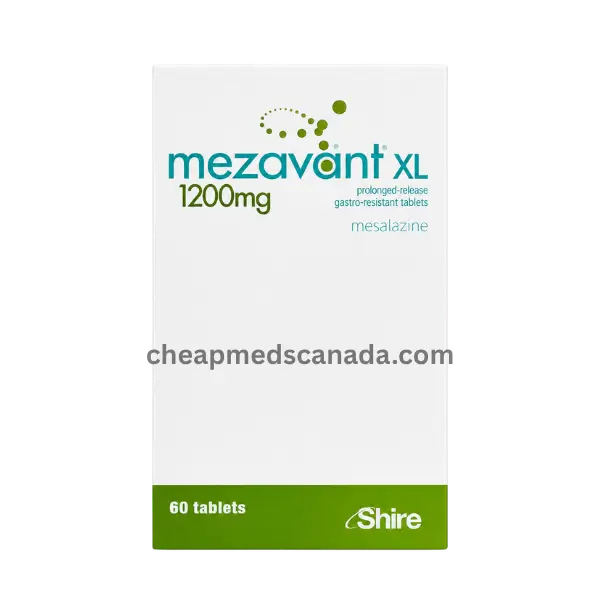

Description
What Makes Mezavant XL Different From Other Mesalamine Brands?
If you've been prescribed mesalamine for ulcerative colitis, you've probably noticed there are several brand names floating around — Asacol, Lialda, Pentasa, Apriso — and they're not all built the same way. Mezavant XL uses a delivery technology called MMX (Multi Matrix System), which is genuinely worth understanding before you fill the prescription, because it changes how — and when — you should take it.
Ulcerative colitis mostly affects the colon, particularly the left side and rectum. A standard oral tablet dissolves too early and releases most of its mesalamine before it ever reaches that part of the gut. MMX technology wraps the mesalamine in a pH-sensitive outer coating that only starts dissolving once the tablet reaches the colon, then releases the drug gradually through a lipophilic-hydrophilic matrix core over several hours. The practical result is more of the anti-inflammatory drug arriving where it's actually needed, released slowly instead of all at once.
Quick fact: Mezavant XL is the Canadian/UK brand name. In the United States, the identical formulation is sold as Lialda. Same drug, same MMX technology, different label.
Mezavant XL Dosing Guide
| Purpose | Typical Dose | Frequency | With Food? |
|---|---|---|---|
| Inducing remission (active mild-to-moderate UC) | 2.4g–4.8g (2–4 tablets of 1.2g) | Once daily | Yes, with a meal |
| Maintaining remission | 2.4g (2 tablets of 1.2g) | Once daily | Yes, with a meal |
| Standard tablet strength | 1.2g per tablet | — | — |
A few dosing details that matter more than people expect:
- Take it with food, every time. This isn't a minor suggestion — food intake affects how the MMX coating behaves and how much mesalamine actually gets absorbed where it needs to. Taking it on an empty stomach can reduce effectiveness.
- Swallow tablets whole. Crushing, splitting, or chewing defeats the entire point of the delayed-release coating.
- Don't panic if you see something in your stool. Occasionally the outer shell of the tablet passes through mostly intact after the medication has released — this is expected with MMX tablets and not a sign the dose failed. If it happens repeatedly, mention it to your prescriber.
- Missed a dose? Take it as soon as you remember unless it's nearly time for the next one — then just skip it. Don't double up.
Mezavant XL Side Effects, Organized by How Urgently You Should Act
Most people tolerate mesalamine reasonably well, but it helps to know what's routine versus what needs a call to your doctor versus what needs emergency care. Health Canada's product monograph and clinical trial data group these roughly as follows:
Common, usually not a concern:
- Headache
- Nausea or abdominal discomfort
- Flatulence
- Fatigue
Less common — flag to your doctor, don't just wait it out:
- Rash
- Joint pain
- Elevated liver enzymes on bloodwork
- Hair thinning
Rare but serious — stop the medication and seek care:
- Signs of pancreatitis (severe upper abdominal pain, often radiating to the back)
- Mesalamine-induced acute intolerance syndrome — cramping, bloody diarrhea, and fever that can mimic a UC flare itself, which is part of what makes it tricky to spot
- Kidney function changes (decreased urination, swelling in the ankles/feet, unusual fatigue)
- Signs of a hypersensitivity reaction — hives, facial or throat swelling, difficulty breathing
A detail worth flagging specifically: because mesalamine is chemically related to salicylates (the same drug family as aspirin), anyone with a known salicylate allergy needs to raise that with their prescriber before starting Mezavant XL.
Who Should Be Cautious With Mezavant XL?
Your pharmacist or doctor should know if you have any of the following before you start:
- Pre-existing kidney or liver disease
- A history of pericarditis (mesalamine has been linked to rare cases)
- Pregnancy or plans to become pregnant
- Current use of other salicylate-based medications
Periodic kidney function monitoring is generally recommended for patients on long-term mesalamine therapy, particularly in the first few months.
Is Mezavant XL the same as Lialda?
Yes. Mezavant XL and Lialda contain the same active ingredient, mesalamine, and use the same MMX extended-release technology. The difference is the brand name—Mezavant XL is marketed in Canada and the UK, while Lialda is the brand used in the United States.
Can I take Mezavant XL without food?
No. Mezavant XL should be taken with food as directed. Taking it with a meal helps ensure the medication works as intended and supports the proper release of mesalamine in the colon.
How long does Mezavant XL take to work?
Many people begin to notice an improvement in their symptoms within 2 to 4 weeks of consistent daily treatment. However, achieving full remission may take longer depending on the severity of your condition.
What is the difference between Mezavant XL and Asacol?
Both Mezavant XL and Asacol contain mesalamine, but they use different drug delivery systems. Mezavant XL uses MMX technology to release the medication gradually throughout the colon, while Asacol uses a pH-dependent coating that releases the medication in specific areas of the intestine.
Mezavant XL is a prescription medication and should only be used under the supervision of a qualified healthcare professional. Take it exactly as prescribed and do not stop treatment without medical advice. Common side effects may include headache, nausea, abdominal pain, or diarrhea. This information is for educational purposes only and is not a substitute for professional medical advice, diagnosis, or treatment.




Reviews
There are no reviews yet.