
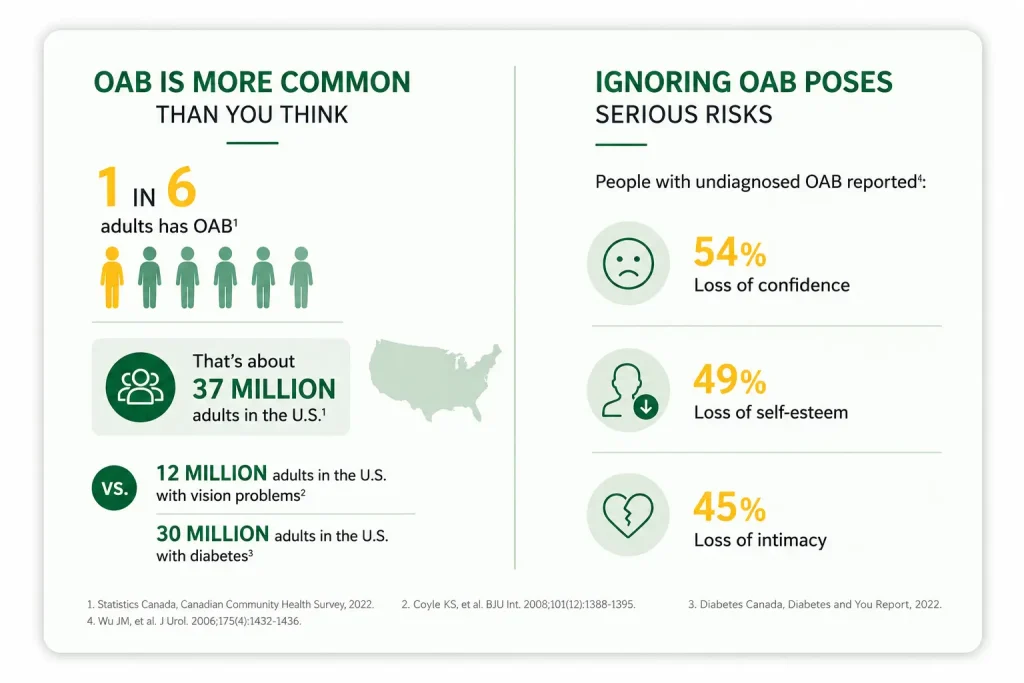
If you've been dealing with overactive bladder — the constant urgency, the unexpected leaks, the trips to the bathroom that interrupt everything — you already know how much it affects daily life. Work meetings, long drives, sleeping through the night, even just sitting through a movie without anxiety. It's exhausting in a way that's hard to explain to someone who hasn't experienced it.
Myrbetriq is one of the medications that has genuinely changed that picture for a lot of Canadian patients. It works differently from older bladder medications, it tends to be better tolerated, and for many people it's the first treatment that actually fits into a normal life without constant side effects getting in the way. This guide covers everything worth knowing — what Myrbetriq is, how it works, the doses available, what side effects to expect, the generic situation in Canada, and who it's actually right for.
Myrbetriq is the brand name for mirabegron, a prescription medication approved by Health Canada for the treatment of overactive bladder (OAB) in adults. It comes in two oral tablet strengths — 25 mg and 50 mg — and is taken once daily.
Overactive bladder is a condition characterized by:
Not everyone with OAB experiences all four symptoms. Some people have urgency without incontinence. Others deal primarily with frequency and nocturia. Myrbetriq is approved for OAB with any combination of these symptoms.
It's worth being clear about what Myrbetriq does not treat. It is not for stress urinary incontinence (leaking when you cough, sneeze, or exercise), bladder infections, or other urinary conditions. If you're unsure which type of urinary issue you're dealing with, that's exactly the kind of question a healthcare provider should sort out before any treatment is started.
This is where Myrbetriq genuinely stands apart, and it's the main reason so many Canadian patients have switched to it from older bladder medications.
For decades, the standard treatment for overactive bladder was a class of drugs called anticholinergics — medications like oxybutynin, tolterodine, and solifenacin. These work by blocking muscarinic receptors in the bladder, which reduces involuntary contractions. They work reasonably well, but their side effect profile — dry mouth, constipation, blurred vision, cognitive effects in older adults — causes a significant number of patients to stop taking them within a few months.
Myrbetriq works through a completely different pathway. It is a beta-3 adrenergic receptor agonist. Instead of blocking signals to the bladder muscle, it activates beta-3 receptors in the detrusor muscle (the main muscle of the bladder wall), which causes the muscle to relax. A relaxed detrusor holds more urine comfortably, reduces urgency signals, and gives patients more time between bathroom visits.
Why this matters practically:
Because it targets a different receptor type from anticholinergics, Myrbetriq avoids most of the drying and cognitive side effects that make older medications so difficult to tolerate long-term. It's particularly significant for older patients, for whom anticholinergic-associated cognitive effects are a genuine concern.
Myrbetriq is available in two strengths in Canada, and the starting dose is determined by your doctor based on your health history and any other medications you're taking.
| Dose | Typical Use | Notes |
|---|---|---|
| Myrbetriq 25 mg | Starting dose for most patients | Also the recommended dose for patients with moderate liver or kidney impairment |
| Myrbetriq 50 mg | Standard dose if 25 mg is well tolerated but insufficient | Titrated up after 4–8 weeks if needed |
How to take it correctly:
How long before it works:
Most patients start noticing a reduction in urgency and frequency within 4 to 8 weeks of consistent use. Full benefit often takes the complete 8-week period. Stopping too early because "it's not working yet" is one of the most common reasons people miss out on results they would have gotten with more time.
Myrbetriq's cleaner side effect profile compared to anticholinergic OAB medications is one of its biggest selling points — but it still has side effects worth knowing about.
Common side effects (usually mild):
Less common but notable:
What Myrbetriq generally does not cause:
This is equally important. Unlike anticholinergic OAB medications, Myrbetriq is not associated with:
For older Canadian patients in particular, this difference in cognitive safety profile is why Myrbetriq is increasingly preferred over older OAB medications in guidelines for elderly care.
Myrbetriq is not appropriate for everyone, and there are specific situations where it either requires dose adjustment or should be avoided.
Myrbetriq is not recommended if you have:
Dose adjustment needed for:
Drug interactions to flag with your doctor:
| Drug/Class | Interaction |
|---|---|
| Digoxin | Myrbetriq increases digoxin plasma levels — requires monitoring and possible dose reduction of digoxin |
| CYP2D6-metabolized drugs (e.g., metoprolol, desipramine) | Myrbetriq inhibits CYP2D6; co-administration may increase blood levels of these drugs |
| Other antimuscarinic OAB drugs | Combination increases risk of urinary retention |
| Warfarin | May slightly increase INR; monitoring recommended |
Always give your prescribing doctor a complete list of every medication and supplement you currently take before starting Myrbetriq.
Pregnancy and breastfeeding:
Myrbetriq has not been studied adequately in pregnant or breastfeeding women. It should only be used in pregnancy if the benefit clearly outweighs any potential risk, as determined by your physician. It is not recommended during breastfeeding.
This is a question many Canadian patients ask, and the honest answer is: it depends on when you're reading this and where in Canada you're located.
Myrbetriq (mirabegron) has faced patent challenges, and generic versions of mirabegron have been approved and become available in Canada in recent years. Generic mirabegron contains the same active ingredient as Myrbetriq at the same doses (25 mg and 50 mg), is manufactured to the same Health Canada pharmaceutical standards, and is therapeutically equivalent to the brand-name version.
What this means for patients:
The active ingredient — mirabegron — is identical between brand and generic. The extended-release tablet formulation must also be bioequivalent to meet Health Canada approval requirements for generics.
Most Canadian patients who end up on Myrbetriq have tried at least one anticholinergic medication first, or their doctor has recommended Myrbetriq based on their overall health profile. Here's how they compare on the factors that actually matter day-to-day:
| Feature | Myrbetriq (Mirabegron) | Anticholinergics (e.g., oxybutynin, tolterodine) |
|---|---|---|
| Mechanism | Beta-3 agonist — relaxes bladder muscle | Antimuscarinic — blocks bladder contractions |
| Dry mouth | Uncommon | Very common — major reason for discontinuation |
| Cognitive effects | Not associated | Associated — significant concern in elderly |
| Constipation | Mild/uncommon | Common |
| Blood pressure effect | Can raise BP | Generally neutral |
| Urinary retention risk | Possible (especially with BPH) | Possible |
| Cardiac effects | Mild palpitations possible | Less common |
| Once-daily dosing | Yes | Varies by drug |
| Available as generic | Yes (mirabegron) | Yes (most are generic) |
| Best for | Patients who can't tolerate anticholinergic side effects; older adults; patients with cognitive concerns | Patients who responded well and tolerate them; may cost less |
Neither class is universally better — the right choice depends on your health profile, other medications, and which side effects you are most concerned about avoiding. Your prescribing physician's assessment of your specific situation is what drives that decision.
A few practical points that tend to come up after the prescription is written but before the first pill is taken:
Blood pressure monitoring is not optional. Myrbetriq can raise systolic blood pressure by a few mmHg on average. That's not alarming in most healthy adults, but if you already have hypertension or are on blood pressure medication, your doctor should check your baseline BP before starting and re-check it within a few weeks. Don't skip this step.
Give it time. Eight weeks is the realistic window for assessing whether Myrbetriq is working. Many patients who report that "it didn't work" stopped after 2–3 weeks, before the medication had time to show its full effect. Stick with it unless side effects are a problem.
The extended-release tablet matters. Swallowing it whole isn't a preference — it's how the drug is designed to release at a controlled rate throughout the day. Crushing or splitting an extended-release tablet changes its pharmacokinetics and can affect both its effectiveness and its side effect profile.
Lifestyle changes work alongside medication. Bladder training, timed voiding, reducing caffeine and alcohol intake, and managing fluid timing all help Myrbetriq work better. Medication alone rarely delivers the full benefit that medication combined with behavioural strategies does.
Most patients notice meaningful improvement in urgency and frequency within 4 to 8 weeks of consistent daily use. Some people improve sooner, while others may need the full 8 weeks. If symptoms have not improved after 8 weeks at the 50 mg dose, speak with your healthcare provider about whether another treatment approach may be appropriate.
It depends on the specific medication. Myrbetriq may slightly increase blood pressure and can interact with medicines metabolized by the CYP2D6 enzyme, including some blood pressure medications such as metoprolol. Your healthcare provider or pharmacist should review all of your medications before treatment.
Many patients begin treatment with 25 mg once daily. If symptom control is insufficient and the medication is well tolerated, the dose may be increased to 50 mg. Patients with certain kidney or liver conditions may be advised to remain on 25 mg. The most appropriate dose should be determined by a healthcare professional.
Myrbetriq (mirabegron) and Vesicare (solifenacin) treat overactive bladder through different mechanisms. Vesicare is an anticholinergic and commonly causes dry mouth and constipation, while Myrbetriq generally does not. In some cases, both medications may be prescribed together under medical supervision.
Yes. Myrbetriq is approved for adults with overactive bladder, including both men and women. Men with benign prostatic hyperplasia (BPH) should use it cautiously because it may increase the risk of urinary retention in some individuals.
Coverage varies by province and by individual insurance plan. Some provincial drug plans cover generic mirabegron, while others cover the brand-name product or have different eligibility requirements. Your pharmacist can confirm your specific coverage.
There is no known direct interaction between Myrbetriq and alcohol. However, alcohol can irritate the bladder and may worsen overactive bladder symptoms such as urgency and frequent urination. Limiting alcohol intake may help improve symptom control.
Weight gain is not considered a common side effect of Myrbetriq. Clinical studies have not identified weight gain as an expected adverse effect, although individual experiences may vary.
This article is for informational and educational purposes only and does not constitute medical advice, diagnosis, or treatment recommendation. Myrbetriq (mirabegron) is a prescription medication in Canada and should only be used under the supervision of a licensed healthcare provider. Individual results vary. Always consult your doctor or pharmacist before starting, stopping, or adjusting any prescription medication. Read the product monograph provided with your medication carefully.