

Description
Vilitra 10 mg (Vardenafil) — The Third ED Option Canadians Should Know About
When most Canadian men start looking into prescription ED treatment, the conversation usually lands on two names. Sildenafil — the ingredient in generic Viagra. Or Tadalafil — the ingredient in Cialis. Both are well-established, widely prescribed, and genuinely effective for most men who try them.
But there's a third PDE5 inhibitor that doesn't get nearly the same attention, and for some men it's actually the better fit. Vardenafil — the active ingredient in Vilitra 10 mg — has a slightly different pharmacological profile from its two more famous counterparts, and those differences matter more than most product pages bother to explain.
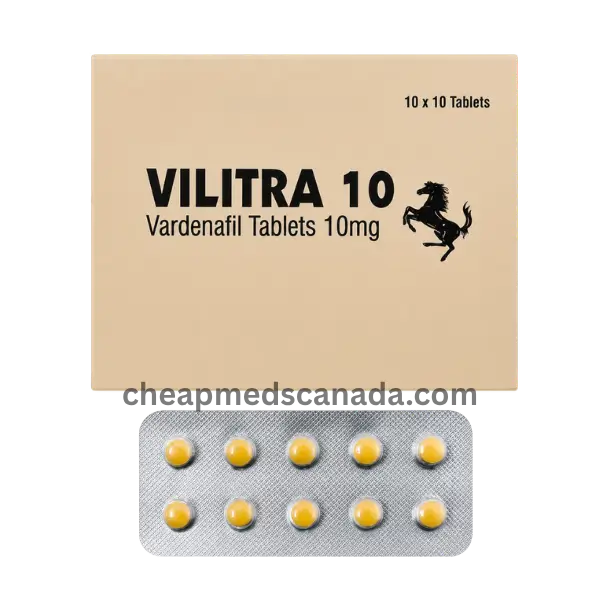
Vilitra 10 mg is a prescription tablet containing Vardenafil 10 mg, manufactured by Centurion Laboratories. It's an on-demand ED medication taken roughly 30 to 60 minutes before sexual activity, effective for up to five hours per dose. The 10 mg strength sits in the middle of the Vardenafil dose range — below the maximum 20 mg, above the starting 5 mg — making it a practical choice for men who've already confirmed Vardenafil suits them, or for those whose doctor has determined the entry dose isn't sufficient.
What Makes Vardenafil Different From Other ED Medications
All three major PDE5 inhibitors — Sildenafil, Tadalafil, and Vardenafil — work by the same basic mechanism. They block the PDE5 enzyme, which normally limits blood flow in penile tissue during arousal. Block it, and the blood flow response to sexual stimulation proceeds more fully and lasts longer.
The differences are in the details, and Vardenafil has a few worth knowing.
Selectivity: Vardenafil is considered one of the more selective PDE5 inhibitors, meaning it targets the PDE5 enzyme with a high degree of specificity compared to some related enzymes found in other tissues. This is part of why Vardenafil tends to produce fewer vision-related side effects than Sildenafil — Sildenafil has somewhat greater cross-activity with PDE6, the enzyme responsible for colour vision processing in the retina. For men who've experienced that characteristic blue-tinted visual effect with Sildenafil, switching to Vardenafil often resolves it.
Food interaction: Sildenafil is noticeably affected by high-fat meals — eating a big dinner before taking it can delay onset by 60 minutes or more. Vardenafil is less sensitive to this. A moderate meal doesn't meaningfully affect how quickly Vilitra 10 mg works, which matters practically for men who don't want to time their meals around their medication.
Onset speed: Vardenafil can begin working in as little as 15 to 25 minutes in some men — though the standard guidance is 30 to 60 minutes to be safe. This places it at the faster end of the on-demand PDE5 inhibitor range.
Duration: At around four to five hours of active effect per dose, Vardenafil's window is shorter than Tadalafil (which can last up to 36 hours) but roughly comparable to Sildenafil. For men who specifically prefer a shorter-duration medication — not wanting the drug active all weekend — that's actually a preference, not a limitation.
None of this makes Vardenafil categorically superior to Sildenafil or Tadalafil. It means it suits different men differently, and for some the pharmacological profile is a genuinely better match.
Why 10 mg Specifically — Understanding the Dose
Vardenafil is available in three strengths: 5 mg, 10 mg, and 20 mg. The 10 mg dose is where most men who've been trialled on Vardenafil end up — it's the middle ground between a cautious starting dose and the maximum.
Canadian prescribing practice for ED medications typically follows a "start low, adjust as needed" approach. A patient who's already tried 5 mg and found it insufficient, or someone whose doctor has assessed their cardiovascular profile and determined 10 mg is appropriate from the outset, is the typical candidate for Vilitra 10 mg.
It's also the dose most studied in Vardenafil clinical trials as the reference point for efficacy data. The documented average improvement in erectile function scores in those trials was meaningful at 10 mg — statistically significant versus placebo, and comparable to what Sildenafil achieved at its standard dose in head-to-head comparisons.
Don't adjust the dose on your own. If 10 mg isn't providing sufficient effect after two to three honest attempts under appropriate conditions, that conversation goes back to your prescribing doctor — not to doubling up on tablets.
How to Take Vilitra 10 mg
One tablet, taken roughly 30 to 60 minutes before sexual activity. That's the core of the dosing instruction. A few practical details make the difference between getting the full effect and wondering why it didn't work:
Timing matters more than people realise: Taking Vilitra and then immediately expecting results doesn't reflect how the drug works. The 30 to 60 minute window is real — the absorption and onset process takes time regardless of the dose. Many first-time "failures" with any ED medication come down to insufficient wait time after taking the tablet.
Food: Vilitra 10 mg can be taken with a light or moderate meal without meaningfully affecting how quickly it works. Avoid an extremely heavy, high-fat meal immediately before — while less sensitive than Sildenafil, very fatty food in large quantities can still slow gastric absorption of Vardenafil somewhat.
Alcohol: A standard drink or two is unlikely to cause serious problems, but Vardenafil and alcohol both lower blood pressure to varying degrees. Together, the dizziness risk increases. Heavy drinking before taking Vilitra is asking for a poor outcome — both from an effectiveness standpoint and a safety one.
One tablet per 24 hours: Maximum. Not two tablets if the first one feels like it isn't kicking in fast enough. That's not how it works and it significantly increases side effect risk.
Arousal is still required: Vilitra 10 mg supports the physiological response to sexual stimulation — it does not create an erection independently of arousal. This is one of the most common misunderstandings about ED medications.
Side Effects — Honest and Complete
At 10 mg, Vardenafil's side effect profile is generally well-tolerated. The most commonly reported effects are mild and linked to the vasodilatory action of the drug — the same mechanism that makes it work.
Frequently reported, usually settling within a few hours:
- Headache — the most common, typically related to vasodilation and responds well to hydration and over-the-counter pain relief
- Facial flushing or warmth, particularly in the cheeks and neck
- Nasal congestion or runny nose
- Indigestion or acid reflux, especially if taken shortly after eating
- Mild dizziness — most often when standing up quickly
Less common — report to your doctor if persistent:
- Back pain or muscle aches
- Vision changes — mild blurring or light sensitivity. Less common than with Sildenafil, but still possible. Any sudden vision change warrants immediate medical attention
- Palpitations or awareness of your heartbeat
Rare but serious — stop use and seek immediate care:
- Priapism — a prolonged erection lasting more than four hours. This is a urological emergency regardless of whether it's painful. Waiting it out is not an option; permanent tissue damage can result from delayed treatment
- Sudden loss of vision in one or both eyes
- Sudden decrease or loss of hearing, potentially with ringing or dizziness
- Chest pain, shortness of breath, or signs of a cardiac event during or after sexual activity
An important cardiac note specific to Vardenafil: clinical data has shown Vardenafil can prolong the QT interval — a measure of electrical activity in the heart — slightly more than other PDE5 inhibitors. For most men with healthy hearts this is clinically insignificant. For men with pre-existing QT prolongation, a family history of sudden cardiac events, or those on medications that also affect QT interval (certain antibiotics, antiarrhythmics), this warrants specific discussion with your cardiologist before starting Vardenafil.
Who Should Not Take Vilitra 10 mg
The contraindications for Vardenafil are similar to other PDE5 inhibitors but have a few Vardenafil-specific considerations:
Absolute contraindications — do not take under any circumstances:
- Concurrent use of any nitrate medication (nitroglycerin, isosorbide mononitrate, isosorbide dinitrate) prescribed for angina or chest pain — the combined blood pressure drop can be severe and life-threatening
- Use of recreational nitrates (poppers — amyl nitrite, butyl nitrite) — same dangerous interaction
- Taking Riociguat (prescribed for pulmonary hypertension)
- Severe liver disease — Vardenafil is primarily metabolised by the liver, and severe impairment significantly elevates drug levels in the bloodstream
Use with caution and only under medical supervision:
- Alpha-blockers for blood pressure or prostate conditions (tamsulosin, doxazosin, terazosin) — requires careful dose spacing to avoid blood pressure drops
- CYP3A4 inhibitors including ketoconazole, itraconazole, ritonavir, clarithromycin — these significantly increase Vardenafil blood levels and may require dose reduction to 5 mg
- Moderate liver impairment — maximum dose typically reduced to 10 mg
- Moderate kidney impairment — no dose adjustment usually required, but monitoring is appropriate
- Any personal or family history of QT prolongation or sudden cardiac death
- Men who've had a heart attack, stroke, or serious cardiac event in the past six months
Vilitra 10 mg is not approved for use in women or anyone under 18 years of age.
How is Vilitra 10 mg different from Vilitra 20 mg?
Both medications contain the same active ingredient, vardenafil. Vilitra 20 mg contains twice the amount of vardenafil as Vilitra 10 mg and may be prescribed when the lower dose does not provide adequate results. Do not increase your dose without consulting your doctor, as higher doses may increase the risk of side effects.
Is Vardenafil stronger than Sildenafil?
Vardenafil and sildenafil are different medications within the same drug class. Vardenafil is effective at lower milligram doses than sildenafil, but individual response varies. One medication is not necessarily better or stronger for every person, and suitability depends on individual factors and treatment response.
Can Vilitra 10 mg be taken with blood pressure medication?
It depends on the specific blood pressure medication you are taking. Some medications may interact with vardenafil and require special precautions. Always inform your doctor about all prescription medications, supplements, and health conditions before using Vilitra 10 mg.
What if Vilitra 10 mg doesn't work the first time?
It is not unusual for erectile dysfunction medication to be less effective on the first attempt. Factors such as anxiety, timing, alcohol consumption, and insufficient sexual stimulation can affect results. If the medication does not work initially, follow your doctor's instructions and discuss any ongoing concerns with a healthcare professional.
Is it safe to take Vilitra 10 mg if I have diabetes?
Many men with diabetes use vardenafil successfully. However, your doctor should review your overall health, medications, and cardiovascular risk factors before prescribing treatment to ensure it is appropriate and safe for you.
How should I store Vilitra 10 mg tablets?
Store Vilitra 10 mg tablets at room temperature, generally between 15°C and 30°C, away from excessive heat, moisture, and direct sunlight. Keep the tablets in their original packaging until use and always check the expiry date before taking the medication.
Vilitra 10 mg is a prescription medication containing vardenafil, designed to help men manage erectile dysfunction. It works by improving blood flow to the penis during sexual stimulation, supporting stronger and longer-lasting erections. When used as directed, Vilitra 10 mg can help enhance sexual confidence, performance, and overall satisfaction.


Reviews
There are no reviews yet.