

Description
Understanding What Remeron Actually Treats
Depression is not one thing. It can look like not being able to get out of bed. It can look like sleeping 11 hours and still feeling exhausted. It can look like going through the motions at work while feeling nothing inside, or like losing all interest in people and things you used to care about.
Remeron (Mirtazapine) 30 mg is a prescription antidepressant that Canadian physicians have been using for decades to help patients manage moderate to severe depression. But what separates it from many other antidepressants — and why some doctors specifically choose it over [SSRIs like sertraline or fluoxetine] — is its particular combination of effects. Beyond mood, it meaningfully addresses two symptoms that quietly destroy quality of life during a depressive episode: disrupted sleep and lost appetite.
Health Canada has approved Mirtazapine for the treatment of major depressive disorder in adults. It is prescribed across provinces, and generic Mirtazapine 30 mg appears on the formularies of several provincial drug plans including Ontario's ODB program and British Columbia PharmaCare for eligible patients.
How Mirtazapine Works — Different From SSRIs in an Important Way
Most people who have heard of antidepressants associate them with SSRIs — drugs like [Prozac (fluoxetine)], [Zoloft (sertraline)], or [Lexapro (escitalopram)] that block the reuptake of serotonin. Mirtazapine takes a fundamentally different approach, which is part of why it works for patients who have not responded well to SSRIs.
Mirtazapine belongs to a class called NaSSA — Noradrenergic and Specific Serotonergic Antidepressants. Here is what that means in plain terms:
- It blocks alpha-2 adrenergic receptors, which acts like removing a brake from the release of both norepinephrine and serotonin simultaneously. More of both neurotransmitters become available in the brain's synapses.
- At the same time, it selectively blocks certain serotonin receptors (5-HT2 and 5-HT3), which means the serotonin that is released goes preferentially through the pathways associated with mood improvement — while minimising the side effects (like nausea and sexual dysfunction) that come from serotonin activating the other pathways.
- It also blocks histamine H1 receptors, which is why it causes sedation — a feature, not a bug, for patients who are losing sleep to depression.
The end result: Remeron addresses the norepinephrine system, the serotonin system, and the sleep system at once. For a patient who is depressed, cannot sleep, and has stopped eating — this multi-pronged effect can be exactly what is needed.
One practical note: a phenomenon sometimes called the "Remeron paradox" is worth knowing about. At lower doses (15 mg), the antihistamine sedation effect is stronger. At higher doses (30–45 mg), the noradrenergic stimulation partially counteracts the sedation, so some patients find 30 mg gives them more energy than 15 mg did, while still improving sleep quality. Your doctor will take this into account when adjusting your dose.
Remeron 30 mg Dosage — Starting, Adjusting, and Stopping Safely
Starting Dose
The standard starting point for most adults is Remeron 15 mg taken once daily at bedtime. The evening timing is deliberate — the sedating effect is most pronounced in the first few hours after taking it, and this helps reset disrupted sleep rather than causing daytime impairment.
After 1 to 2 weeks, if symptoms are partially improving but more effect is needed and the medication is being tolerated well, your doctor will typically increase to Remeron 30 mg — the dose most commonly associated with effective antidepressant response in clinical practice.
At the 30 mg Dose
- Take once daily, preferably at bedtime
- Swallow the tablet whole with water — do not crush or chew
- Can be taken with or without food
- Do not skip doses — consistency is critical with antidepressants; the steady-state level in your blood matters
Patience is essential: Mirtazapine, like all antidepressants, takes time to reach its full effect. Most patients begin to notice meaningful improvement in sleep and appetite within 1 to 2 weeks, but the full antidepressant effect on mood typically takes 4 to 6 weeks of consistent use. This is normal — not a sign the medication is not working.
Maximum Dose
The maximum recommended dose is 45 mg daily. Your doctor will only increase beyond 30 mg if there is clear benefit to doing so and the lower dose is being tolerated without significant concerns.
What to Do If You Miss a Dose
If you forget your evening dose, do not take it in the morning. Skip that dose entirely and take your next scheduled dose the following evening. Taking a double dose to compensate is not safe and can increase side effects significantly.
Stopping Remeron — Do Not Stop Suddenly
⚠️ This is important: stopping Mirtazapine abruptly can cause discontinuation symptoms including dizziness, agitation, confusion, sweating, and insomnia. These are not signs of addiction — but they are uncomfortable and avoidable. Always taper off under physician guidance with a gradual dose reduction over time. Discuss any intention to stop with your doctor before making any changes.
Remeron 30 mg Side Effects — What Patients Actually Experience
🟢 Common, Usually Manageable
These occur in a meaningful number of patients, particularly in the first few weeks. Most settle with time:
- Drowsiness / sedation — Expected, especially at 15 mg. Taking it at bedtime manages this effectively for most people. If daytime sleepiness persists at 30 mg, discuss timing with your doctor.
- Increased appetite and weight gain — Mirtazapine stimulates appetite, which is therapeutically useful for patients who have stopped eating due to depression. For patients who are already at a healthy weight, this is worth monitoring over time.
- Dry mouth — Sip water throughout the day; sugar-free lozenges help
- Constipation — Increase fibre intake and water; most patients manage this without medication
- Dizziness on standing — Gets up slowly from sitting or lying positions, particularly in the first few weeks
- Vivid dreams or nightmares — Reported by some patients, typically early in treatment
- Headache, mild weakness — Tends to resolve within the first two weeks
🟡 Less Common — Report to Your Doctor
These are not emergencies but should be discussed with your prescriber:
- Abnormal heart rate or rhythm
- Confusion or changes in thinking
- Difficulty urinating (particularly in men with prostate issues)
- Joint or muscle pain
- Breast changes (discharge or enlargement — affects a small number of patients)
- Signs of elevated cholesterol (relevant for patients with existing cardiovascular concerns)
- Restless legs or sensations of tingling or stinging in the skin
- Signs of a urinary tract infection
🔴 Stop Immediately and Seek Emergency Medical Attention
These are rare but serious and require urgent care:
- Seizures
- Signs of serotonin toxicity — sudden agitation, muscle rigidity, high fever, rapid heartbeat, confusion or delirium. Most likely if Remeron is combined with other serotonergic drugs without medical supervision
- Neuroleptic Malignant Syndrome (NMS) — high fever, severe muscle stiffness, sweating, altered consciousness
- Severe skin reactions — blistering, widespread rash, peeling or shedding skin
- Signs of allergic reaction — swelling of the face, throat, or tongue; hives; difficulty breathing
- Thoughts of suicide or self-harm — see the section below on monitoring during early treatment
🔴 Black Box Warning — Suicidal Thoughts in Early Treatment
Mirtazapine, like all antidepressants, carries a Health Canada-mandated warning about the increased risk of suicidal thinking, particularly in the first few weeks of treatment and following any dose change.
This risk is most significant in children, adolescents, and young adults under 25. Remeron is not approved for use in patients under 18 years of age in Canada.
For adults of any age, doctors typically schedule more frequent check-ins during the first 4 to 8 weeks on a new antidepressant. If you or a family member notices any increase in agitation, restlessness, aggression, emotional distress, or thoughts of self-harm after starting Remeron, contact your doctor or go to your nearest emergency department immediately.
If you are in Canada and in crisis, you can reach the 988 Suicide Crisis Helpline by calling or texting 988.
Who Should Not Take Remeron 30 mg
Mirtazapine is not appropriate for everyone. You should not take it if you:
- Are allergic to Mirtazapine or any component of the tablet (the 30 mg tablet contains lactose — relevant for patients with lactose intolerance or galactose metabolic disorders)
- Have taken a monoamine oxidase inhibitor (MAOI) — such as phenelzine or tranylcypromine — within the past 14 days. Combining MAOIs with Mirtazapine can cause life-threatening serotonin syndrome. At least 2 weeks must pass between stopping an MAOI and starting Remeron.
Special Populations and Precautions
Seniors (65+): Older adults metabolise Mirtazapine more slowly due to age-related changes in kidney and liver function. The drug can build up to higher levels in the body, increasing side effects. Doctors typically start seniors at lower doses and increase more cautiously.
Kidney or liver disease: Both conditions slow Mirtazapine clearance from the body. Dosing adjustments and regular monitoring may be needed. Do not adjust your dose without your doctor's instruction.
Bipolar disorder: Mirtazapine, like other antidepressants, can trigger manic episodes in people with bipolar disorder. If you have a personal or family history of bipolar disorder, your doctor needs to know before prescribing. [Mood stabilisers like lithium or valproate] are typically part of the picture for bipolar patients receiving antidepressants.
Glaucoma: Mirtazapine may worsen symptoms in patients with glaucoma. Report any new changes in vision to your doctor promptly.
Diabetes: Mirtazapine can affect blood glucose regulation. Patients with diabetes may need more frequent blood sugar monitoring after starting this medication.
Heart conditions (QT prolongation history): Mirtazapine may affect heart rhythm. Patients with a history of QT prolongation, heart failure, or family history of sudden cardiac death at a young age should discuss this with their cardiologist and prescribing physician.
Pregnancy: Babies born to people who took Mirtazapine in the third trimester may experience complications requiring extended hospital observation. Use only if the clinical benefit clearly outweighs the risk, and only under close physician supervision.
Breastfeeding: Mirtazapine passes into breast milk in small quantities. The clinical significance for nursing infants is not fully established. Discuss with your doctor.
Drug Interactions — A Medication That Requires Careful Co-prescribing
Mirtazapine has a wide interaction profile because it acts on multiple neurotransmitter systems. The most clinically important categories to know:
🚫 Combinations to Avoid:
- MAOIs (phenelzine, tranylcypromine, moclobemide) — risk of fatal serotonin syndrome; 14-day washout required in both directions
- Methylene blue — serotonergic agent; avoid concurrent use
- Linezolid — antibiotic with MAOI properties; discuss with your doctor if prescribed
⚠️ Use With Caution — Discuss With Your Doctor:
- Other antidepressants — [SSRIs like sertraline or paroxetine], [SNRIs like venlafaxine or duloxetine], [tricyclic antidepressants like amitriptyline] — serotonin toxicity risk increases with combinations
- Benzodiazepines (diazepam, lorazepam, alprazolam) — combined sedation effect is amplified; use under strict medical supervision
- Opioid pain medications (codeine, oxycodone, tramadol, fentanyl) — both CNS depression and serotonin interaction risk
- Antipsychotics (quetiapine, risperidone, olanzapine) — additive sedation and potential cardiac effects
- Anticonvulsants (carbamazepine, phenytoin, phenobarbital) — some of these induce the liver enzymes that metabolise Mirtazapine, potentially reducing its effectiveness
- "Triptan" migraine medications (sumatriptan, rizatriptan) — serotonergic interaction; use cautiously
- Warfarin — Mirtazapine may alter INR; closer monitoring required if you are on blood thinners
- St. John's Wort — a natural health product with serotonergic properties; avoid concurrent use
- Alcohol — significantly amplifies sedation and CNS depression. Avoid completely while on Remeron, particularly in the adjustment period.
- Cannabis — additive CNS effects; discuss with your doctor
- Zopiclone or zolpidem (sleep aids) — combined sedation risk; your doctor may reassess the need for these once Remeron's sleep-improving effects take hold
This is not a complete list. Any time a new prescription or over-the-counter medication is added to your regimen, mention that you are taking Mirtazapine. This includes vitamins, supplements, and herbal products.
Remeron vs. Generic Mirtazapine 30 mg — What You Need to Know
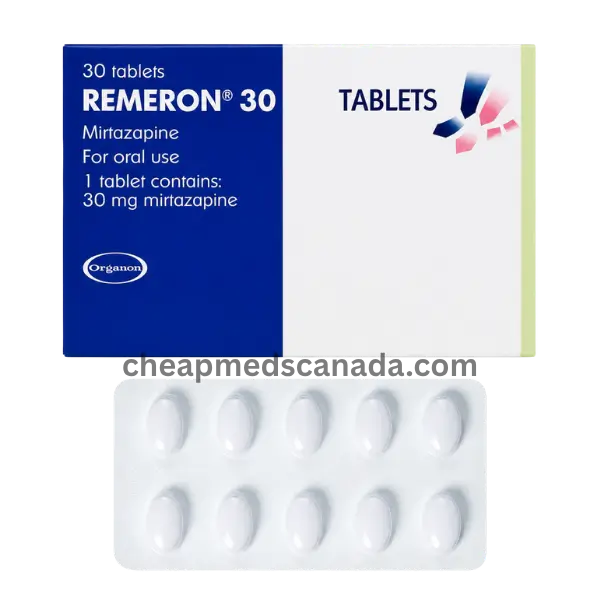
Brand Remeron is manufactured by Organon and is available as a film-coated 30 mg tablet (red-brown, oval, scored). In Canada, it carries DIN 02243910.
Generic Mirtazapine 30 mg contains the same active ingredient at the same dose and must demonstrate bioequivalence to the brand product under Health Canada's requirements. This means the generic version reaches the same blood concentration in the same timeframe as Remeron — the clinical effect is equivalent.
The differences are largely cosmetic: tablet colour, shape, and the specific non-medicinal ingredients (binders, dyes, fillers) may vary between manufacturers. For most patients, the switch between brand and generic is seamless. However, patients with known sensitivities to specific dyes or excipients should review the ingredient list with their pharmacist.
Cost difference: Generic Mirtazapine 30 mg is substantially less expensive than brand Remeron — often by 50% to 70% or more. For patients taking this medication long-term, the savings across a year of treatment are significant. [Generic Mirtazapine 30 mg] is available through licensed Canadian pharmacies with a valid prescription.
How to Store Remeron Tablets
- Store at room temperature (15°C to 30°C)
- Keep away from moisture, light, and heat
- Keep the bottle tightly closed
- Keep out of reach of children and pets — this is a prescription medication with significant CNS effects
- Do not flush unused medication down the sink or toilet. Return unused or expired Mirtazapine to your pharmacy through Canada's unused medication return programs — available at most Shoppers Drug Mart, Rexall, and independent pharmacy locations across Ontario, BC, and Alberta.
Will Remeron make me gain weight?
Weight gain is a known side effect of Remeron and may occur in some patients due to increased appetite. The degree of weight change varies from person to person. Monitoring your weight and maintaining healthy eating and exercise habits during treatment may help manage this effect. Speak with your doctor if weight gain becomes a concern.
Why is Remeron taken at night rather than in the morning?
Remeron can cause drowsiness, especially when treatment begins. Taking it at bedtime may help reduce daytime sleepiness and can also improve sleep quality in patients experiencing insomnia related to depression.
Can I take Remeron with my other antidepressant?
Only under the guidance of your healthcare provider. Some antidepressant combinations are prescribed intentionally in certain situations, while others may increase the risk of side effects or drug interactions. Never start, stop, or combine antidepressants without medical advice.
How long will I need to stay on Remeron?
The duration of treatment depends on your condition, treatment response, and medical history. Many patients continue antidepressant therapy for at least 6 to 12 months after symptoms improve, while others may require longer-term treatment as recommended by their doctor.
I've been on Remeron for three weeks and don't feel better yet. Should I stop?
No. Antidepressants often take several weeks to reach their full effect, and three weeks may be too early to assess the medication's effectiveness. Do not stop taking Remeron without speaking to your doctor, as sudden discontinuation may cause withdrawal-like symptoms.
Is Remeron addictive?
Remeron is not considered addictive and is not classified as a controlled substance. However, your body can become accustomed to the medication over time, which is why treatment should be discontinued gradually under medical supervision rather than stopped abruptly.
Remeron 30 mg contains mirtazapine and should be used only under the supervision of a qualified healthcare professional. Do not start, stop, or change your dosage without medical advice. Antidepressants may increase the risk of suicidal thoughts in some individuals, particularly during the early stages of treatment. Contact your healthcare provider immediately if you notice worsening mood, unusual behavior changes, or severe side effects. Individual results may vary.



Reviews
There are no reviews yet.