
Ask ten guys how long Cialis actually lasted for them and you'll get ten different answers — "a day," "into the next morning," "I didn't even need it the second time." That's not inconsistency in the drug. It's tadalafil doing exactly what it's built to do, just showing up differently depending on your body, your dose, and how you're taking it. If you've already looked into what erectile dysfunction actually is and you're now comparing treatment options, the honest answer to "how long does Cialis work" needs more than the marketing line of "up to 36 hours." Here's the real breakdown.
Cialis is the brand name for tadalafil, a PDE5 inhibitor that relaxes smooth muscle in the penis and lets more blood flow in when you're aroused. It doesn't create an erection out of nowhere — you still need stimulation for anything to happen. What separates tadalafil from sildenafil (Viagra) or vardenafil (Levitra) is purely pharmacokinetics: how long the drug hangs around in your bloodstream before your liver clears it out.
Most breakdowns stop at "starts in 30 minutes, lasts 36 hours." That's technically true but not useful if you're trying to plan around it. Here's what the timeline actually looks like for a typical 10mg or 20mg on-demand dose:
That gradual taper — not a hard cutoff — is the part most articles skip, and it's exactly why "weekend pill" became the nickname.
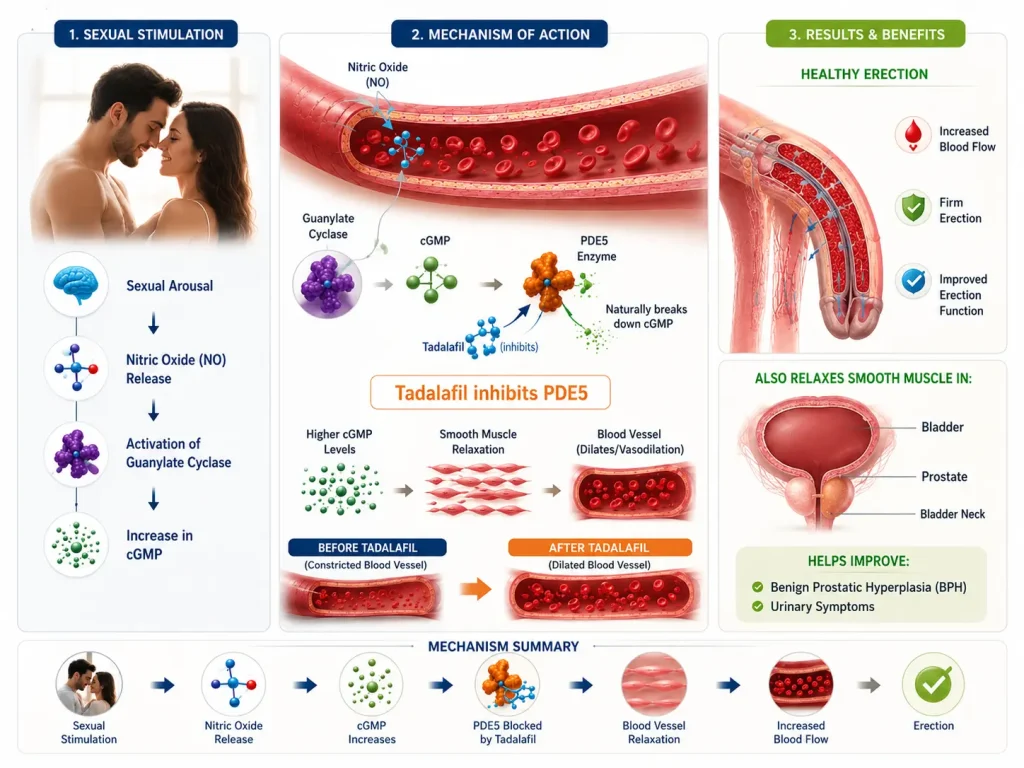
Tadalafil's half-life is about 17.5 hours, versus roughly 4 hours for sildenafil. Half-life means the time it takes your body to clear half of what's in your system. So if you take a 20mg dose:
This is also why tadalafil clears more slowly in men with reduced liver or kidney function — the enzyme systems doing that clearance work more slowly, so the drug lingers past the typical window.
This is where most competitor content stays thin, and it matters a lot if you're deciding between formats. Daily Cialis (2.5mg or 5mg) isn't dosed for a single event — it's meant to build a steady concentration in your blood over time. The realistic timeline looks like this:
If there's no improvement after a full four weeks of consistent daily use, that's the point to go back to your doctor rather than assuming the drug isn't for you — dose adjustment or an underlying issue (low testosterone, vascular disease, uncontrolled stress) may be the actual factor, not the medication itself.
| On-Demand Cialis | Daily Cialis | |
|---|---|---|
| Typical dose | 10mg or 20mg | 2.5mg or 5mg |
| When to take it | 30 min-2 hrs before activity | Same time every day, regardless of plans |
| Time to onset | 30 min-2 hrs per dose | 3-5 days for initial effect |
| Time to full effect | ~2 hrs (single dose peak) | ~4 weeks (steady baseline) |
| Effective window | Up to 36 hrs per dose | Continuous, no per-dose window |
| Best fit for | Sex less than 2x/week | Sex more than 2x/week, or reducing timing pressure |
| Planning required | Yes — timed to the event | No — always covered |
Your doctor's recommendation usually comes down to frequency of use, kidney function, and how you responded to an initial on-demand trial.
Sildenafil typically lasts 4-6 hours with a somewhat faster peak for some men, while tadalafil trades that early speed for an 8-9x longer window. If you've already read the sildenafil vs Viagra comparison or want to understand sildenafil citrate as a drug class and its documented safety profile and typical uses, the mechanism is identical to tadalafil's — both are PDE5 inhibitors — but the lived experience of using them is genuinely different: one is built around planning a window, the other around a single close-timed event.
Tadalafil can cause a dangerous drop in blood pressure if combined with nitrate medications (often prescribed for chest pain/angina) or with guanylate cyclase stimulators like riociguat. This interaction isn't rare or theoretical — it's one of the most important things a pharmacist checks before dispensing tadalafil, and it's worth mentioning explicitly to your doctor if you're on any heart medication, not just assuming it will come up on its own.
Wearing off is gradual, not sudden — there's no crash, no rebound effect, just a slow return to how you were before taking it. That's different from Cialis simply not working. If you're not getting a response even at 20mg after multiple attempts, or the effect seems to disappear far earlier than the typical window, that's worth raising with a doctor rather than increasing the dose on your own. Persistent non-response can point to cardiovascular or hormonal causes that need their own evaluation. And if an erection lasts more than 4 hours (priapism), that's a medical emergency — contact your local poison control centre or an emergency department right away.
If you are using on-demand Cialis, do not take more than one dose within the recommended dosing interval. If you are sexually active several times a week, your doctor may recommend the once-daily low-dose version instead. Always follow your prescribed dosing schedule.
A higher dose may provide a slightly longer duration of effect, but the main difference is increased strength rather than a significantly longer action. For most people, the increase in duration is modest.
Daily Cialis works by maintaining a steady level of tadalafil in your body over time, which can take several days of consistent use. On-demand Cialis is designed to reach effective levels quickly, usually within 30 to 60 minutes before sexual activity.
Yes. Factors such as sexual arousal, stress, alcohol consumption, food intake, and overall health can all influence how well Cialis works on different occasions, even when taking the same dose.
The 36-hour figure gets used as a headline because it's the single most marketable fact about tadalafil, but the real value is in the taper — a wide, flexible window rather than a hard on/off switch. Where you land in that window depends on your dose, your liver and kidney function, and what else is going on in your body that day, which is exactly why a pharmacist conversation beats guessing every time.
This content is provided for educational purposes only and should not replace professional medical advice, diagnosis, or treatment. Cialis (tadalafil) should be used only under the guidance of a qualified healthcare provider. Individual results may vary based on medical history, dosage, and other medications. Seek immediate medical attention if you experience chest pain, sudden vision or hearing changes, or an erection lasting longer than four hours.